
Water Bowls Dogs Can’t Knock Over: 3 Options Compared

For most dogs, Neater Pet Brands 16 oz Non-Tip Bowl is the simplest choice because its rubber base is designed to resist tipping and sliding. Choose Amazon Basics 38 oz Bowls, 2-Pack if you need two larger bowls, or MidWest Snap’y Fit 10 oz Crate Bowl if your dog drinks in a wire crate and you want a bowl that locks onto the bars.
Water bowls use a weighted or grippy base, or attach to a fixed surface, to reduce movement and spills; the right style depends on where your dog drinks.
We earn a commission if you buy through links on this page. As an Amazon Associate I earn from qualifying purchases. Products are compared on manufacturer specifications, not hands-on testing.
- Best overall: Neater Pet Brands 16 oz Non-Tip Bowl – A removable rubber ring helps keep this 16-ounce bowl from tipping or sliding.
- Best for two-bowl setups: Amazon Basics 38 oz Bowls, 2-Pack – The set includes two bowls, each with a recommended fill of up to 28 ounces.
- Best for crates: MidWest Snap’y Fit 10 oz Crate Bowl – Its bracket locks the 10-ounce bowl onto wire crate or cage bars.
| Product | Best for | Capacity | Stability style | Dimensions | Shop |
|---|---|---|---|---|---|
| Neater Pet Brands 16 oz Non-Tip Bowl | Small dogs | 16 oz | Removable rubber ring | 11.25 × 8.5 × 3 in | Check Price on Amazon |
| Amazon Basics 38 oz Bowls, 2-Pack | Two-bowl households | 38 oz each (28 oz recommended fill) | Rubber non-slip base | 10.1 × 10.1 × 2.8 in | Check Price on Amazon |
| MidWest Snap’y Fit 10 oz Crate Bowl | Wire crate use | 10 oz | Locking crate bracket | 5 × 5 × 1.68 in | Check Price on Amazon |
Water Bowls Dogs Can’t Knock Over
Compare base grip, crate mounting, and capacity to match a bowl to your dog’s drinking spot.
Neater Pet Brands 16 oz Non-Tip Bowl

For a small dog that drinks on a hard floor, Neater Pet Brands 16 oz Non-Tip Bowl pairs a non-tip shape with a removable rubber ring intended to reduce sliding. The 16-ounce stainless-steel bowl can hold water or food, and the maker says it is dishwasher-safe. Stainless steel does not retain odors or taste, according to the maker. Its capacity suits smaller servings, but dogs that drink a lot or share a bowl may need more frequent refills than with a larger option. The ring can be removed for cleaning.
Bottom line: Pick it for a small dog drinking from a floor bowl where sliding is the main concern.
Amazon Basics 38 oz Bowls, 2-Pack
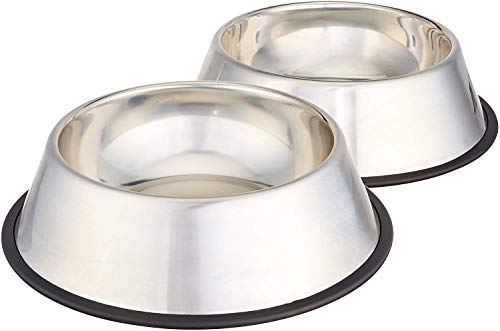
Unlike a single-bowl setup, Amazon Basics 38 oz Bowls, 2-Pack provides two stainless-steel bowls, each with a 38-ounce rim capacity and a recommended fill of up to 28 ounces. Their rubber bases are designed to limit sliding and protect floors; the maker says the bowls are rust-resistant and dishwasher-safe. This set suits a home that wants separate food and water bowls or bowls in two locations. The recommended fill is lower than the maximum capacity, so use 28 ounces as the practical fill limit rather than filling to the rim.
Bottom line: Choose this set when two bowls and a larger serving capacity matter more than crate attachment.
MidWest Snap’y Fit 10 oz Crate Bowl

For water inside a wire crate, MidWest Snap’y Fit 10 oz Crate Bowl differs from floor bowls by attaching to crate bars with a locking bracket, helping keep the bowl in place during crate time. The removable 10-ounce stainless-steel bowl can be lifted out for refills and cleaning, and the maker says the bowl is dishwasher-safe. Its bracket is e-coated, and the maker says it resists corrosion. The small capacity means this is best for limited crate sessions or small dogs; it is less suitable as the only bowl for a dog that needs a larger water supply.
Bottom line: Pick it when your dog drinks in a wire crate and the bowl needs to attach to the bars.
How to choose a spill-resistant dog water bowl
Choose by where the bowl sits and how much water your dog needs between refills. A rubber-base bowl can reduce sliding on a smooth floor, while a locking bracket anchors a bowl to compatible wire crate bars. As a general guide, dogs often need about 1 ounce of water per pound of body weight per day; heat, activity, and food moisture can change that need. For a 30-pound dog, that is roughly 30 ounces across the day, not necessarily in one sitting. A 10-ounce crate bowl therefore needs monitoring and refills. Prioritize an accessible supply of fresh water, and do not use a small bowl as the only source for a dog that drinks more than it holds.
Capacity and refill frequency
Match bowl capacity to your dog’s daily water needs and how often someone can refill it. A commonly used estimate is about 1 ounce per pound of body weight per day, so a 20-pound dog may need around 20 ounces in a day; warmer weather and exercise can raise intake. Food moisture also affects how much a dog drinks from a bowl. Keep water available and refill with fresh water rather than treating a bowl’s full capacity as a daily ration. For the two-bowl set, the recommended fill is 28 ounces per bowl even though the rim capacity is 38 ounces. Avoid filling any bowl to the brim, where splashing and spills are more likely.
Floor bowls versus crate-mounted bowls
Floor bowls rely on contact with the floor to resist movement; crate bowls rely on a bracket attached to wire bars. A rubber ring can help limit sliding but does not anchor a bowl to the room, so a determined dog may still move it. A mounted bowl can reduce tipping in a crate, but it depends on compatible bars and secure installation. Use this guide to match the mechanism to the drinking location.
| Drinking location | Useful design | Tradeoff |
|---|---|---|
| Smooth floor | Rubber non-slip base | Can still move if pushed hard |
| Wire crate | Locking bracket | Requires compatible bars |
| Two locations | Two-bowl set | Each bowl needs regular refills |
Before buying a mounted option, confirm the crate has wire bars that the bracket can attach to; a fixed-sided kennel is not the same setup.
Cleaning and water-bowl hygiene
Wash a dog’s water bowl at least once a day and replace the water with fresh water daily; more frequent rinsing helps when saliva, food, or debris collects. A bowl’s dishwasher-safe construction can simplify cleaning, but remove detachable rubber parts first if the care directions require it. Stainless steel is nonporous and generally resists lingering odors better than scratched plastic, though any bowl still needs routine washing. Check the ring, seams, and mounting hardware while cleaning: residue can collect around joints, and a loose bracket may let a crate bowl shift. Keep the water station away from food debris and clean spills promptly to avoid a slippery floor.
Frequently Asked Questions
How much water should a dog bowl hold?
A common daily estimate is about 1 ounce per pound of a dog’s body weight, though heat, exercise, and food moisture affect drinking. A 25-pound dog may need around 25 ounces over a day, so a 10-ounce bowl may require multiple refills.
How often should I refill my dog’s water bowl?
Keep fresh water available and refill whenever the level is low or the water is dirty. In warm weather or after exercise, check more often because dogs may drink more than usual.
Do non-slip dog bowls stop all spills?
No; a rubber base can reduce sliding on a smooth floor, but it does not anchor the bowl in place. If your dog pushes hard, a crate-mounted bowl may be a better match when drinking in a compatible wire crate.
Can I use a crate-mounted bowl in any kennel?
A bracket-style bowl is intended to attach to wire bars, so it may not fit a kennel with solid walls. Check that the crate has compatible bars and that the bracket locks securely before leaving water in it.