
Senix Lawn Mowers Compared by Cut and Yard Size

For most buyers, Senix 21-Inch 144cc 3-in-1 Push Mower is the most versatile Senix lawn mower because its 21-inch deck offers rear bagging, side discharge and mulching. Choose a smaller push model for a compact yard or the self-propelled model for slopes and larger areas where pushing takes more effort.
A gas walk-behind mower cuts grass with a rotating blade beneath a deck; the deck width and drive system affect how much ground you cover and how much effort mowing takes.
We earn a commission if you buy through links on this page. As an Amazon Associate I earn from qualifying purchases. Products are compared on manufacturer specifications, not hands-on testing.
- Best overall: Senix 21-Inch 144cc 3-in-1 Push Mower – Its 21-inch deck has three clipping options: rear bagging, side discharge and mulching.
- Best for slopes: Senix 22-Inch 201cc Self-Propelled Mower – Self-propelled rear-wheel drive and 11-inch rear wheels suit uneven terrain.
- Best for tight spaces: Senix 18-Inch 144cc Push Mower – The 18-inch deck and 37.5-pound stated weight suit compact areas and close maneuvering.
| Product | Best for | Cutting width | Engine | Drive and clipping options | Shop |
|---|---|---|---|---|---|
| Senix 21-Inch 144cc 3-in-1 Push Mower | Versatile mowing | 21 in | 144 cc | Push; bag, mulch, side discharge | Check Price on Amazon |
| Senix 22-Inch 201cc Self-Propelled Mower | Slopes and large yards | 22 in | 201 cc | Self-propelled; 3-in-1 | Check Price on Amazon |
| Senix 20-Inch 144cc Push Mower | Small yards | 20 in | 144 cc | Push; — | Check Price on Amazon |
| Senix 18-Inch 144cc Push Mower | Narrow lawn areas | 18 in | 144 cc | Push; side discharge | Check Price on Amazon |
Senix Lawn Mowers
Compare the deck widths, engines and mowing features to match a Senix mower to your yard and terrain.
Senix 21-Inch 144cc 3-in-1 Push Mower
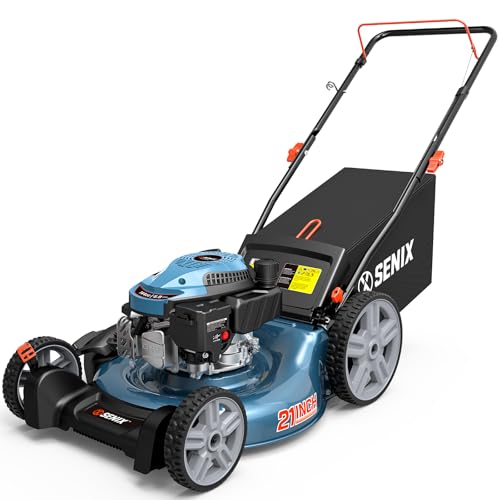
The 21-inch deck and three clipping options make this push mower the most adaptable choice here for changing lawn conditions. Its 144cc four-stroke OHV engine is rated at 3.4 horsepower and 5.8 ft-lb of torque, and the steel deck supports rear bagging, side discharge or mulching. The included grass catcher holds 1.7 bushels. Choose it if you want to switch how clippings are handled without moving to a self-propelled machine. The limitation is that it is push-operated, so it asks more effort on slopes or over a large yard than Senix 22-Inch 201cc Self-Propelled Mower.
Bottom line: Pick this for a mix of bagging, mulching and side discharge on a yard you can comfortably push.
Senix 22-Inch 201cc Self-Propelled Mower

The self-propelled rear-wheel drive sets this model apart for mowing when pushing a mower across slopes or uneven ground is a concern. Its 201cc four-cycle OHV engine powers a 22-inch steel deck, wider than the 20-inch deck of Senix 20-Inch 144cc Push Mower and the 18-inch deck of Senix 18-Inch 144cc Push Mower. The 11-inch rear wheels are another terrain-oriented feature. Choose it for a larger or more demanding yard where the drive system matters more than minimizing mower weight. At 79 pounds, it is the heaviest of these four models, which can matter when moving or storing it.
Bottom line: Choose this when self-propulsion and a wider deck matter more than easy lifting or storage.
Senix 20-Inch 144cc Push Mower

The 39.3-pound stated weight makes this the lighter 20-inch option compared with the 54.2-pound Senix 21-Inch 144cc 3-in-1 Push Mower, while keeping a 144cc four-cycle engine. Its 20-inch deck is a middle ground between the narrow 18-inch cut of Senix 18-Inch 144cc Push Mower and the wider 21- and 22-inch decks. That makes it a reasonable match for a smaller yard where a compact push mower is preferable to a self-propelled machine. The product name describes it as intended for a quarter-acre yard. Its features do not establish a clipping collection or mulching setup, so verify the needed clipping method before choosing it.
Bottom line: Pick this for a modest yard where a lighter 20-inch push mower is the priority.
Senix 18-Inch 144cc Push Mower

The 18-inch cutting width is the narrowest among these mowers, which can help when navigating narrow lawn strips and obstacles. This push model pairs that deck with a 144cc four-cycle engine and a side-discharge design; its weight is 37.5 pounds. The cutting-height range is 1.2 to 3.15 inches across three positions, a useful specification when grass conditions call for a change in height. It suits a compact lawn better than a broad area where a wider deck can reduce passes. The clipping method is side discharge, rather than the three options offered by Senix 21-Inch 144cc 3-in-1 Push Mower.
Bottom line: Choose this for a compact or narrow lawn where a small deck and side discharge fit the job.
How to choose a Senix lawn mower
Choose by terrain and clipping needs first, then compare deck width. A self-propelled mower reduces the effort of pushing across slopes; a push mower has no drive system to engage, but the operator supplies all forward force. A wider deck covers more ground per pass, while a narrower deck is easier to route through tight spaces. Decide whether you need bagging, mulching or side discharge: mulching returns finely cut clippings to the lawn, bagging collects them, and side discharge ejects them away from the deck. For a yard with narrow gates or many obstacles, measure the opening and mower width before deciding. The width is not necessarily the full handle or wheel span.
Cutting height and grass condition
Most lawn grasses do best when you avoid removing more than one-third of the blade in a single mowing; if the lawn is overgrown, lower it over more than one cut instead of scalping it. The appropriate final height depends on grass species, shade and season, so a single setting is not right for every yard. Senix 21-Inch 144cc 3-in-1 Push Mower has a 1.25- to 3.75-inch range, while Senix 18-Inch 144cc Push Mower spans 1.2 to 3.15 inches across three settings. Raise the cut during heat or drought stress rather than cutting grass unusually short. Mow when grass is dry when possible: wet clippings can clump and make discharge or bagging less consistent.
Push versus self-propelled mower types
Push mowers require the operator to move the mower, while self-propelled models use a drive system to assist forward travel. For slopes or a large lawn where repeated pushing is tiring, the rear-wheel-drive system on Senix 22-Inch 201cc Self-Propelled Mower is the most relevant distinction in this group. A push model such as Senix 20-Inch 144cc Push Mower or Senix 18-Inch 144cc Push Mower may suit a smaller, flatter area where compactness matters more. Deck width also changes the tradeoff: wider decks reduce passes on open lawn, and narrower decks improve access around beds and tight corners. This table compares the practical choice rather than ranking one type for every yard.
| Yard condition | Useful mower trait |
|---|---|
| Slopes or uneven ground | Self-propelled drive |
| Narrow paths or obstacles | Narrower cutting deck |
| Open lawn with fewer obstacles | Wider cutting deck |
| Need to collect clippings | Rear bagging capability |
Safe mowing and routine care
Keep hands and feet away from the blade and discharge opening, and stop the mower before clearing packed grass or adjusting the machine. Before mowing, remove sticks, stones and other debris that can become projectiles, and keep bystanders away from the cutting area. For gas mower upkeep, check the engine oil before use and follow the engine manual’s oil-change and air-filter service intervals; dust and frequent use can make maintenance more demanding. Keep the blade sharp and balanced so it cuts cleanly rather than tearing grass. Use fresh, appropriate fuel and store gasoline in an approved container away from heat or sparks.
Frequently Asked Questions
How often should I mow my lawn?
Mow often enough that no more than one-third of the grass blade is removed at once. Fast spring growth may call for more frequent cuts than slow growth during heat or drought.
Should I mulch or bag lawn clippings?
Mulch when the grass is dry and short enough for clippings to filter back into the lawn; bag when clippings are too long, wet or likely to smother the grass. Side discharge is useful when collection is unnecessary and clippings can be spread across the lawn.
How high should I set a lawn mower?
Set the cut based on grass species and growing conditions, and avoid removing more than one-third of the blade at one mowing. Raise the cutting height during hot, dry periods to avoid stressing the lawn.
Can a push mower handle sloped lawns?
A push mower can be used on a manageable slope, but it requires more effort than a self-propelled mower. On steeper ground, mow across the slope rather than directly up and down, and avoid mowing when the grass is wet.
How should I maintain a gas lawn mower?
Check engine oil before operation and use the engine manual’s service schedule for oil changes and air-filter care. Clean grass buildup only after the mower is shut off and the blade has stopped moving; disconnect the spark plug lead before blade service.