
Silver Paint for Jewelry: 4 Options Compared by Finish

For jewelry that needs precise silver detailing, Pagather Silver Chrome Markers is the closest match because its fine-tip pens are described for jewelry and metal touch-ups. Choose a liquid leaf paint instead for broader brush-on coverage, but verify that its formula suits the jewelry material and intended wear.
We earn a commission if you buy through links on this page. As an Amazon Associate I earn from qualifying purchases. Products are compared on manufacturer specifications, not hands-on testing.
- Best overall: Pagather Silver Chrome Markers – Three fine-tip silver chrome markers are specifically described for jewelry and metal touch-ups.
- Best for brush application: KAMENSKAYA Silver Leaf Paint – The 0.68-ounce liquid leaf paint has a built-in brush.
- Best for airbrushing: FusionFirm Silver Liquid Leaf – The alcohol-based liquid leaf paint is identified for airbrush use.
| Product | Best for | Application | Package size | Finish | Shop |
|---|---|---|---|---|---|
| Pagather Silver Chrome Markers | Fine details | Fine-tip markers | 3 pens | Mirror-like chrome | Check Price on Amazon |
| FusionFirm Silver Liquid Leaf | Airbrush coverage | Airbrush paint | 1 fl oz | High gloss | Check Price on Amazon |
| YiJiAre Silver Liquid Leaf | Spray application | Spray-gun paint | 1 fl oz | High gloss | Check Price on Amazon |
| KAMENSKAYA Silver Leaf Paint | Brush-on coverage | Built-in brush | 0.68 fl oz | Strong shine | Check Price on Amazon |
Silver Paint for Jewelry
Compare these silver finishes by application method and the level of detail your piece needs.
Pagather Silver Chrome Markers
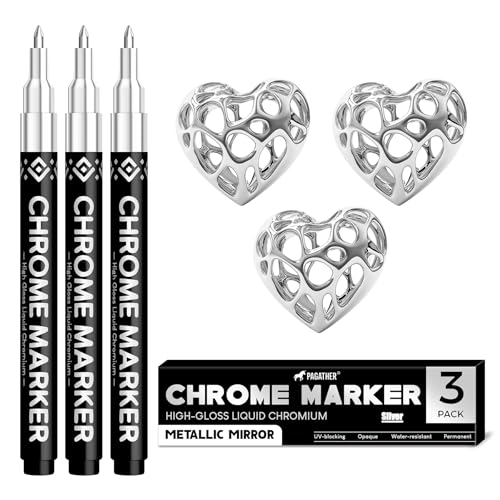
For small jewelry details, these three fine-tip silver pens offer the most targeted application in this group. The maker describes a mirror-like chrome effect with full coverage and opacity, and identifies jewelry and metal among their uses. The formula is described as waterproof and UV-resistant, but those claims do not establish how it will hold up to rubbing, skin contact, or cleaning on a finished piece. Choose these for accents and touch-ups rather than broad coating; the narrow tips are the defining advantage, while a brush-on paint may suit larger areas better.
Bottom line: Pick these for precise silver accents on jewelry or metal.
FusionFirm Silver Liquid Leaf

Unlike a fine-tip pen, this one-ounce silver liquid leaf paint is identified as an alcohol-based airbrush paint, making its application method the key distinction. The maker describes a high-gloss finish, metallic pigments, and use across various surfaces. It may suit a jewelry piece with larger areas to coat, especially where airbrush application is practical.
Bottom line: Choose it when you need a one-ounce airbrush paint for broader areas.
YiJiAre Silver Liquid Leaf

This one-ounce silver liquid leaf paint is the option whose title explicitly identifies spray-gun use, setting it apart from the marker set and built-in-brush paint. The maker describes it as alcohol-based, quick-drying, and suitable for crafts, DIY, and resin projects, with a high-gloss metallic finish. That makes it relevant for jewelry components that can be sprayed, but the claims do not establish compatibility with every metal, resin, or wearable finish. Choose it when spray application matters; for small details, a fine-tip pen gives more localized control.
Bottom line: Pick it for spray-gun application on compatible jewelry components.
KAMENSKAYA Silver Leaf Paint

For brush application without a separate brush, this 0.68-ounce silver leaf paint has a built-in brush in the bottle. The maker describes natural metallic pigment, strong shine, and one-coat coverage, and positions it as a liquid alternative to leaf sheet. It is a practical format for manually coating a component rather than drawing fine lines. The one-coat claim is the maker’s, and the facts do not establish how the paint performs after repeated handling or on a particular jewelry substrate; test compatibility on a discreet area first.
Bottom line: Choose it when an integrated brush and manual coverage are priorities.
Choosing silver paint for jewelry
Match the application method to the area: fine-tip markers suit small accents, while brush-on or sprayable paint is more practical for broader surfaces. Jewelry finishes face repeated rubbing, skin oils, and contact with cleaners, so a reflective or waterproof claim alone does not establish durability on a wearable piece. For items that will touch skin, use only a coating whose maker confirms it is suitable for that substrate and intended contact. Test an inconspicuous spot first, especially on plated or coated jewelry, where an aggressive solvent could affect the original finish.
Surface preparation also matters: remove dirt and oils, then let the piece dry fully before applying a coating. Avoid painting hinges, clasps, or other moving interfaces, where a film can interfere with fit.
How jewelry paint application changes the result
Fine-tip markers concentrate paint at a small point, while a built-in brush lays down a broader wet film; an airbrush or spray gun distributes paint across exposed surfaces. That difference affects control and overspray as much as appearance. Use masking around stones, openings, and unpainted metal, and keep spray application in a ventilated area away from flames because alcohol-based products can be flammable. Follow the product’s safety directions for ventilation and protective equipment.
The products use different application formats, so compare them by the task rather than assuming one finish works for every jewelry shape.
| Task | Application format | Why it fits |
|---|---|---|
| Small lettering or accents | Fine-tip marker | Local control |
| Hand-coating a component | Built-in brush | Direct brush application |
| Coating a broader exposed area | Airbrush or spray gun | Distributed application |
Preparing and protecting a painted jewelry surface
Clean jewelry with a method safe for its base material before painting; some stones and plated finishes can be damaged by solvents or abrasive scrubbing. Keep paint away from stone settings, adhesive joints, and contact surfaces unless the coating maker confirms compatibility. Apply thin, controlled coats rather than flooding crevices, where liquid can collect and dry unevenly.
Allow the coating to dry and cure as directed by its maker before handling or wearing the piece. A quick-drying claim is not the same as full cure, and water resistance does not establish resistance to friction, lotions, or repeated cleaning. Remove jewelry before swimming, bathing, or using household cleaners unless the coating is explicitly rated for those conditions.
Frequently Asked Questions
Can silver paint be used on jewelry metal?
Some paints are intended for metal, but compatibility depends on the particular metal and its existing finish. Test a hidden area first and avoid painting hinges or clasp interfaces.
How do I get a reflective silver finish on jewelry?
A chrome-style marker is described as producing a mirror-like effect, while liquid leaf paints are described as metallic or glossy. Surface smoothness and application can change the appearance, so test the finish on a spare piece of the same material.
Should jewelry be cleaned before painting?
Yes, remove oil and dirt with a cleaning method safe for the jewelry’s materials, then let the piece dry completely. Solvents can damage some stones, adhesives, and plated finishes.
How long should jewelry paint dry before wearing?
Wait for the maker’s full drying or curing period before handling or wearing a painted piece. Quick-drying wording does not establish full cure, and wear can abrade a surface that is still soft.
Can painted jewelry get wet?
Water resistance does not guarantee that a coating will withstand soaking, friction, soap, or cleaners. Keep painted jewelry dry unless the maker confirms suitability for those conditions.