
Ultrasonic Repeller for Raccoons: 5 Options Compared

For most yards, Solar Ultrasonic Repeller, 5 Modes is the most flexible ultrasonic repeller for raccoons because it offers five modes to try against different animal responses. Choose another option if you need broader sensing coverage or several units for separate approach paths.
Ultrasonic deterrents use motion-triggered high-frequency sound, sometimes paired with lights or alarms; they work best as one part of a plan that removes food access and blocks entry routes.
We earn a commission if you buy through links on this page. As an Amazon Associate I earn from qualifying purchases. Products are compared on manufacturer specifications, not hands-on testing.
- Best overall: Solar Ultrasonic Repeller, 5 Modes – Five modes let you compare different ultrasonic and alarm-and-strobe responses.
- Best for wide coverage: 360° Solar Repeller, 2 Pack – Three PIR sensors provide 360-degree detection, with movement sensing up to 32 feet away.
- Best for multiple areas: Solar Ultrasonic Repeller, 4 Pack – The four-unit pack can be positioned at separate yard approaches; each sensor detects within a 110-degree angle up to 30 feet.
| Product | Best for | Detection range | Sensor coverage | Pack size | Shop |
|---|---|---|---|---|---|
| Solar Ultrasonic Repeller, 5 Modes | Mode flexibility | — | — | 1 unit | Check Price on Amazon |
| 360° Solar Repeller, 2 Pack | All-around sensing | Up to 32 ft | 360° | 2 units | Check Price on Amazon |
| Solar Ultrasonic Repeller, 4 Pack | Several approach paths | Up to 30 ft | 110° | 4 units | Check Price on Amazon |
| Solar Ultrasonic Repeller, 2 Pack | Wide-angle sensing | 25–30 ft | Up to 150° | 2 units | Check Price on Amazon |
| Broox Solar Animal Repeller | Compact placement | — | — | 1 unit | Check Price on Amazon |
Ultrasonic Repellers for Raccoons
Compare sensing coverage, mode options, and pack size against the paths raccoons use to reach your yard.
Solar Ultrasonic Repeller, 5 Modes

Five selectable modes make this option stand out: four use different ultrasonic frequencies, while one pairs an audible alarm with strobe lights. The maker recommends trying a mode consistently for 10 to 15 days, since animals may respond differently. Solar power and an IP65 waterproof rating suit outdoor placement. This may fit a yard where you can observe a regular approach route and adjust the setting over time.
Bottom line: Choose it if you want several deterrent modes to try in one location.
360° Solar Repeller, 2 Pack

Three PIR sensors provide this two-unit option with 360-degree motion detection, unlike devices described with a single detection angle. Each sensor detects movement up to 32 feet away, and the product is rated IP65 waterproof. The maker says it is intended for a range of animals, including raccoons, and solar power supports outdoor use. Consider it for an open area where movement may approach from several directions. The 32-foot figure is a sensor detection distance, not a guarantee that sound or light will deter raccoons across a 32-foot radius.
Bottom line: Pick it for an open space where approach direction is hard to predict.
Solar Ultrasonic Repeller, 4 Pack

A four-unit pack makes this the clearest choice for covering separate yard approaches rather than relying on one device. Each unit has a 110-degree PIR sensor with detection up to 30 feet, and the deterrent response combines ultrasonic sound with a white flashing light. The maker says it is intended to help discourage raccoons and other animals near gardens and landscape borders. Place each sensor facing a route of activity. The 110-degree sensing angle is narrower than a full-circle setup, so placement matters when paths approach from behind or around obstructions.
Bottom line: Choose it when you want separate devices aimed at several entry routes.
Solar Ultrasonic Repeller, 2 Pack
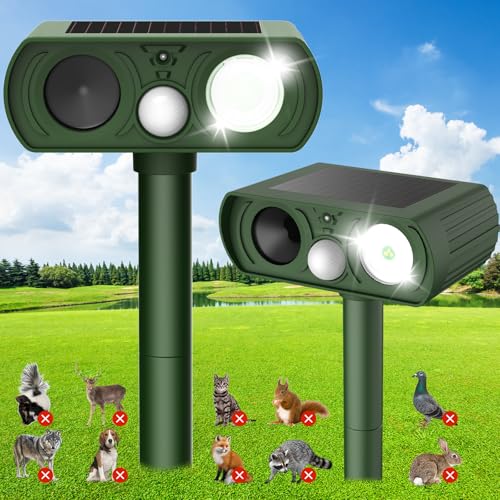
With a detection angle up to 150 degrees, this two-unit model offers a wider stated sensing angle than the 110-degree alternative. Its infrared sensor detects movement from 25 to 30 feet, and activation triggers ultrasonic sound and flashing strobe lights. The maker names raccoons among the animals it is designed to deter. It may suit a yard with a broad approach zone where one sensor can face an open area. The range tops out at 30 feet, so a long or obstructed route may require a different placement plan.
Bottom line: Pick it for a broad but defined approach area within its sensor range.
Broox Solar Animal Repeller
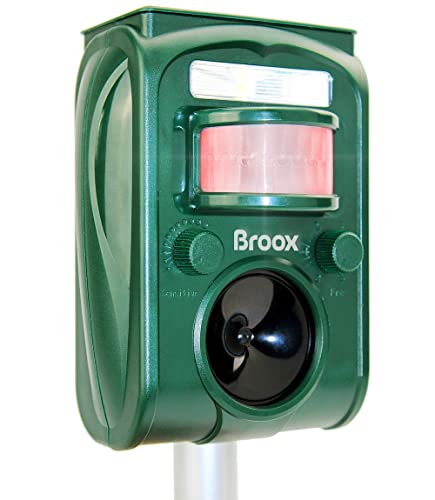
This single-unit option measures about 4.3 inches on each side, making it the most compact by the dimensions. It is described with motion activation, ultrasonic sound, an alarm, flashing LED light, and an IP65 waterproof rating. The maker names raccoons among its target animals. Its size may be useful where a larger device would be awkward to position.
Bottom line: Choose it for compact placement near a known approach route.
How to Choose an Ultrasonic Raccoon Repeller
Choose by matching the sensor’s view and range to the route raccoons use, not by the broadest animal list on a package. PIR motion sensors need a clear view of movement; fences, dense plants, and other obstructions can leave blind spots. A device’s detection distance describes when it triggers, not the distance at which sound will reliably deter an animal. If you have several entry routes, favor a multi-unit set or plan to reposition a single unit. Ultrasonic deterrents can be inconsistent, so remove attractants such as accessible garbage, pet food, and fallen fruit, and block access where practical. For electrical or physical exclusion work, use methods appropriate to the location and local rules.
Sensor Range and Placement for Yard Paths
Place a motion-triggered unit facing the approach path, with its sensor unobstructed and positioned where an animal will cross its field of view. The products here specify sensing distances from 25 to 32 feet, while coverage angles range from 110 degrees to 360 degrees; use those figures to compare geometry, not guaranteed deterrent reach. A narrow side yard may need only a forward-facing sensor, while a broad open area can benefit from wider sensing. Walk the area and identify gaps, fence openings, and routes to food before choosing a position. Recheck placement after vegetation grows or yard objects move, since a new obstruction can change what the sensor detects.
Ultrasonic Sound, Lights, and Raccoon Habits
Ultrasonic devices create high-frequency sound, and some models add flashing lights or audible alarms when motion triggers them. Raccoons are adaptable foragers, so a single repeated stimulus may not be dependable as the only deterrent; changing food access and entry conditions matters. Secure garbage lids, bring pet food indoors, and remove fallen produce rather than expecting a sound device to compensate for an easy food source. Lights and alarms may be more noticeable to people and nearby animals than ultrasound, so consider neighbors and household pets when choosing where to aim a unit. Avoid placing any deterrent where it could create a trip hazard or interfere with routine access.
Compare Sensor Coverage and Pack Size
Use the sensor angle and unit count to match a device to the number and shape of approach routes. A wider angle covers more directions from one position, while multiple units can face separate paths or blind spots. The comparison below separates detection range from sensing geometry; neither figure proves a particular raccoon will leave.
| Yard need | Useful feature | Placement consideration |
|---|---|---|
| Several separate paths | Multiple units | Aim each sensor at a different route |
| Open area with approaches from many directions | Broad-angle or 360° sensing | Keep the sensing area unobstructed |
| Known, narrow path | Defined detection range | Place the sensor facing the crossing point |
When a raccoon continues visiting, treat that as a sign to reassess the route and food access rather than assuming a higher setting will solve the problem.
Frequently Asked Questions
Do ultrasonic repellers reliably keep raccoons away?
No device can guarantee that raccoons will leave; responses can vary, and adaptable animals may return. Remove food sources and close access points alongside any motion-triggered deterrent.
How far away should I place a raccoon repeller?
Use the sensor’s detection range as a placement guide, not as proven deterrent distance. In these choices, stated detection ranges run from 25 to 32 feet, and obstructions can reduce the useful sensing area.
Can ultrasonic repellers bother dogs or cats?
Some pets may hear high-frequency sounds, while sensitivity varies by animal and frequency. Avoid aiming a unit toward places pets regularly rest, and watch for signs of discomfort after changing its location or mode.
Should a repeller face the ground or a fence opening?
Aim the motion sensor across the route where an animal will pass, such as a fence gap or side-yard path. Keep plants and objects from blocking its view, because the sensor must detect movement to activate.
What else helps stop raccoons from visiting a yard?
Remove easy food access by securing garbage, bringing pet food indoors, and collecting fallen fruit. Closing likely entry gaps can also reduce repeat visits, while a repeller alone may not address the attraction.