
R134a With Stop Leak: 4 Options Compared

For an R134a replacement with stop leak in a multi-can supply, Enviro-Safe Replacement, 4 Cans offers four 8-ounce cans and says each is equivalent to more than 21 ounces of R134a.
R-134a is a refrigerant used in automotive air conditioning, while stop-leak products are intended to address minor leaks. These products are not interchangeable: confirm your system’s refrigerant type and whether its manufacturer permits leak sealants before charging.
We earn a commission if you buy through links on this page. As an Amazon Associate I earn from qualifying purchases. Products are compared on manufacturer specifications, not hands-on testing.
- Best overall: Enviro-Safe Replacement, 4 Cans – Four 8-ounce cans provide the largest documented total can quantity among the replacement options.
- Best for a repair kit: ZeroR Repair & Recharge Kit – Combines sealant and moisture-removal/lubrication products with a 24-inch hose, can tap and gauge.
| Product | Best for | Can quantity or size | Included charging gear | System or product type | Shop |
|---|---|---|---|---|---|
| Enviro-Safe Replacement, 4 Cans | Multi-can supply | 4 × 8 oz | — | R134a replacement | Check Price on Amazon |
| ZeroR Repair & Recharge Kit | Repair accessories | — | 24 in hose, tap, gauge | R134a-system repair kit | Check Price on Amazon |
| Enviro-Safe Replacement, 3 Cans | Piercing-valve pack | 3 cans; 21 oz equivalent each | Piercing valve | R134a replacement | Check Price on Amazon |
| Enviro-Safe Replacement, 12 Cans | Bulk supply | 12 × 8 oz | Piercing top | R134a replacement | Check Price on Amazon |
R134a With Stop Leak Options
Compare replacement refrigerants, a repair kit and an additive by what each includes and which AC system it is meant for.
Enviro-Safe Replacement, 4 Cans

Four 8-ounce cans make this the practical pick when you want more replacement refrigerant on hand than a smaller pack provides. The maker says one can is equivalent to more than 21 ounces of R134a and claims lower head pressure and improved cooling. The product is a replacement refrigerant, not HFC-R134a itself. Its can count suits repeated service or keeping supplies together, but buyers needing a charging gauge or hose should choose a kit that includes those tools instead.
Bottom line: Choose this for a four-can supply of replacement refrigerant.
ZeroR Repair & Recharge Kit

The ZeroR kit stands apart by combining repair products with charging hardware rather than offering a multi-can refrigerant pack. It includes Max Seal for minor leaks, Permafrost for moisture removal and friction reduction, plus a 24-inch hose, can tap and gauge. The maker says the contents are intended for a single system repair.
Bottom line: Pick this when an all-in-one single-system repair kit is the priority.
Enviro-Safe Replacement, 3 Cans

This three-can option pairs Enviro-Safe replacement refrigerant with a piercing valve, making its pack size and valve the main distinction from the four-can supply. The maker says each can equals 21 ounces of R134a and describes the product as a replacement rather than HFC-R134a. Its three-can quantity works for buyers who prefer a smaller pack.
Bottom line: Choose this for a three-can pack with a piercing valve.
Enviro-Safe Replacement, 12 Cans
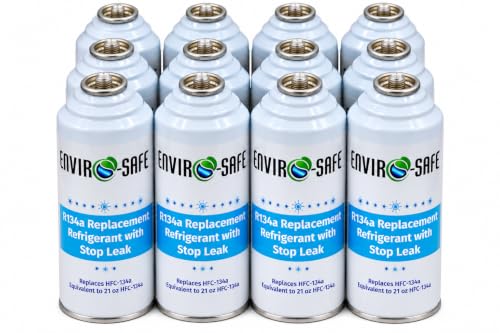
A 12-can case is the bulk-supply choice among these replacement refrigerants, with 8 ounces in each can and a piercing top. The maker says each can is equivalent to more than 21 ounces of R134a and claims lower head pressure and improved cooling.
Bottom line: Select this for a 12-can case of replacement refrigerant.
How to choose R134a with stop leak
Start by matching the product type to the job: replacement refrigerant replenishes a system, while a sealant additive is intended to address minor leaks. A kit can combine sealant, other treatment and charging hardware. R-134a is a specific refrigerant designation; an R134a replacement is not automatically the same substance, so do not treat the terms as interchangeable. For automotive AC, the service label under the hood or the owner’s manual identifies the required refrigerant. If the system calls for R-134a, do not use a substitute unless the vehicle maker and applicable rules permit it. Choose a kit when you need its included hose and gauge, and a multi-can pack when quantity is the deciding factor.
Check AC system compatibility before adding sealant
Confirm the refrigerant type before connecting any can: automotive AC systems are designed around a specified refrigerant and lubricant, and mixing refrigerants can complicate servicing. Stop-leak additives can also affect professional recovery equipment, so ask the service shop before adding one if the system may later need recovery. A product labeled for R-134a is not necessarily suitable for a replacement refrigerant. The measurable decision rule is simple: if the vehicle label does not say R-134a, do not select an R-134a-only additive. Sealants are intended for minor leaks, not failed compressors, damaged hoses or major leaks; those faults call for diagnosis and repair rather than repeated charging.
Replacement refrigerant, repair kit and additive compared
The key difference is whether you are buying refrigerant, treatment or tools. Use the table to narrow the choice by product role rather than assuming every can labeled stop leak does the same job.
| Need | Product type | What to compare |
|---|---|---|
| Replenish refrigerant | Replacement refrigerant | Can count and stated equivalence |
| Combine treatment and charging gear | Repair kit | Included treatment, hose and gauge |
| Add leak sealant to R-134a | Stop-leak additive | System compatibility and use conditions |
That distinction matters because an additive’s ounce size is not a refrigerant-equivalence figure. Do not infer total charge from pack count alone; the vehicle’s specified charge amount is the relevant reference.
Use charging cans and gauges carefully
Automotive AC is a pressurized system, so keep cans upright or in the position required by the specific charging equipment, and wear eye protection and gloves when connecting a can. Liquid refrigerant contacting skin can cause cold burns, and refrigerant should not be intentionally vented. A gauge can show pressure, but pressure alone does not confirm the correct refrigerant charge; ambient temperature and system operation affect readings. Never charge beyond the vehicle’s specified amount. If the system has lost its charge rapidly or the compressor does not engage, stop and have the fault diagnosed instead of adding more product.
Frequently Asked Questions
Can R134a replacement be used in an R-134a system?
Only when the replacement product is explicitly permitted for that system and jurisdiction. The product labeled as a replacement here says it is not HFC-R134a, so it should not be assumed interchangeable with R-134a.
Does stop leak replace lost refrigerant?
No, a stop-leak additive is not a refrigerant replacement. A leak can continue to reduce charge, and a system that loses refrigerant quickly needs diagnosis rather than repeated top-offs.
How much refrigerant does a car AC system need?
The required charge is vehicle-specific and is commonly given in ounces on an under-hood label. Use that vehicle’s specified charge amount rather than converting can equivalence claims into a system charge.
Can I use an R-134a stop leak in another refrigerant system?
Do not assume compatibility across refrigerants. Use an additive only when its label and the vehicle’s service information identify the system as compatible.
What does a can tap gauge measure during AC charging?
A gauge measures pressure at the connection, not the exact mass of refrigerant in the system. Ambient temperature and operating conditions affect pressure, so a gauge reading alone cannot establish a correct charge.