
Best Hardwired Under Cabinet Lighting: 3 Models Compared

For most kitchens, Ansen 18-Inch LED Bar is the strongest choice because its 18-inch bar combines 998.4 lumens with five selectable color temperatures and dimming. Choose NICOR UCB 24-Inch LED Bar for a longer 24-inch fixture with selectable white tones, or 24-Inch 5000K Daylight LED Bar when a fixed 5000K daylight color and higher stated output matter more.
Hardwired under-cabinet lights connect to a building’s electrical wiring rather than plugging into an outlet, so plan for safe installation as well as light output.
We earn a commission if you buy through links on this page. As an Amazon Associate I earn from qualifying purchases. Products are compared on manufacturer specifications, not hands-on testing.
- Best overall: Ansen 18-Inch LED Bar – Five selectable color temperatures and 998.4 lumens in an 18-inch dimmable fixture.
- Best for adjustable length coverage: NICOR UCB 24-Inch LED Bar – A 24-inch direct-wire bar with five selectable color temperatures and 612–648 lumens.
- Best for bright daylight: 24-Inch 5000K Daylight LED Bar – A 24-inch fixture with 1,250 lumens and a fixed 5000K color temperature.
| Product | Best for | Length | Light output | Color temperature | Shop |
|---|---|---|---|---|---|
| Ansen 18-Inch LED Bar | Flexible task lighting | 18 in | 998.4 lm | 2700–5000K, 5 settings | Check Price on Amazon |
| NICOR UCB 24-Inch LED Bar | Longer adjustable coverage | 24 in | 612–648 lm | 2700–5000K, 5 settings | Check Price on Amazon |
| 24-Inch 5000K Daylight LED Bar | Bright daylight task light | 24 in | 1250 lm | 5000K | Check Price on Amazon |
Hardwired Under Cabinet Lighting Compared
Compare fixture length, brightness, and color control to match the light bar to your cabinets and work surfaces.
Ansen 18-Inch LED Bar

Ansen 18-Inch LED Bar offers a useful balance of output and color flexibility in an 18-inch fixture. It uses a 15-watt LED, has a built-in on/off switch, and supports smooth dimming from 100% to 5%; the maker says it is compatible with most LED dimmers. The aluminum-alloy and plastic body is suited to cabinets, shelves, and closets where adjustable white light helps match the room. The main limitation is its shorter 18-inch span, which may leave a longer cabinet run needing additional fixtures. Linking fixtures requires separate ROMEX cable.
Bottom line: Pick this if you want adjustable color and dimming in an 18-inch bar.
NICOR UCB 24-Inch LED Bar

NICOR UCB 24-Inch LED Bar covers a longer stretch than Ansen 18-Inch LED Bar while offering five selectable color temperatures from warm to daylight white. Its 9-watt output is 612 to 648 lumens, and its polycarbonate diffuser is designed to distribute light evenly. The direct-wire design and multiple knockouts support hardwired installation; the maker says it dims to 5% with standard TRIAC or ELV dimmers. This lower output may suit a less demanding counter or ambient cabinet lighting, but it is the least bright option here for detailed work.
Bottom line: Choose this for a 24-inch bar with selectable white tones and lower output.
24-Inch 5000K Daylight LED Bar
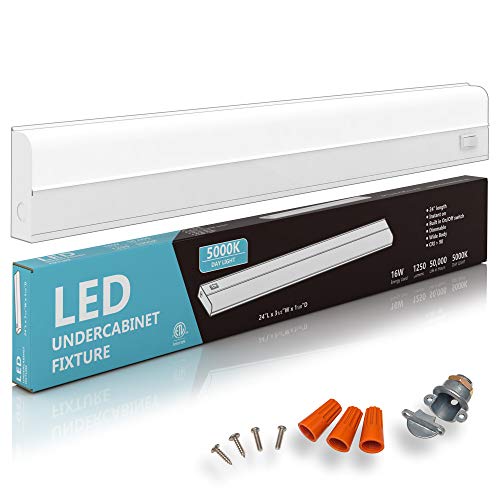
24-Inch 5000K Daylight LED Bar has the highest output among these options: 1,250 lumens from a 16-watt, 24-inch fixture. Its 5000K daylight color is fixed, making it a straightforward fit when you want a consistent cool-white appearance rather than selectable tones. The bar has a metal housing, frosted diffuser, and on/off switch; the maker says it is dimmable and ETL listed, and provides a five-year warranty. The fixed color is the tradeoff: choose another option if you need to shift between warmer and cooler light.
Bottom line: Pick this for the brightest output in a fixed daylight color.
How to Choose Hardwired Under Cabinet Lighting
Start with the counter task, then match output, spread, and color control to it. A useful target for detailed kitchen work is roughly 300–500 lux on the work surface; cabinet height, fixture spacing, and diffuser design affect how much light reaches the counter. Lumens measure total light leaving a fixture, not the brightness at a particular spot. For example, a longer bar does not automatically deliver more light: compare output as well as length. Choose selectable color temperature if you want to tune warm-to-cool white, and dimming if the same counter serves both food prep and softer evening lighting. For long cabinet runs, measure each section and plan fixture spacing so dark gaps do not fall over the main work area.
Color Temperature and Dimming Choices
Color temperature changes the appearance of white light: about 2700K reads warm, while 5000K reads cool daylight. A fixed 5000K fixture suits buyers who want one consistent cool tone; a selectable range gives more flexibility between rooms or tasks. Dimming changes brightness, not color, unless the fixture specifically supports both functions. LED dimmers must be compatible with the fixture, and incompatible dimmers can cause flicker, limited dimming range, or buzzing. Check the dimmer’s compatibility and load requirements before installation. A practical rule is to prioritize selectable CCT when the kitchen also functions as a living or dining space, and prioritize a fixed tone when a consistent appearance matters more than adjustment.
Measure Cabinets Before Installing a Hardwired Bar
Measure the usable underside of each cabinet section, including obstructions such as trim, hinges, and corner joints. A 24-inch bar needs a clear mounting span close to its full length; for a shorter cabinet, select a shorter fixture or verify the available mounting clearance. Also check depth: a fixture around 3 to 3.5 inches wide may be visible from some seating angles, depending on the cabinet overhang. Center a bar over the counter’s working area rather than automatically placing it at the rear edge, where the cabinet can cast a shadow. Mark the planned position and check the door swing before making mounting holes.
Hardwired Lighting Installation and Electrical Safety
Hardwired fixtures connect to household wiring, so installation involves line-voltage electrical work rather than just mounting a light. Turn off the circuit breaker and verify that the conductors are de-energized before handling wiring; a wall switch alone is not a safe way to isolate power. Follow local electrical code, use an appropriate junction box and cable connections, and keep wiring protected from sharp cabinet edges. If the existing wiring, grounding, or circuit arrangement is unclear, use a qualified electrician. The fixture’s dimmer compatibility also matters: select an LED-compatible control that matches the product’s dimming method. Never leave splices exposed or rely on a fixture body to enclose loose connections.
Hardwired Versus Plug-In Under-Cabinet Lights
Hardwired bars give a built-in appearance and avoid a cord running to an outlet, but installation requires access to house wiring and careful electrical work. Plug-in fixtures are easier to move or replace and can make sense when wiring access is limited, though their cords need a tidy, safe route. Battery-powered bars avoid wiring altogether but require charging or battery replacement. Use the comparison below to narrow the format by installation constraints, then compare individual hardwired fixtures by length, lumens, and color control.
| Type | Best fit | Main tradeoff |
|---|---|---|
| Hardwired | Permanent, cord-free installation | Line-voltage wiring work |
| Plug-in | Existing outlet and easier replacement | Visible cord routing |
| Battery-powered | No nearby wiring or outlet | Charging or battery changes |
Frequently Asked Questions
How many lumens should under-cabinet lights have?
For detailed counter work, aim for roughly 300–500 lux at the surface; lumens alone cannot guarantee that because mounting height, beam spread, and spacing change the result. As a starting point, compare fixture lumen output and arrange bars to avoid dark gaps over the work zone.
What color temperature is best for kitchen counters?
Around 3000K to 4000K is a common middle ground for kitchens, while 2700K looks warmer and 5000K cooler. Choose selectable color temperature if you want to adjust the appearance after installation.
Can hardwired LED lights use any dimmer?
No; the dimmer must be compatible with the LED fixture and its dimming method. TRIAC and ELV dimmers are different types, so verify compatibility before connecting a control to avoid flicker or a restricted dimming range.
Can hardwired under-cabinet lights be linked together?
Some fixtures support linking, but only use the connection method approved for that specific model. For a multi-fixture run, confirm the required cable type and keep all wiring connections inside appropriate enclosures.
Should I install under-cabinet lighting at the front or back?
Position the fixture to illuminate the main work surface without leaving the cabinet itself blocking the beam. Check the planned location from normal standing and seated angles, and account for cabinet overhang, backsplash, and door hardware before drilling.