
Best Tonsil Stone Removal Tool: 4 Types Compared

Oravix Manual Tonsil Stone Vacuum is the best fit for most people because its manual suction design avoids a metal pick at the tonsil. Choose a camera kit instead if seeing the area matters more to you, but a camera does not remove the risks of probing delicate tissue.
Tonsil stones are debris that can collect in tonsil crypts; home tools are not a substitute for medical care when symptoms are persistent or severe.
We earn a commission if you buy through links on this page. As an Amazon Associate I earn from qualifying purchases. Products are compared on manufacturer specifications, not hands-on testing.
- Best overall: Oravix Manual Tonsil Stone Vacuum – A manual rubber-bulb vacuum design offers suction without a metal pick.
- Best for replaceable tips: Oravix Stainless-Steel Pick Set – The pack includes two stainless-steel picks and 10 soft silicone tips.
- Best for camera capture: Gywwn 1080p Camera Removal Kit – The 1080p camera kit includes six LED lights and supports photos and videos.
- Best for app viewing: 1080p Wi-Fi Camera Tonsil Kit – The camera connects to a phone over Wi-Fi and has six LED lights.
| Product | Best for | Design | Camera and lighting | Included features | Shop |
|---|---|---|---|---|---|
| Oravix Manual Tonsil Stone Vacuum | Manual suction | Rubber bulb and curved pipe | — | 3-in-1 kit | Check Price on Amazon |
| Oravix Stainless-Steel Pick Set | Replaceable tips | Two 7-inch steel picks | — | 10 silicone tips | Check Price on Amazon |
| Gywwn 1080p Camera Removal Kit | Photo and video | Camera and stainless-steel tools | 1080p; 6 LEDs | Syringe and retractors | Check Price on Amazon |
| 1080p Wi-Fi Camera Tonsil Kit | Phone viewing | Camera and five steel heads | 1080p; 6 LEDs | Irrigator | Check Price on Amazon |
Tonsil stone removal tools compared
Compare each tool’s contact method and visibility features, and prioritize gentle care around tonsil tissue.
Oravix Manual Tonsil Stone Vacuum

Unlike a metal pick, this tool uses a rubber bulb and curved pipe for manual suction. ORAVIX says the design needs no power source or batteries and has smooth edges intended to make use more comfortable. The format may suit someone who prefers suction over pressing a tip against a tonsil. Its main limitation is that the kit has no camera, so it does not provide a live view of the area; avoid using it where you cannot see or comfortably reach.
Bottom line: Choose this if you prefer a manual suction format over a pick.
Oravix Stainless-Steel Pick Set
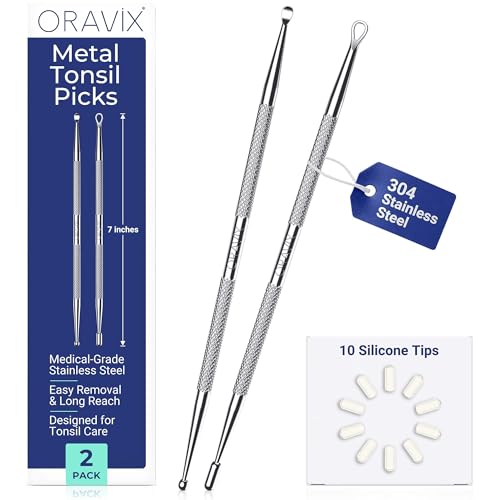
This set is the only option here with two 7-inch metal picks and 10 soft silicone tips. ORAVIX identifies the steel as 304 stainless steel and says the tips are intended to soften contact; the package is described as containing four tip types. The two-pick format may appeal to someone seeking a reusable tool with interchangeable ends. Its limitation is that even a softened tip remains a contact tool near delicate tissue, so do not force it into a tonsil crypt or use it if you cannot see clearly.
Bottom line: Choose this only if interchangeable tips are your priority and you can avoid forceful contact.
Gywwn 1080p Camera Removal Kit

This kit stands out for its 1080p camera, six LED lights, and ability to take photos and record videos. The kit also includes stainless-steel tools, an oral syringe, mouth retractors, and interchangeable accessories. The camera may help a user see the area more clearly than an unlit tool, but visibility is not a safety guarantee and does not justify reaching or probing deeply. The added components also make this a more involved kit than the manual suction option.
Bottom line: Choose this if camera capture and a multi-part kit matter more than simplicity.
1080p Wi-Fi Camera Tonsil Kit

This camera kit differentiates itself with a 1080p camera, six LED lights, five stainless-steel heads, and a phone connection over Wi-Fi. Its instructions describe connecting the phone and device through Wi-Fi rather than Bluetooth, with app support for exporting media to the phone. That phone-based setup may suit someone who wants a live view on a larger screen. The tradeoff is setup complexity, and a live image still cannot prevent irritation or injury from contact with tonsil tissue.
Bottom line: Choose this if phone-based viewing and five tool heads suit your needs.
How to choose a tonsil stone removal tool
Start with the least forceful approach, not the most elaborate tool. Tonsil tissue is delicate and can bleed when scratched or pressed; a metal pick, camera, or suction device cannot make probing risk-free. For a visible, loose stone, gentle gargling with warm salt water is a lower-contact first step. If selecting among these tools, favor a design you can control without reaching blindly, and stop if you feel pain, gagging, or bleeding. Do not insert a tool deeply into a tonsil crypt. Recurrent stones, persistent throat pain, or difficulty swallowing call for advice from a clinician rather than stronger pressure or repeated attempts.
Camera, suction, and pick designs
Camera kits add visibility, while suction and picks change how the tool contacts the tonsil. A camera can show the area on a connected screen, but magnification and lighting do not establish that a stone is safe to remove at home. Manual suction avoids a rigid pick tip, though suction can still irritate tissue. A metal pick allows direct contact and calls for especially careful control. Use this comparison to match the format to your comfort; if a stone is hard to reach or not clearly visible, do not keep probing.
The practical difference is the tool’s contact style, not a promise of safer removal.
| Design | What it offers | Key caution |
|---|---|---|
| Manual suction | Rubber bulb and curved pipe | Use gentle suction only |
| Pick with soft tips | Direct access with interchangeable tips | Avoid pressure and deep insertion |
| Camera kit | Lit view on a connected device | Visibility does not remove contact risk |
When to stop home removal
Stop immediately if an attempt causes bleeding, sharp pain, or persistent gagging. Tonsils contain delicate tissue, and repeated poking can worsen irritation; do not continue to reach a stone that is embedded or difficult to see. Seek medical advice for recurrent stones, ongoing bad breath with throat symptoms, or trouble swallowing. Urgent evaluation is appropriate for breathing difficulty or significant bleeding. People with a bleeding disorder or taking blood-thinning medicine should get professional guidance before trying a tool that touches tonsil tissue. No camera, silicone tip, or suction bulb changes those limits.
Gentler tonsil stone care
Warm salt-water gargling, regular tooth brushing, and cleaning between teeth can help clear loose debris and reduce food residue in the mouth. Use a gentle gargle rather than forceful high-pressure irrigation directed at the tonsils; concentrated pressure can irritate tissue. Drink water regularly to keep the mouth from becoming dry, and clean any reusable tool after use according to its maker’s directions. Do not share oral tools. Persistent or recurring stones merit a clinician’s assessment, particularly when accompanied by pain, fever, or swallowing problems; home removal is not the only care option.
Frequently Asked Questions
Can a tonsil stone removal tool cause bleeding?
Yes. Tonsils are delicate tissue, and a pick or other contact tool can scratch them and cause bleeding. Stop at the first sign of blood rather than trying again.
Are tonsil stone camera tools safer to use?
A camera can improve visibility, but it does not prevent tissue injury from a tool touching the tonsil. Do not probe a stone that is difficult to see or reach.
How can I loosen a tonsil stone gently?
A warm salt-water gargle is a lower-contact first step for a loose stone. Avoid forceful pressure directed at the tonsils, which can irritate tissue.
When should I ask a doctor about tonsil stones?
Ask a clinician about recurring stones, persistent throat pain, or difficulty swallowing. Seek urgent care for breathing difficulty or significant bleeding.
Can I use a tonsil tool with blood thinners?
Get professional guidance before using any tool that touches tonsil tissue if you take blood-thinning medicine or have a bleeding disorder. A small scratch can be more consequential in those situations.