
KSP Upper Control Arms: Fitment and Lift Compared

For a 6-lug Silverado or Sierra with a 2–4-inch lift, KSP Stage 2.0 GM Tubular Arms is the clearest match because its fitment covers those trucks and it uses 1.25-inch DOM tubing. F-150 owners should choose between KSP F-150 Tubular Arms, 2nd Generation and KSP Red Adjustable F-150 Arms, while GM owners should check model year, original arm type, and wheel clearance before choosing.
We earn a commission if you buy through links on this page. As an Amazon Associate I earn from qualifying purchases. Products are compared on manufacturer specifications, not hands-on testing.
- Best overall: KSP Stage 2.0 GM Tubular Arms – Covers 2007–2018 6-lug Silverado and Sierra fitment and specifies 1.25-inch DOM tubing.
- Best for F-150 wheel fit: KSP F-150 Tubular Arms, 2nd Generation – Its fitment notes call for at least a 1.5-inch spacer or a zero-offset aftermarket wheel with conservative stock wheels.
- Best for red adjustable arms: KSP Red Adjustable GM Arms – It is described as an adjustable steel arm and covers several 6-lug GM models.
| Product | Best for | Vehicle fitment | Arm construction | Shop |
|---|---|---|---|---|
| KSP Stage 2.0 GM Tubular Arms | GM 6-lug trucks | 2007–2018 Silverado/Sierra 1500 | 1.25-in DOM tubing | Check Price on Amazon |
| KSP F-150 Tubular Arms, 2nd Generation | F-150 stock wheels | 2004–2020 F-150 | Tubular; larger tube | Check Price on Amazon |
| KSP GM Tubular Arms for Cast-Steel Applications | GM cast-steel arms | 2007–2018 listed GM models | Tubular; TIG-welded | Check Price on Amazon |
| KSP Red Adjustable GM Arms | Red GM adjustable arms | 2007–2018 listed GM models | 1.25-in DOM tubing | Check Price on Amazon |
| KSP Red Adjustable F-150 Arms | Red F-150 arms | 2004–2020 F-150 | 1.25-in DOM tubing | Check Price on Amazon |
KSP Upper Control Arms Compared
Start with vehicle fitment, then check the original arm type and wheel setup before selecting an arm.
KSP Stage 2.0 GM Tubular Arms

For 6-lug Silverado and Sierra 1500 trucks, this option combines a broad year range with 1.25-inch DOM tubing. The fitment also includes several Yukon, Tahoe, Suburban, Avalanche, and Escalade models, with model-year limits that vary by vehicle. The arms use polyurethane bushings and have grease zerks; the maker says new ball joints need no added grease within the first year. This is a practical match for a GM owner looking for a tubular arm for a 2–4-inch lift. Confirm the exact vehicle and original arm configuration before ordering, since fitment is not universal across every GM trim or wheel pattern.
Bottom line: Choose this for a 6-lug GM application when its year and original arm setup match.
KSP F-150 Tubular Arms, 2nd Generation

For F-150 owners keeping conservative stock wheels, the key point is the wheel-clearance warning: the maker says ET44 stock wheels can rub the arm and calls for at least a 1.5-inch wheel spacer or a zero-offset aftermarket wheel. The arms fit 2004–2020 F-150 models and are intended for a 2–4-inch lift. The maker also requires an alignment after installation and cautions against overtightening the copper grease zerks. Choose this option only after checking wheel offset and tire clearance; buyers who want to retain an unmodified ET44 setup should treat that clearance note as a deciding limitation.
Bottom line: Choose this for a compatible F-150 when the wheel offset and clearance suit the arm.
KSP GM Tubular Arms for Cast-Steel Applications
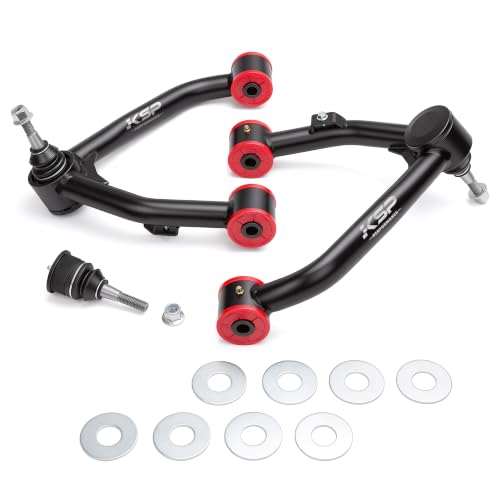
This version is distinguished by its narrower fitment condition: some 2014–2018 new-body Silverado and Sierra applications require the original forged or cast-steel arm type. It covers a range of 6-lug GM trucks and SUVs, and its name identifies factory cast-steel arms as the intended application. The lift range is 2–4 inches. That makes original arm construction a more important selection check here than color or appearance. The fitment spans different model years by vehicle, so do not assume that every 2014–2018 GM truck qualifies; verify both the model year and original arm style before choosing this version.
Bottom line: Choose this when the vehicle is in the GM fitment and has the compatible original arm type.
KSP Red Adjustable GM Arms

Among the GM options, this one is specifically identified as adjustable and comes in red. It covers 6-lug Silverado and Sierra 1500 applications along with Yukon, Tahoe, Suburban, Avalanche, and Escalade models; individual year limits differ. Its construction uses 1.25-inch DOM tubing, and the maker describes polyurethane bushings and a dust cover. Like other lift-oriented suspension changes, installing these arms calls for a post-installation alignment. This is a fit for buyers seeking the adjustable red version, but the color and adjustability do not remove the need to confirm vehicle year, wheel pattern, and original arm compatibility.
Bottom line: Choose this for a GM application if you specifically want an adjustable red arm.
KSP Red Adjustable F-150 Arms
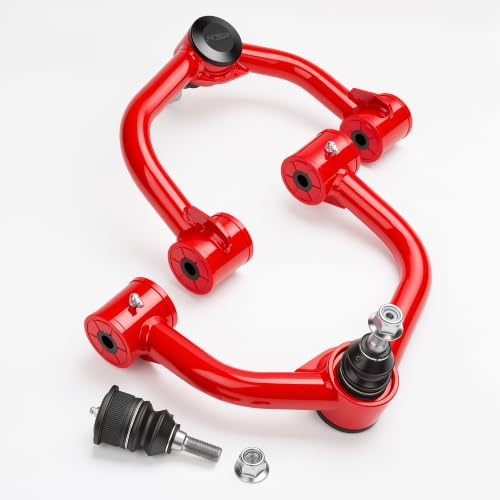
This red F-150 option is described as a welded steel arm with an adjustable ball joint, setting it apart from the black tubular F-150 version. It fits 2004–2020 F-150 models and is intended for 2–4-inch front lift kits. The maker says the ball joints are pre-greased and calls for an alignment after installation; larger tires on factory wheels require wheel spacers. That tire-and-wheel limitation matters if the truck retains factory wheels while moving to a larger tire. Check the wheel and tire combination as a whole rather than assuming vehicle-year fitment guarantees clearance.
Bottom line: Choose this for a F-150 when the red finish and adjustable ball joint suit your setup.
How to choose KSP upper control arms
Choose by vehicle and original arm style first, then match the arm to the lift and wheel setup. A 2–4-inch lift is the range across these KSP options, but that range alone does not establish fitment: GM arms are limited to listed 6-lug applications, and one version has an original cast/forged-arm condition for some later trucks. For the F-150 choices, wheel offset is consequential; the maker warns that ET44 stock wheels can rub one option. A suspension lift changes front-end geometry, so plan for an alignment after installation; one supplied F-150 option specifically requires it. If the truck has a different wheel pattern, year, or original arm type than the fit, do not infer compatibility from the model name alone.
Use a measurable gate before buying: if your F-150 retains ET44 stock wheels, account for the noted spacer or offset requirement rather than assuming clearance.
GM and F-150 fitment differences
GM and F-150 arms in this group are not interchangeable: the GM choices are listed for specific 6-lug trucks and SUVs, while the F-150 choices cover 2004–2020 F-150s. GM fitment also depends on vehicle and year; for example, the cast-steel version limits some 2014–2018 new-body applications to original forged or cast-steel arms. F-150 fitment has a separate wheel-clearance condition, with ET44 stock wheels called out for possible rubbing. A truck’s lift height does not override either condition. Confirm the exact model year, drivetrain, wheel pattern, original arm style where relevant, and wheel offset as separate checks. Replacing a part by broad make and model alone can miss a year-specific or configuration-specific boundary.
What lift range and alignment mean
These arms are described for 2–4-inch lifts, so they are aimed at setups within that stated band rather than stock-height or higher-lift builds. Lift height is only one part of suspension fit: wheel offset and tire size affect clearance, and the F-150 maker notes rubbing risk with ET44 stock wheels. After installation, alignment matters because suspension-arm changes can alter wheel angles; the F-150 product notes explicitly call for an alignment. Plan the alignment as part of the installation, not as an optional cosmetic adjustment. Before work begins, identify the actual front lift and wheel/tire combination. If the setup falls outside the 2–4-inch range or has unusual wheels, these product facts do not establish that the arms will fit or clear.
Grease and installation checks
These arms use grease zerks, and the product notes warn that the fittings are copper and can break if overtightened. Tighten a zerk only gently after greasing; do not use excessive force. The product notes also say the new ball joints do not need extra grease within the first year, or describe them as pre-greased. Avoid adding grease simply because the arms are new. Suspension work involves loaded components and can affect steering control, so use correctly rated support equipment and secure the vehicle before working underneath it. Check fasteners and alignment according to the vehicle service procedure; a correct year/model match does not make an unsafe installation acceptable.
Frequently Asked Questions
Do KSP upper control arms fit a stock-height truck?
The arms here are specified for lifts from 2 to 4 inches, so the fitment does not establish stock-height suitability. Match the actual front lift to that range before choosing.
Will KSP F-150 arms clear ET44 stock wheels?
The maker warns that conservative ET44 stock wheels can rub the arm. It calls for at least a 1.5-inch spacer or a zero-offset aftermarket wheel for that setup.
Is an alignment needed after installing upper control arms?
Yes, the F-150 product notes require alignment after installation. Suspension-arm changes can affect wheel angles, so schedule alignment as part of the work.
Do new KSP upper control arm ball joints need grease?
The product notes say the ball joints are pre-greased and do not need extra grease within the first year. The notes also caution against overtightening copper zerks.
Can these arms fit trucks with five-lug wheels?
The GM applications specify 6-lug wheels, so five-lug fitment is not established for those arms. Check wheel pattern and exact vehicle configuration before choosing.