
Highest Quality Battery Terminal Connectors for Cars

For a car battery’s top-post connection and multiple cable sizes, Bates Multi-Gauge Brass Top-Post Terminals is the closest match because it uses brass terminals with several wire ports. Choose a ring lug set instead if you are terminating cables to a stud rather than clamping directly to the battery post.
Battery terminals clamp to the battery posts, while cable lugs join a cable to a threaded stud or bolt; matching the connection type and cable gauge matters more than a broad quality claim.
We earn a commission if you buy through links on this page. As an Amazon Associate I earn from qualifying purchases. Products are compared on manufacturer specifications, not hands-on testing.
- Best overall: Bates Multi-Gauge Brass Top-Post Terminals – Brass top-post terminals include multiple ports and support several listed wire gauges.
- Best for multiple connections: Vgate A8 8-Way Battery Terminals – Eight-way terminals combine four hole-holders and four threaded studs.
- Best for cable repairs: TKDMR Copper Ring Lug and Heat-Shrink Kit – The kit includes copper ring lugs across 10 AWG through 2 AWG with heat-shrink tubing.
| Product | Best for | Connection type | Cable range | Material | Shop |
|---|---|---|---|---|---|
| Bates Multi-Gauge Brass Top-Post Terminals | Top-post cables | Top-post clamp | 0–10 AWG | Brass | Check Price on Amazon |
| Vgate A8 8-Way Battery Terminals | Many cable connections | SAE/DIN/EN tapered post | 8 AWG–4/0 AWG | — | Check Price on Amazon |
| TKDMR Copper Ring Lug and Heat-Shrink Kit | Mixed gauge repairs | Ring lug | 2–12 AWG | Copper | Check Price on Amazon |
| THJMJN Brass Top-Post Terminals | Basic top-post swap | Top-post clamp | — | Brass | Check Price on Amazon |
| AIRIC 1/0 AWG Copper Cable Lugs | Heavy cable ends | 3/8-inch ring lug | 1/0 AWG | Copper | Check Price on Amazon |
Car Battery Terminal Connectors
Match the terminal style to the battery post or cable stud, then confirm the cable gauge before choosing.
Bates Multi-Gauge Brass Top-Post Terminals
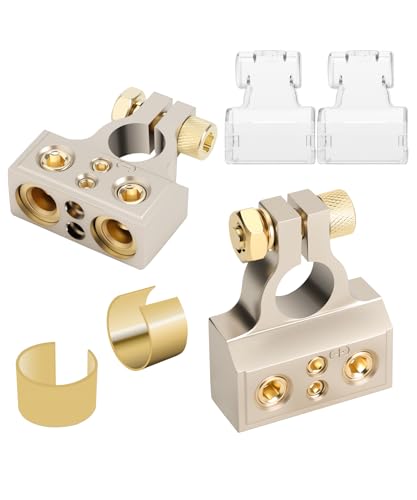
For a top-post battery connection with more than one cable size, these brass clamps provide several ports and set screws, so wires can be secured without crimping a lug onto each cable. The two-terminal set has transparent covers and positive and negative markings. It suits car, marine, and RV wiring where cables fall within its supported gauge range. The product name references 0/2/4/6/8/10 AWG, while the maker lists 0, 4, 8, and 10 AWG; verify compatibility with the cable gauge you plan to use before ordering.
Bottom line: Pick these for top-post batteries when you need multi-port connections and set-screw wire attachment.
Vgate A8 8-Way Battery Terminals

Unlike basic battery clamps, the Vgate A8 combines four hole-holders with four threaded studs, making it the option here for a setup that needs several separate attachment points. It is designed for lead-acid batteries, including AGM, gel, wet, MF, and CA/CA types, and SAE, DIN, or EN tapered posts. The compatibility excludes JIS pencil posts, and the maker advises a stud-to-post adapter for lithium batteries. This is a more specialized choice than a simple top-post clamp, so check post style and battery chemistry first.
Bottom line: Choose this for multiple accessory connections on a compatible lead-acid tapered-post battery.
TKDMR Copper Ring Lug and Heat-Shrink Kit

For cable ends that attach to a bolt or stud rather than directly to a battery post, this assortment supplies 80 copper ring lugs and 80 pieces of adhesive heat-shrink tubing. The lug sizes cover AWG 2, 4, 6, 8, 10, and 12, with a tinned surface and inspection windows for checking wire insertion. The tubing is rated up to 600 volts and 257°F. The kit requires a suitable crimping or soldering method and is not a replacement for post-clamp terminals, so choose it only when your connection uses ring terminals.
Bottom line: Pick this assortment for replacing cable-end ring lugs across several wire gauges.
THJMJN Brass Top-Post Terminals

These two brass terminals are a straightforward positive-and-negative replacement for standard vehicle battery wiring, without the multiple ports highlighted on some alternatives. The compact dimensions are 2.28 by 1.26 by 0.82 inches, and the maker describes the design as resistant to loosening and corrosion. They suit a basic top-post connection where the existing cable ends and post size match. No supported cable-gauge range is provided in the specifications, so confirm that the clamp accepts your cable before buying; this matters especially for unusually thick or multiple cables.
Bottom line: Choose these for a basic brass top-post replacement when your cable fit is confirmed.
AIRIC 1/0 AWG Copper Cable Lugs

These AIRIC lugs are the focused choice for 1/0 AWG cable that needs a 3/8-inch (M10) stud connection; they are not battery-post clamps. The package contains 10 copper lugs and 10 pieces of 3:1 dual-wall adhesive heat-shrink tubing. A flared opening helps with cable insertion, and the maker describes the lugs as suitable for crimping or welding. This narrow gauge and stud size are useful when they match the existing hardware, but the set will not serve other cable gauges or post-clamp connections.
Bottom line: Pick these only when your cable is 1/0 AWG and the stud is 3/8 inch.
How to Choose Car Battery Terminal Connectors
Choose by connection style first: a post clamp attaches directly to a tapered battery post, while a ring lug fits a threaded stud or bolt. Then match the connector’s cable gauge range to the cable; AWG numbers run in reverse, so a smaller number such as 1/0 denotes thicker wire than 10 AWG. For multi-wire installations, count the separate attachment points rather than assuming one clamp accepts every cable. With a stud connection, confirm both the lug’s hole diameter and the stud size; a 3/8-inch hole does not fit every battery terminal.
A practical rule is to select a post-clamp model for a direct top-post replacement and a ring lug set only when the cable terminates on a bolt or stud. Disconnect the negative cable first during battery-terminal work to reduce the risk of a short circuit.
Battery Post and Cable Fit
Battery post shape determines whether a terminal will clamp securely: SAE, DIN, and EN tapered top posts are not the same as JIS pencil posts. The Vgate A8 fits the former group and excludes JIS pencil posts, so a visual match is not enough if the battery is an uncommon type. Cable fit is a separate check: a terminal’s gauge range must include the actual wire size, and the wire must be fully captured by its port or lug barrel.
Use the connection map below to avoid choosing a cable lug for a battery post or a post clamp for a stud.
| Connection | Attaches to | Check before use |
|---|---|---|
| Top-post clamp | Tapered battery post | Post style and cable gauge |
| Ring lug | Threaded stud or bolt | Wire gauge and hole diameter |
| Multi-port clamp | Battery post plus several cables | Number of ports and wire sizes |
Brass Terminals and Copper Cable Lugs
Brass post terminals and copper cable lugs serve different points in the circuit, even though both are conductive metal parts. Brass clamps attach at the battery post; copper lugs terminate cable ends at a stud or bolt. Tinned copper surfaces add a protective coating to cable lugs, while heat-shrink tubing can cover the crimped or soldered barrel to help seal the cable end. Do not treat shrink tubing as a substitute for a sound mechanical connection.
For a direct battery replacement, prioritize matching the post and clamp geometry. For a cable repair, choose a lug with the right AWG size and stud hole, then use a crimper sized for that lug or an appropriate soldering method.
Safe Battery Terminal Installation
Disconnect the negative terminal before working on the positive side, and keep metal tools from bridging the positive post to the vehicle body; a short can produce intense heat and sparks. Wear eye protection, remove jewelry, and work in a ventilated area because lead-acid batteries can release explosive hydrogen gas while charging. Keep flames and sparks away from the battery.
After installation, check that the clamp cannot rotate by hand and that no bare conductor can touch the opposite terminal or bodywork. Do not overtighten a battery clamp: excessive force can deform the clamp or damage the battery post. If a connection remains loose after correct positioning, stop and verify that the terminal matches the post type.
Frequently Asked Questions
What does 1/0 AWG mean for battery cable?
1/0 AWG is a thick cable size, larger in diameter than 1 AWG and much thicker than 10 AWG. Match a lug marked 1/0 only to cable of that gauge, and confirm its stud-hole size separately.
Can ring lugs replace battery post clamps?
No, ring lugs and post clamps attach to different hardware. A ring lug fits over a threaded stud or bolt, while a post clamp grips the tapered battery post.
Should I disconnect the positive or negative terminal first?
Disconnect the negative terminal first when removing a typical vehicle battery connection. That reduces the chance that a tool touching the vehicle body will complete a short through the positive terminal.
How can I tell whether my battery uses JIS pencil posts?
JIS pencil posts are narrower than common SAE-style top posts, so compare the post shape and dimensions with the battery and terminal specifications. A connector for SAE, DIN, or EN tapered posts may not clamp a pencil post securely.
Do battery cable lugs need heat-shrink tubing?
Heat-shrink tubing is commonly used to cover a completed cable lug connection and help seal it against moisture and corrosion. Use tubing sized for the cable and lug, and shrink it only after the mechanical crimp or solder joint is secure.