
Japan Steel Toe Insulated Boots: 5 Models Compared

For cold-weather work, Muck Arctic Sport High Steel Toe is the strongest all-around match because it combines a steel toe, waterproof construction and fleece lining. The products here are steel toe insulated work boots, but none is identified as Japan-made; choose another option if country of manufacture is essential.
Pick by cold exposure, fit and jobsite hazards: insulation types and safety claims differ, and a warm boot is not automatically suitable for every worksite.
We earn a commission if you buy through links on this page. As an Amazon Associate I earn from qualifying purchases. Products are compared on manufacturer specifications, not hands-on testing.
- Best overall: Muck Arctic Sport High Steel Toe – Waterproof construction, 5 mm neoprene and a fleece lining suit wet, cold work.
- Best for deep cold: Muck Arctic Pro Steel Toe – The maker gives a comfort range down to -60°F.
- Best for defined insulation: Rocky Blizzard Stalker 1200G – Its 1,200-gram 3M Thinsulate Ultra insulation is a clear cold-weather specification.
| Product | Best for | Insulation | Waterproofing | Safety marking | Shop |
|---|---|---|---|---|---|
| Muck Arctic Sport High Steel Toe | Wet cold work | 5 mm neoprene, fleece lining | 100% waterproof | ASTM F2413-11 M I/75 C/75 EH | Check Price on Amazon |
| Muck Arctic Pro Steel Toe | Subfreezing shifts | 8 mm neoprene, fleece lining | 100% waterproof | ASTM F2413-11 M I/75 C/75 EH | Check Price on Amazon |
| Rocky Blizzard Stalker 1200G | Tall insulated fit | 1,200 g 3M Thinsulate Ultra | Waterproof construction | ASTM F2413 protective toe; EH | Check Price on Amazon |
| Angryram Winter Steel Toe Boots | Puncture resistance | Faux-fur lining | Water-resistant material | ASTM 2413-18 claimed; impact >200 J | Check Price on Amazon |
| Koifish Fur-Lined Steel Toe Boots | Sole protection | Plush fleece lining | — | Impact up to 200 J; compression 15 kN | Check Price on Amazon |
Steel Toe Insulated Boots Compared
Compare the insulation, water protection and stated safety markings to narrow the choice for your work conditions.
Muck Arctic Sport High Steel Toe

Muck Arctic Sport High Steel Toe pairs 5 mm CR Flex-Foam with fleece and a 2 mm thermal layer under the footbed, making it a practical choice for wet, cold shifts. The boot has an EVA contoured molded midsole and MS-1 molded outsole, plus a steel toe. Its ASTM F2413-11 marking includes M I/75 C/75 EH. The specifications give a size 11, but no temperature comfort range, so buyers facing severe cold should compare that need against a boot with a range.
Bottom line: Choose this for waterproof protection and layered insulation when no temperature rating is required.
Muck Arctic Pro Steel Toe

Muck Arctic Pro Steel Toe stands apart with an 8 mm neoprene upper and a comfort range from -60°F to 30°F, which makes it the clearest match here for work in subfreezing conditions. The maker also specifies fleece lining and 2 mm thermal foam under the footbed. It is waterproof and has a steel toe; its ASTM F2413-11 marking includes M I/75 C/75 EH. The size is 13, so workers needing another size should confirm availability before choosing it.
Bottom line: Choose this when the cold-weather comfort range matches your work conditions.
Rocky Blizzard Stalker 1200G
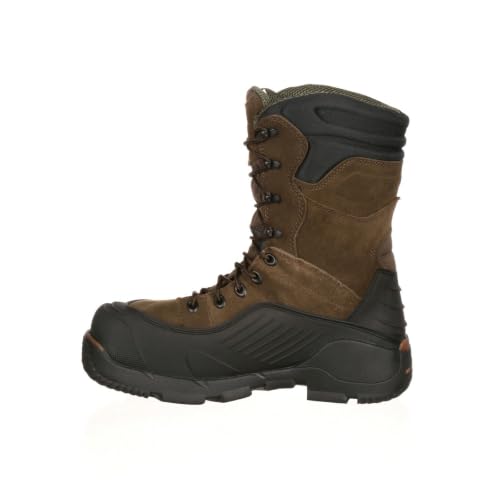
Rocky Blizzard Stalker 1200G is the tallest option described, at 9 inches, and uses 1,200 grams of 3M Thinsulate Ultra insulation rather than a specified neoprene thickness. Its maker guarantees waterproof construction and identifies ASTM F2413 protective toe classification and electrical-hazard protection. The boot also has a rubber vamp, removable mesh PU footbed, TPU heel stabilizer, nylon shank and multidirectional Blizzard Max sole. At 6.1 pounds per pair for size 10, its weight may matter to workers who prioritize a lighter boot for long shifts.
Bottom line: Choose this for a 9-inch boot with quantified insulation and stated electrical-hazard protection.
Angryram Winter Steel Toe Boots

Angryram Winter Steel Toe Boots combines faux-fur lining with a claimed puncture-resistant midsole, adding a sole-protection feature not specified for every option here. Its maker says the steel toe exceeds ASTM 2413-18 and gives impact resistance above 200 J; it also claims water-resistant construction. Those are maker claims, not a substitute for confirming that the exact protection classification is accepted at your workplace. The size is 12 men’s (also labeled 13.5 women’s), so verify sizing carefully if ordering by the women’s designation.
Bottom line: Choose this if puncture resistance and faux-fur lining fit your work needs.
Koifish Fur-Lined Steel Toe Boots
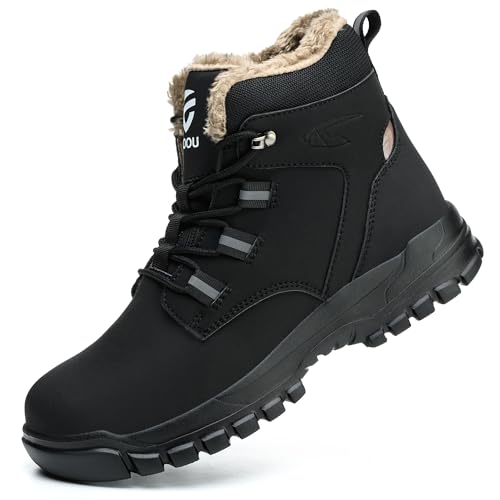
Koifish Fur-Lined Steel Toe Boots is the option that specifies Kevlar-reinforced puncture resistance, with the maker claiming resistance of at least 1,100 N. Its plush fleece lining targets cold-weather comfort, while its steel toe is claimed to absorb up to 200 J of impact and withstand 15 kN of compression. The text also calls these boots lightweight, but supplies no weight figure for comparison.
Bottom line: Choose this for its puncture-resistance claim and plush lining.
How to Choose Insulated Steel Toe Boots
Start with the hazards and temperature, then compare the boot’s protection marking and insulation. ASTM F2413 is the US specification for performance requirements for protective footwear; the marking matters because a steel toe alone does not establish every protective feature. Electrical-hazard protection is a separate designation, and puncture resistance is a distinct sole hazard claim. Match each claim to your employer’s requirements rather than assuming one safety feature covers another.
For warmth, compare the insulation material and any temperature range the maker provides. A gram weight such as 1,200 g describes the insulation amount, but it is not interchangeable with a comfort-temperature rating. If your work includes prolonged exposure below freezing, favor a product with a temperature range rather than relying only on lining type.
Waterproof and Water-Resistant Boots
Waterproof and water-resistant are not equivalent claims: waterproof construction is intended to resist water penetration, while water resistance does not promise the same protection. That distinction matters for wet job sites, where water can enter around seams, openings or worn areas even when the material sheds splashes. Among these options, several make explicit waterproof claims, while one claims water resistance and one has no water-protection claim in the specifications.
For standing water or extended outdoor exposure, choose a boot that explicitly claims waterproof construction and check that the shaft height suits the depth of likely water. A taller shaft can help cover more of the lower leg, but it does not establish a waterproof seal above the boot. Keep the boot’s care and replacement needs in view: cracks, separated soles and damaged seams can undermine water protection regardless of the original construction.
Getting the Fit Right in Work Boots
Try insulated work boots with the socks you expect to wear on shift; thick winter socks change the space needed across the toe box and instep. Leave roughly a thumb’s width in front of the toes when standing, while keeping the heel secure enough to avoid rubbing. A boot that is too tight can compress insulation and reduce comfort, while excessive room can let the foot slide during lifting or walking.
Use the size and width system for the intended wearer, and do not assume a women’s size label maps cleanly to a men’s size without checking the maker’s conversion. If a boot must accommodate orthotics, confirm that its footbed can be removed and that the replacement leaves enough toe clearance. Break-in time should not be used to justify pressure on the toes or heel slipping.
Reading Steel Toe and Worksite Safety Markings
ASTM F2413 markings identify protective footwear performance categories, so compare the exact marking rather than treating every steel toe as interchangeable. The M I/75 C/75 notation indicates men’s impact and compression classifications; EH refers to electrical-hazard protection. Requirements depend on the hazards and policies at the worksite, and an electrical-hazard boot is not a substitute for electrically insulating footwear in every task.
Steel toes protect against impact and compression hazards but do not make a boot suitable for every environment. Wet floors, sharp debris and electrical exposure call for separate checks of slip resistance, puncture protection and the applicable electrical rating. Before buying for a regulated workplace, confirm that the exact safety classification and any required puncture or slip rating meet the employer’s rules.
Frequently Asked Questions
How much toe room should insulated work boots have?
Leave about a thumb’s width in front of the toes while standing in the socks you will wear on shift. The fit should keep the heel from slipping without squeezing the toe box.
Does 1,200 grams mean a boot has a temperature rating?
No; 1,200 grams identifies the insulation amount, not a specific temperature comfort range. Compare a maker’s temperature range when you need a boot for prolonged subfreezing work.
What does ASTM F2413-11 M I/75 C/75 EH mean?
The marking identifies protective-footwear classifications for men’s impact and compression, plus an electrical-hazard designation. Check the exact marking against the hazards and footwear rules at your worksite.
Are water-resistant boots suitable for standing water?
A water-resistant claim does not promise the same protection as waterproof construction. For standing water or long wet shifts, choose an explicitly waterproof boot and ensure the shaft height suits the expected water depth.
Can steel toe boots protect against nails underfoot?
A steel toe protects the front of the foot, not the sole from punctures. For nail or scrap hazards, look for a separate puncture-resistant midsole claim and verify that the protection meets your workplace requirements.