
Lab Charge Air Purifiers: 3 Models Compared by Pack Size

Lab Charge Ionic Purifier, 5-Pack is the Lab Charge air purifier option for most buyers who want five compact plug-in ionic units, each for 250 square feet. Choose a different pack size if you need four units or eight; these options share the same dimensions and coverage.
These are ionizers, which use charged particles rather than a conventional fan-and-filter setup. They are not equivalent to a HEPA purifier for capturing particles in a replaceable filter.
We earn a commission if you buy through links on this page. As an Amazon Associate I earn from qualifying purchases. Products are compared on manufacturer specifications, not hands-on testing.
- Best overall: Lab Charge Ionic Purifier, 5-Pack – It includes five plug-in units, with each for 250 square feet.
- Best for four rooms: Lab Charge Ionic Purifier, 4-Pack – The pack includes four units with the same coverage and dimensions.
- Best for more rooms: Lab Charge Air Ionizer, 8-Pack – Eight plug-in units make this the largest pack, while each lists 250-square-foot coverage.
| Product | Best for | Pack count | Shop |
|---|---|---|---|
| Lab Charge Ionic Purifier, 5-Pack | Five-room setup | 5 units | Check Price on Amazon |
| Lab Charge Ionic Purifier, 4-Pack | Four-room setup | 4 units | Check Price on Amazon |
| Lab Charge Air Ionizer, 8-Pack | More-room setup | 8 units | Check Price on Amazon |
Lab Charge Air Purifiers
Compare these plug-in ionic options by pack count; each lists the same coverage and compact dimensions.
Lab Charge Ionic Purifier, 5-Pack

Lab Charge Ionic Purifier, 5-Pack stands out for buyers who want five units rather than a smaller or larger pack. Each compact black purifier measures 3.5 × 1.5 × 2.0 inches and is listed for coverage of 250 square feet. The maker describes it as a filterless ionic device for plug-in use, with no replacement filters. That makes it a fit for someone seeking a small device without a fan-and-filter assembly. The limitation is important: an ionizer is not a HEPA filter purifier, so choose a conventional filtered model if your priority is capturing particles in a filter.
Bottom line: Choose this pack if five compact ionic units suit your room plan.
Lab Charge Ionic Purifier, 4-Pack

Lab Charge Ionic Purifier, 4-Pack gives buyers the same compact format as the other Lab Charge options but with four units in the pack. Each is black, measures 3.5 × 1.5 × 2.0 inches, and is listed for 250 square feet. The maker describes the device as ionic and filterless, intended to plug in without routine filter replacement. This pack suits a buyer matching a smaller number of rooms or outlets. Its main limitation is the purification approach: negative-ion devices do not pass room air through a HEPA filter, so they serve a different purpose from filtered purifiers.
Bottom line: Choose this pack when four units match the number of rooms you plan to equip.
Lab Charge Air Ionizer, 8-Pack
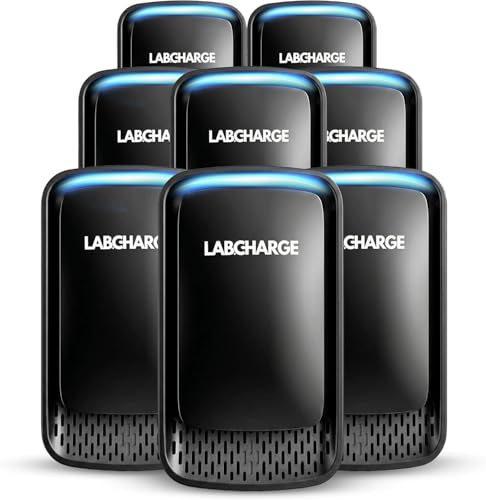
Lab Charge Air Ionizer, 8-Pack is the largest pack, with eight plug-in ionizers for buyers setting up more rooms or keeping spares. Each black unit measures 3.5 × 1.5 × 2.0 inches and is listed for 250 square feet. The maker says its negative-ion design has no fan or replaceable filter. That filterless construction is the distinguishing point, not a substitute for a purifier that draws air through a filter. If you need measurable particle removal through HEPA filtration or adjustable fan circulation, this small ionizer is the wrong type to compare on those terms.
Bottom line: Choose this pack if you need eight small ionic units rather than a filtered purifier.
How to choose a Lab Charge air purifier pack
Choose by the number of units you can place and plug in, not by assuming the pack size increases coverage per device. The three ionic options each list 250 square feet and dimensions of 3.5 × 1.5 × 2.0 inches; pack count is the difference. For a room larger than 250 square feet, a single unit is outside its coverage, so consider a larger-capacity purifier or a correctly sized filtered unit. Measure outlet placement and nearby furniture before choosing a plug-in device: blocking an air inlet can limit circulation, and an outlet behind a curtain or cabinet is a poor location. These are ionizers, not conventional fan-driven HEPA purifiers.
Ionic purifiers versus HEPA filters
Ionizers charge particles so they can settle onto surfaces, while HEPA purifiers pull air through a filter that captures particles. A true HEPA filter is defined to remove at least 99.97% of particles at 0.3 microns under specified test conditions; that figure is not a claim about these Lab Charge ionizers. Ionization can leave settled material on floors and furniture, so it does not eliminate the need for normal dusting and vacuuming. Some ionizing air cleaners can produce ozone, a lung irritant; check the specific device’s ozone emissions and applicable safety certification before choosing one for occupied rooms. If filter-based particle capture is the goal, choose a model that identifies its filter and a suitable clean-air delivery rate.
Room coverage and placement
Room coverage figures are useful only when paired with airflow or clean-air delivery data and assumptions about room height and air changes. A 250-square-foot figure alone does not tell you how quickly particles are removed, so avoid treating it as equivalent to the coverage of a fan-driven purifier with a published CADR. Place an ionizer in an open outlet away from curtains, furniture, and damp areas; keep cords and devices out of children’s reach. For a room with a ceiling higher than the common 8-foot assumption, square footage understates the air volume and may overstate suitability. A measurable rule: if the room exceeds 250 square feet, do not rely on one of these units as the sole device based on its coverage.
Frequently Asked Questions
Do Lab Charge ionic purifiers have HEPA filters?
The Lab Charge options here are described as ionic and filterless, so they do not use a replaceable HEPA filter. A true HEPA filter captures at least 99.97% of particles at 0.3 microns under specified test conditions.
Can an ionizer replace a HEPA air purifier?
No, an ionizer and a HEPA purifier work differently: ionizers charge particles, while HEPA units draw air through a filter. If capturing particles in a filter is your priority, choose a filtered purifier with a suitable CADR for the room.
How many square feet does each Lab Charge unit cover?
Each option lists coverage of 250 square feet per unit. For a room larger than 250 square feet, do not rely on one unit as the sole purifier based only on that coverage figure.
Do air ionizers produce ozone in a bedroom?
Some ionizing air cleaners can produce ozone, which can irritate the lungs. Check the exact device’s ozone emissions and safety certification before using an ionizer in an occupied bedroom.
Where should I place a plug-in air ionizer?
Place a plug-in ionizer in an open outlet with space around it, rather than behind curtains or furniture. Keep it away from damp areas and where children can reach or pull it.