
Starting Fluid for Small Engines: 4 Options Compared

Lucas Oil Sure Start 10.7 oz is the clearest match for small engines because its maker names lawn mowers, chainsaws, outboard motors and fractional-horsepower engines among its uses. Choose a different option if you need a two-can bundle or prefer an 11-ounce can.
Starting fluid is a volatile spray used to help an engine ignite; for small equipment, check the owner’s manual before use because some engines prohibit it.
We earn a commission if you buy through links on this page. As an Amazon Associate I earn from qualifying purchases. Products are compared on manufacturer specifications, not hands-on testing.
- Best overall: Lucas Oil Sure Start 10.7 oz – Its maker specifically names lawn mowers, chainsaws, outboard motors and fractional-horsepower engines.
- Best for stocking up: 6762 Starting Fluid 2-Pack – The package includes two 10.7-ounce cans and names lawn mowers and tractors.
- Best for an 11-ounce can: Valvoline Starting Fluid 11 oz – The can holds 11 fluid ounces and includes an upper-cylinder lubricant.
| Product | Best for | Can size | Named small-engine uses | Cold-weather claim | Shop |
|---|---|---|---|---|---|
| Lucas Oil Sure Start 10.7 oz | Small-engine range | 10.7 oz | Mowers, chainsaws, outboards | To -65°F | Check Price on Amazon |
| 6762 Starting Fluid 2-Pack | Two-can supply | Two 10.7 oz cans | Mowers, tractors, ATVs | Sub-zero conditions | Check Price on Amazon |
| Valvoline Starting Fluid 11 oz | Lubricant included | 11 fl oz | — | Cold-weather start claim | Check Price on Amazon |
| Johnsen’s 6762 Starting Fluid 10.7 oz | Basic can size | 10.7 oz | — | — | Check Price on Amazon |
Starting Fluid for Small Engines
Compare the can sizes, engine applications and cold-weather claims before choosing a formula.
Lucas Oil Sure Start 10.7 oz

Lucas Oil Sure Start 10.7 oz is the most explicit match for small equipment: its maker names lawn mowers, chainsaws, outboard motors and fractional-horsepower engines, alongside passenger cars and diesel engines. The maker says it performs to -65°F and includes an upper-cylinder lubricant. Those stated applications make it the clearest fit for owners choosing a starting fluid for varied small engines.
The limitation is the one-can size; buyers who want two cans in one package should consider 6762 Starting Fluid 2-Pack. Follow the equipment manual’s starting procedure, and do not use starting fluid if the manual prohibits it.
Bottom line: Choose this for its specifically named range of small engines and stated cold-weather performance.
6762 Starting Fluid 2-Pack

6762 Starting Fluid 2-Pack differs by packaging: it supplies two 10.7-ounce cans and names lawn mowers, tractors and ATVs among its applications. Its maker says the formula is for gasoline and diesel engines and supports starting in sub-zero conditions. That combination suits owners maintaining several pieces of equipment or keeping a second can available.
Before spraying, confirm that the equipment manual permits starting fluid; using an unsuitable starting aid can create a fire or engine-damage risk.
Bottom line: Pick this when you want two cans and your equipment is among the named applications.
Valvoline Starting Fluid 11 oz
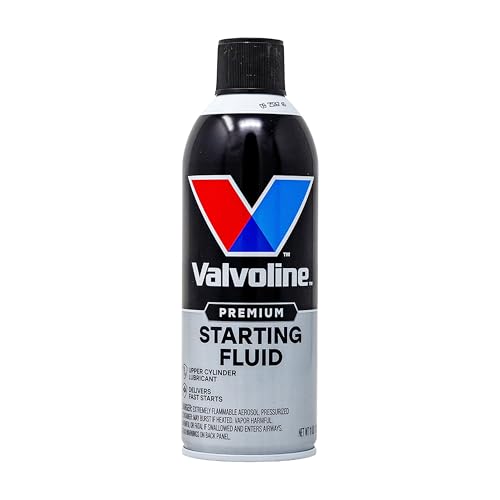
Valvoline Starting Fluid 11 oz stands out for its 11-fluid-ounce can and an upper-cylinder lubricant, which its maker says accompanies the starting aid. The maker also claims cold-weather starting support.
Choose it only after confirming compatibility with the specific equipment. Its 11-ounce can is larger than the 10.7-ounce cans in Johnsen’s 6762 Starting Fluid 10.7 oz and Lucas Oil Sure Start 10.7 oz, but can size alone does not establish that a formula is suitable for a given engine.
Bottom line: Consider it only when its features suit your needs and the engine manual permits starting fluid.
Johnsen’s 6762 Starting Fluid 10.7 oz

Johnsen’s 6762 Starting Fluid 10.7 oz is a straightforward 10.7-ounce can of starting fluid, without a small-engine application or cold-weather performance claim in its specifications. Its package weight is 0.88125 pounds, but that figure is not the amount of fluid in the can. Buyers looking for explicit compact-equipment coverage have a clearer match in Lucas Oil Sure Start 10.7 oz, whose maker names several small-engine types.
This option may suit someone comparing a standard-size can, provided the engine maker allows starting fluid. Do not treat a starting fluid spray as a substitute for checking the choke, primer or fuel supply when an engine will not start.
Bottom line: Choose it only when you need a 10.7-ounce can and have confirmed engine compatibility.
How to choose starting fluid for small engines
Start with the engine manual, then match the product’s named applications to your equipment. Small gasoline engines often rely on a choke or primer to enrich the fuel mixture; use that starting system as directed before reaching for a volatile spray. A measurable decision rule is simple: if the manual says not to use starting fluid, do not spray it, even in cold weather. If a product names the exact equipment type, that is a stronger fit than a general starting claim. Also consider whether one can or a two-can package suits the number of engines you maintain. Starting fluid is highly flammable, so keep it away from sparks, open flames and hot surfaces, and use it only as the engine maker allows.
Starting fluid compatibility and engine type
Engine type determines whether starting fluid is appropriate; a can’s cold-weather claim does not establish compatibility. Some diesel engines use glow plugs or intake heaters, and ether-based starting aids can ignite prematurely around those hot components. Avoid starting fluid on an engine with glow plugs or an intake heater unless its manufacturer expressly approves the specific product and procedure. For small gasoline equipment, a failed start often points first to choke position, primer operation, stale fuel or a clogged air filter. Correct those basic issues rather than repeatedly spraying. A product that names lawn mowers or chainsaws gives a more direct application match than one whose uses do not identify small engines.
Cold-weather starts without overusing spray
Cold weather slows fuel vaporization and can make an engine harder to start, but repeated starting fluid bursts are not a safe fix. Use the manufacturer’s cold-start sequence, including the correct choke setting and any primer bulb, and let the engine rest between attempts. Starting fluid makers may give a temperature claim, such as an operating limit, but that claim does not override an equipment manual’s restrictions. If the engine still will not start after the specified procedure, inspect ordinary causes such as fuel condition, a wet or fouled spark plug, and airflow. Keep cans upright and away from ignition sources, and never spray toward a running engine or exposed electrical spark.
Starting fluid options by intended use
Application wording and package format separate these options more clearly than can dimensions. Use this guide to identify which specifications align with your need, then verify that the engine manufacturer permits the product before use.
| Need | Closest match | Reason |
|---|---|---|
| Named mower, chainsaw or outboard use | Lucas Oil Sure Start 10.7 oz | Maker names those engine types and fractional-horsepower engines. |
| Two cans and mower or tractor use | 6762 Starting Fluid 2-Pack | Two 10.7-ounce cans; maker names lawn mowers and tractors. |
| 11-fluid-ounce can with lubricant | Valvoline Starting Fluid 11 oz | Can size and upper-cylinder lubricant are specified. |
| Single 10.7-ounce can | Johnsen’s 6762 Starting Fluid 10.7 oz | Can size is specified. |
Frequently Asked Questions
Can starting fluid be used on a lawn mower?
Only if the mower manufacturer permits it. First use the mower’s normal cold-start steps, including the specified choke or primer setting; a product naming lawn mowers is a clearer match, but does not replace the manual’s instructions.
Is starting fluid safe for a small diesel engine?
Not around glow plugs or intake heaters unless the engine maker explicitly approves the particular starting aid and procedure. Ether can ignite on hot components, so check the engine type before spraying.
Why does a small engine need a choke in cold weather?
A choke enriches the air-fuel mixture, helping a cold gasoline engine start when fuel vaporizes less readily. Use the engine’s specified choke position and open it as directed after the engine catches.
How should starting fluid be stored around yard equipment?
Store the can away from heat, sparks and open flames because starting fluid is highly flammable. Keep it in its original container and follow its label’s storage and disposal precautions.
What should I check before using starting fluid on a chainsaw?
Check the chainsaw manual for approval and its cold-start procedure first. A chainsaw’s chain must also remain clear of people and objects during starting, with the saw secured as the maker directs.