
Queenmew Anti Barking Device: Models Compared

For a Queenmew anti barking device, choose Queenmew 4-Transmitter Bark Deterrent if you want the 50-foot range and four transmitters; it also provides three modes. Choose a different option if solar charging, additional modes or a longer range matters more.
Ultrasonic bark deterrents detect or respond to barking and emit high-frequency sound as a training cue; results can vary with the dog and setting.
We earn a commission if you buy through links on this page. As an Amazon Associate I earn from qualifying purchases. Products are compared on manufacturer specifications, not hands-on testing.
- Best overall: Queenmew 4-Transmitter Bark Deterrent – Its four transmitters and stated 50-foot range suit broader coverage.
- Best for more modes: Queenmew 4-Mode Bark Deterrent – It offers four selectable training modes and four transmitter heads.
| Product | Best for | Modes | Range | Charging | Shop |
|---|---|---|---|---|---|
| Queenmew 4-Transmitter Bark Deterrent | Broad coverage | 3 | 50 ft | — | Check Price on Amazon |
| Queenmew 4-Mode Bark Deterrent | Mode flexibility | 4 | 50 ft | Type-C | Check Price on Amazon |
| Queenmew Rechargeable Bark Deterrent | Long battery claims | 3 | — | Rechargeable | Check Price on Amazon |
Queenmew anti barking devices
Compare the Queenmew options by their coverage, modes and power features.
Queenmew 4-Transmitter Bark Deterrent
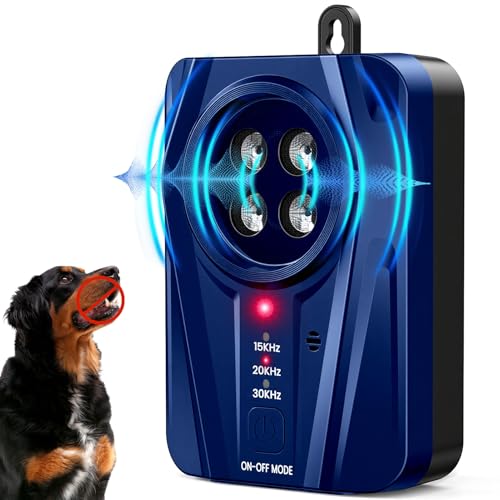
Four ultrasonic transmitters and a 50-foot range distinguish this Queenmew model from the other options. It has three adjustable modes and detects barking to activate its output, making it a fit for buyers who want automatic operation across a yard or room. The maker describes its frequency range as 15–30 kHz. Ultrasonic response can differ among dogs, and the maker advises allowing up to two weeks for training; this approach may not suit a dog that is unsettled by the sound.
Bottom line: Choose this if four emitters and a 50-foot range match your coverage needs.
Queenmew 4-Mode Bark Deterrent

Four selectable training modes set this version apart from Queenmew’s three-mode models. The maker says it can address barking and other unwanted behaviors, but the strongest product-specific distinction is the extra mode choice. Dogs do not all respond to ultrasonic cues, so owners seeking a guaranteed response should consider another training approach.
Bottom line: Pick this when a fourth mode and Type-C charging matter more than solar power.
Queenmew Rechargeable Bark Deterrent

A battery runtime of up to 30 days on a full charge is the defining feature of this Queenmew model. It uses a 1,500 mAh rechargeable battery and can be hung or placed indoors or outdoors, with three modes in its name. The maker positions its ultrasonic cue as a non-contact training aid.
Bottom line: Choose this if the up-to-30-day battery claim is your main priority.
How to choose a Queenmew bark deterrent
Start with the coverage distance and the number of emitters, then weigh charging and mode count. Ultrasonic devices generally work by emitting high-frequency sound when a microphone detects barking; placement and obstructions can affect how well sound reaches the dog. A 50-foot claim is a maximum-style figure, not a guarantee through walls or dense landscaping. For open-yard coverage, position the unit with an unobstructed path toward the barking area; for a room, a shorter clear path is often easier to manage. Choose a model with a range if your target area is more than 20 feet away, and verify the actual placement distance before relying on it.
| Need | Feature to prioritize | Tradeoff |
|---|---|---|
| Wider coverage | Multiple transmitters | Range still depends on placement |
| Less frequent charging | Long stated battery runtime | Runtime depends on use |
| Outdoor power flexibility | Solar plus Type-C | Solar contribution depends on sun |
Ultrasonic range and placement
Ultrasonic sound is directional and can be blocked or weakened by solid barriers, so line of sight matters more than the number on a package. Typical consumer bark deterrents claim ranges from about 15 to 50 feet, but actual reach can vary with room layout, outdoor noise and device orientation. Keep the unit aimed toward the dog’s usual barking location rather than a neighboring property or shared walkway. For a dog farther than 50 feet away or behind a wall, a single ultrasonic unit is a poor fit; choose a closer placement or another training method. Avoid placing sound-producing equipment where people or animals who are not part of the training are routinely exposed.
Using bark deterrents as training cues
An ultrasonic device is a cue, not a substitute for identifying why a dog barks. Territorial alerts, fear, boredom and separation distress call for different responses, and startling a worried dog can worsen the underlying problem. Pair any bark cue with reward-based training: mark and reward quiet behavior, then gradually practice around the trigger at a manageable distance. Keep sessions short, around 5 to 10 minutes, and stop if the dog shows distress, avoidance or agitation. A dog that barks persistently when alone or reacts fearfully needs a behavior plan from a qualified trainer or veterinarian rather than a stronger sound setting.
Charging and outdoor care
Rechargeable models need a regular charging routine, while solar-assisted units rely on adequate direct light to supplement their battery. Keep charging ports dry, inspect cables for damage and bring electronic devices inside during severe weather unless their weather rating supports outdoor exposure. Do not assume “outdoor” means waterproof: look for an IP rating such as IPX4 or higher when rain exposure is expected. A unit with no stated weather rating should be installed under shelter and checked after wet conditions. Clean dust from emitter openings with a dry cloth, because blocked openings can alter sound output.
Frequently Asked Questions
How far away should the device be placed?
Place an ultrasonic deterrent within its range and with a clear path to the dog. Solid walls and dense barriers can reduce reach, so a 50-foot claim should not be treated as reliable through obstructions.
Can ultrasonic bark devices work through walls?
Ultrasonic sound is readily blocked by solid walls, so these devices are most suitable for a direct, unobstructed path. Place the unit in the same room or open area as the dog rather than relying on sound passing between rooms.
How long does bark training usually take?
Behavior change often takes several weeks of consistent practice, and a deterrent alone may not address the reason for barking. Short sessions of 5 to 10 minutes paired with rewards for quiet behavior are more useful than repeated exposure to a sound cue.
Are ultrasonic devices safe around every dog?
No sound-based training cue suits every dog, and some dogs may become fearful or agitated. Stop use if a dog shows distress, and use reward-based training or consult a qualified professional instead.
Should an outdoor bark deterrent stay in the rain?
Only leave an electronic deterrent exposed when its weather rating supports the conditions. Without an IP rating, place it under shelter and protect its charging port from moisture.