
Best Solar Deer Repellent: 5 Devices Compared by Fit

The best solar deer repellent for most yards is Solar Deer Repellent 4-Pack, because its 110-degree sensor detects motion up to about 30 feet and the four-pack lets you cover several approach routes. Choose Solar Ultrasonic Repellent 2-Pack instead for its 150-degree detection angle, or G-Jyuncyou Solar Deer Repellent 4-Pack if the 18–45 kHz range and 1,300-lux strobe matter more.
Solar ultrasonic repellents trigger sound and often flashing lights when motion is detected; results can vary as animals adapt or approach from outside the sensor zone.
We earn a commission if you buy through links on this page. As an Amazon Associate I earn from qualifying purchases. Products are compared on manufacturer specifications, not hands-on testing.
- Best overall: Solar Deer Repellent 4-Pack – Four devices, a 110-degree PIR sensor and detection up to about 30 feet.
- Best for wide detection: Solar Ultrasonic Repellent 2-Pack – Its infrared detection angle reaches 150 degrees, with a 25–30-foot range.
- Best for specified output: G-Jyuncyou Solar Deer Repellent 4-Pack – It specifies 18–45 kHz ultrasonic waves and 1,300-lux strobe lights.
| Product | Best for | Pack size | Detection angle | Detection range | Shop |
|---|---|---|---|---|---|
| Solar Deer Repellent 4-Pack | Most yard routes | 4 devices | 110° | Up to approx. 30 ft | Check Price on Amazon |
| Solar Ultrasonic Repellent 2-Pack | Broad sensor angle | 2 devices | Up to 150° | 25–30 ft | Check Price on Amazon |
| G-Jyuncyou Solar Deer Repellent 4-Pack | Specified light output | 4 devices | — | — | Check Price on Amazon |
| Solar Ultrasonic Repellent 4-Pack | USB backup charging | 4 devices | — | — | Check Price on Amazon |
| Broox Solar Animal Repellent | Single-device setup | 1 device | — | — | Check Price on Amazon |
Solar Deer Repellent Devices
Compare the detection features and pack sizes, then place devices along the routes deer use to reach plants.
Solar Deer Repellent 4-Pack

Four units and a defined motion-sensing area make this set a practical fit for covering multiple approach routes. Each device uses a 110-degree PIR sensor with detection up to approximately 30 feet under suitable conditions; motion triggers ultrasonic output and a white flashing LED. The maker says it is IP65 rated, and the unit is intended for solar outdoor use. Place units near the paths leading to beds, young trees, or landscaping. Its detection figure is conditional, so yards with dense vegetation, uneven terrain, or obstructed views may need closer spacing.
Bottom line: Choose this set to cover several yard approaches with sensor range.
Solar Ultrasonic Repellent 2-Pack
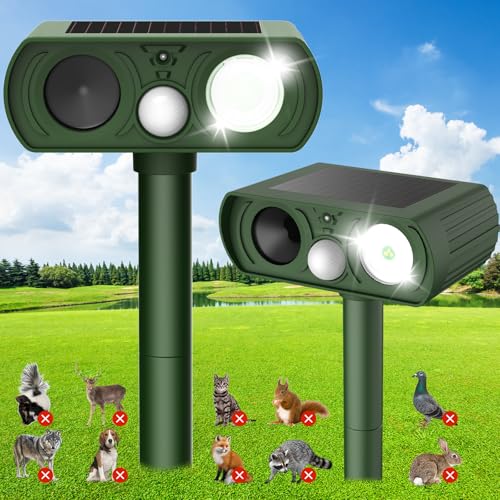
The 150-degree infrared detection angle is the standout here, wider than the angles for the other models. Two devices use motion-triggered ultrasonic sound and flashing LED strobe lights, with a detection range of 25–30 feet. The maker presents it as a deterrent for deer and several other animals, including squirrels, rabbits, raccoons, dogs, and cats. This set suits a smaller area or a buyer prioritizing a broad sensor view. Its two-unit pack has fewer devices than the four-packs, which matters when you need to cover several separated routes.
Bottom line: Pick this set where a wide detection angle matters more than device count.
G-Jyuncyou Solar Deer Repellent 4-Pack

The combination of a ultrasonic frequency range and quantified strobe output sets this four-pack apart: the maker specifies 18–45 kHz sound and 1,300-lux lights. The product also has an 1,800 mAh battery, solar charging, USB-C backup charging, and an IP65 rating. This may suit buyers who want output and charging specifications rather than a sensor angle or range. The maker does not establish how much area each device covers, so plan placement around the garden routes you want to monitor rather than assuming a particular radius.
Bottom line: Choose it if quantified sound and strobe specifications are your priority.
Solar Ultrasonic Repellent 4-Pack

Solar charging plus an included USB backup cable distinguishes this four-pack from the models with specifically named USB-C charging. The motion sensor activates variable-frequency ultrasonic waves and a red indicator light, according to the maker; the maker names deer, raccoons, squirrels, and cats among the targets. The four units may suit a yard with multiple entry points. The maker does not give a detection angle or distance, so buyers who need to lay out coverage precisely should confirm the sensor range before ordering.
Bottom line: Pick this pack if having an included USB backup cable is useful.
Broox Solar Animal Repellent
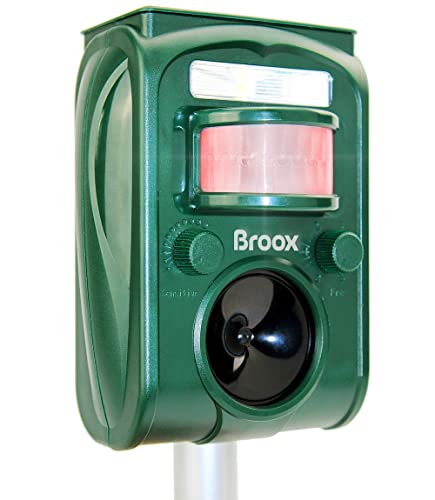
A single device makes this a simpler choice for one focused area instead of a multi-route setup. The maker says motion detection triggers ultrasonic sound and flashing LED light, and identifies deer, cats, squirrels, dogs, raccoons, skunks, rabbits, and rodents as target animals. Its IP65 rating is stated in the product name.
Bottom line: Choose one device for a single area rather than broad yard coverage.
How to choose solar deer repellent
Choose by sensor coverage first, then by how many separate approach routes need monitoring. A motion-triggered unit responds only when an animal crosses its sensor field; a 110-degree field and 30-foot range give a more concrete planning basis than a model without those figures. For a bed with approaches on two sides, orient a sensor toward each route rather than aiming both at the plants. Sound-and-light models combine two cues, but deer may become accustomed to a repeated stimulus, so moving devices periodically and pairing them with physical barriers can help avoid relying on one deterrent alone.
Solar charging depends on panel exposure, not just the unit being outdoors. Select a location with direct daylight where possible, and avoid mounting behind dense foliage or under an overhang that shades the panel. Keep the sensor’s view clear of moving branches that could trigger it repeatedly.
Placement and detection range
Place each device so its sensor faces a likely route, not just the center of the area to protect. A range of 25–30 feet is a planning maximum, not a guarantee through leaves, fencing, or uneven ground; shorten the distance when obstacles interrupt the view. A wider angle can cover a broader approach from one position, while several units can address routes from different directions.
Mount the sensor at a height and angle that gives it an unobstructed view of approaching animals; no single height is specified for these devices. Test the detection zone by walking through the intended path and watching for activation, then adjust the aim. Leave enough space between units to avoid assuming their coverage overlaps perfectly.
| Need | Selection cue |
|---|---|
| Several separated routes | Four-device pack |
| Broad view from one position | Stated angle up to 150° |
| Known sensor distance | Stated range of about 25–30 ft |
| One focused zone | Single-device setup |
Ultrasonic sound and flashing lights
Ultrasonic deterrents emit high-frequency sound when motion is detected, and some pair it with flashing lights. One model specifies 18–45 kHz sound and 1,300-lux strobe output; other products describe their sound as ultrasonic without giving a frequency range. These are deterrent signals, not a physical barrier, so a device cannot block access the way fencing can.
Use sound-and-light deterrents as one part of a yard strategy, especially where deer have multiple routes into beds. Rotate device position if activity continues, and protect vulnerable young plants with barriers while the deterrent is being adjusted. Avoid directing a flashing unit toward neighbors’ windows or places where the light could disturb people.
Solar charging and weather resistance
Solar units need usable daylight to recharge; shade, short winter days, and cloudy stretches can reduce charging opportunity. Some models provide USB backup charging, and one names USB-C with a claimed full charge in about three hours. That charging time is the maker’s claim, not a universal expectation across operating conditions.
An IP65 rating indicates dust-tight protection and resistance to water jets under standardized test conditions, not submersion. Keep ports closed and seals intact, and inspect the housing after harsh weather. Solar-powered does not mean maintenance-free: clear dirt and leaves from the panel so it can receive light, and check that the device remains aimed at the route you intend to monitor.
Frequently Asked Questions
How far away can solar deer repellent detect movement?
The ranges here are about 25–30 feet for two models, with one giving approximately 30 feet under suitable conditions. Treat that as a maximum planning figure and reduce spacing when vegetation or other obstacles block the sensor’s view.
Do ultrasonic deer repellents work through fences?
Do not assume ultrasonic sound or motion sensing works reliably through a solid fence. Place the sensor with a clear view of the animal’s approach, since an obstructed sensor cannot detect movement as intended.
What does an IP65 rating mean outdoors?
IP65 indicates dust-tight construction and protection against water jets, not protection for underwater use. Keep charging ports closed and avoid submerging the device even when it has that rating.
How many solar repellent devices does a garden need?
Start with one device per distinct approach route you need to monitor, then adjust after checking activation. A four-pack is more suitable than a single unit when routes are separated or plants sit on different sides of a yard.
Can deer get used to ultrasonic deterrents?
Deer can become accustomed to repeated deterrents, so do not rely on one fixed sound source as a permanent barrier. Changing device position and protecting high-value plants with fencing adds a different kind of deterrence.