
Best Adjustable Focus Glasses for Near and Distance

PUDOEN Flex Focal Dial Glasses is the best fit for most people who want adjustable focus glasses because its dial spans 0D to +3.50D for near magnification. Choose Vi Shift Adjustable Glasses instead if you need a negative-to-positive range and separate adjustment for each eye.
Adjustable glasses change lens power with a dial; they are not a substitute for a full prescription or safe eyewear for driving.
We earn a commission if you buy through links on this page. As an Amazon Associate I earn from qualifying purchases. Products are compared on manufacturer specifications, not hands-on testing.
- Best overall: PUDOEN Flex Focal Dial Glasses – Its 0D to +3.50D range provides dial-adjusted near magnification.
- Best for separate eye tuning: Vi Shift Adjustable Glasses – Each lens adjusts independently across a -6.00D to +3.00D range.
- Best for a similar alternative: PUDOEN Dial Vision Glasses – It offers the same 0D to +3.50D range as the other PUDOEN option.
| Product | Best for | Adjustment range | Per-eye control | Shop |
|---|---|---|---|---|
| PUDOEN Flex Focal Dial Glasses | Near magnification | 0D to +3.50D | Side dials; per-eye operation unclear | Check Price on Amazon |
| Vi Shift Adjustable Glasses | Different eye powers | -6.00D to +3.00D | Separate adjustment per eye | Check Price on Amazon |
| PUDOEN Dial Vision Glasses | Positive power range | 0D to +3.50D | Side dials; per-eye operation unclear | Check Price on Amazon |
Adjustable Focus Glasses Compared
Compare the lens-power ranges and controls to match adjustable glasses to the way you use them.
PUDOEN Flex Focal Dial Glasses
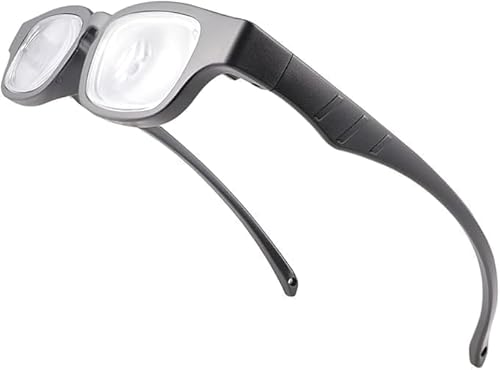
PUDOEN Flex Focal Dial Glasses is a near-magnification option with an adjustment range of 0D to +3.50D. PUDOEN says a dial on each side adjusts the focus, giving readers a way to change magnification rather than select one fixed power. That range suits people whose near tasks call for different levels of help. The specifications do not establish whether each side dial adjusts one eye independently, so buyers who need different powers by eye should confirm that control before ordering. Its range does not cover negative powers.
Bottom line: Pick this for dial-adjusted near magnification within a positive-power range.
Vi Shift Adjustable Glasses

Vi Shift Adjustable Glasses stands apart with separate manual adjustment for each eye and a range from -6.00D to +3.00D per lens. The maker describes it for near and distance viewing, and the frame uses PC lenses. This broader negative-to-positive span may suit someone seeking more adjustment than a near-only positive range provides. The specifications do not establish prescription accuracy or a fit for a particular vision condition; adjustable glasses should not replace an eye exam or prescribed lenses when those are needed.
Bottom line: Choose this when separate lens adjustment and a negative-to-positive range matter.
PUDOEN Dial Vision Glasses

PUDOEN Dial Vision Glasses offers the same 0D to +3.50D range and dial-based focus adjustment as PUDOEN Flex Focal Dial Glasses, making the two PUDOEN choices similar on the specifications provided. The product name positions these as adjustable reading glasses, so the positive range is aimed at near magnification rather than correction for nearsightedness. The specifications do not give a distinct control or lens-range advantage over the other PUDOEN option. Compare the physical fit and intended use before choosing between them, and do not rely on adjustable readers for driving.
Bottom line: Pick this if its positive range matches your near-vision needs.
How to choose adjustable focus glasses
Start with the power range and whether each eye can be adjusted separately. Diopters (D) measure lens power: positive powers add near magnification, while negative powers are used for nearsighted correction. A pair with a positive-only range is not equivalent to a full prescription lens. If one eye needs a different power, individual controls matter; a shared or unclear adjustment may not provide the needed balance. Use a measurable rule: if your prescription includes any cylinder (astigmatism) correction, do not treat adjustable readers as a replacement, because the power ranges do not describe cylinder correction. For changing near tasks, choose a range that covers the strength you actually need rather than assuming the broadest range is automatically suitable.
Reading distance and fit
Set the glasses for the distance you use most: typical close reading is about 14 to 16 inches from the eyes, while computer work is often around 20 to 28 inches. A single setting may not feel clear at both distances, so adjust focus for the actual task and avoid judging fit from a screen held much closer than normal. Frame fit also affects usable vision: the lenses should sit level and remain centered in front of the eyes when you look straight ahead. If the glasses slide, tilt, or force an unusual head position, the power adjustment cannot fix that fit problem. Confirm frame fit and any vision prescription needs before relying on adjustable glasses for extended work.
Adjustable readers versus prescription glasses
Adjustable readers change focus through a manual mechanism, while prescription glasses are made to correct the measured needs of each eye. Standard reading glasses generally use one fixed positive power in both lenses; they are most appropriate when near magnification is the only correction needed. A prescription can also account for differences between eyes, astigmatism, and distance vision. Do not use adjustable readers for driving or other distance-critical tasks unless an eye-care professional has confirmed they provide the required correction. A useful decision rule is to choose prescription eyewear if you need cylinder correction or reliable distance correction, and reserve adjustable readers for near tasks when that use is appropriate.
Using adjustable glasses safely
Adjust the lenses while stationary and looking at a fixed target, not while walking, driving, or operating equipment. A sudden change in lens power can make the view feel distorted until you settle on a setting, and readers can blur distance vision. Use a book or screen at its normal working distance, adjust each side as intended, and stop if the view remains uncomfortable or doubled. Never assume a dial setting corresponds to a verified prescription: power labels alone do not establish a complete eye exam or correction. If vision changes suddenly, or one eye remains blurred at every setting, arrange an eye-care evaluation rather than continuing to increase magnification.
Frequently Asked Questions
Can adjustable focus glasses replace prescription glasses?
No, adjustable glasses should not be treated as a complete prescription. A full prescription can include cylinder correction for astigmatism and different powers for each eye, which a simple power range does not establish.
Are adjustable reading glasses safe for driving?
No, do not use adjustable readers for driving unless an eye-care professional confirms they provide the distance correction you need. Positive reading power is intended for near magnification and can blur distant objects.
What distance should I use to adjust reading glasses?
Use the distance at which you normally read, commonly about 14 to 16 inches from your eyes. Computer viewing is often farther away, around 20 to 28 inches, and may need a different focus setting.
What does the D number mean on adjustable glasses?
D means diopter, a measure of lens power. Positive values add magnification for near viewing, while negative values are used for nearsighted correction; neither alone describes every part of a prescription.