
Plastic Chain Guard for Bicycle: Fit and Mounting Compared

For a plastic chain guard for a bicycle, choose NUOBESTY Plastic Chain Guard if you need a guard described for both mountain and road bikes; the fit decision is whether its mounting points match your bike. Choose a different option if you need a defined chainring size or bolt pattern, since those guards specify narrower fit criteria.
We earn a commission if you buy through links on this page. As an Amazon Associate I earn from qualifying purchases. Products are compared on manufacturer specifications, not hands-on testing.
- Best overall: NUOBESTY Plastic Chain Guard – Its use covers both mountain and road bikes.
- Best for 32-tooth discs: Yardwe 32-Tooth Plastic Guard – It specifies a 32-tooth disc and measures about 15.3 inches long.
- Best for 48-tooth setups: HLGHLG 48-Tooth 4-Bolt Guard – It specifies a 48-tooth chainring and 4.72-inch adjacent-hole spacing.
| Product | Best for | Length | Fit / tooth count | Weight | Shop |
|---|---|---|---|---|---|
| NUOBESTY Plastic Chain Guard | Road and mountain bikes | — | Road and mountain bikes | — | Check Price on Amazon |
| VOSAREA Plastic Chain Cover | Measured replacement fit | 15.35 in | — | 0.42 lb | Check Price on Amazon |
| Yardwe 32-Tooth Plastic Guard | 32-tooth chainrings | 15.3 in | 32 teeth | 0.42 lb | Check Price on Amazon |
| HLGHLG 48-Tooth 4-Bolt Guard | 48-tooth chainrings | 8.15 in | 48 teeth; 4 holes | 0.26 lb | Check Price on Amazon |
Plastic chain guards for bicycles
Compare each guard’s use and dimensions with your chainring and frame mounting points before choosing.
NUOBESTY Plastic Chain Guard

NUOBESTY is the only option explicitly described for both mountain and road bikes. Its black plastic cover is intended to shield clothing from chain grease, and the maker describes installation as possible without tools. That makes it a reasonable starting point when you want a general cover rather than one defined by a particular tooth count. Its dimensions and weight are unavailable, so replacement buyers should verify the mounting fit before choosing.
Bottom line: Choose it for broadly described road- or mountain-bike use after confirming mounting fit.
VOSAREA Plastic Chain Cover
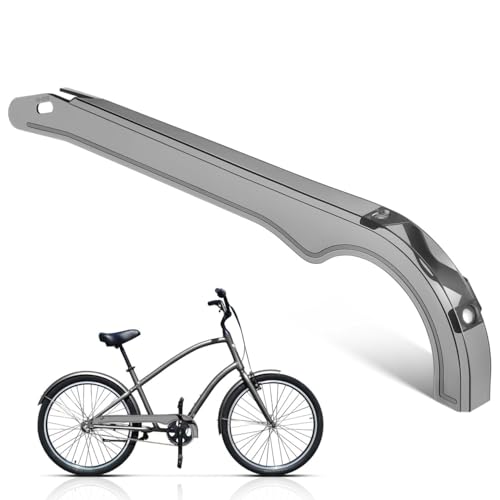
VOSAREA provides dimensions for a black plastic cover: 15.35 inches long, 3.94 inches wide, and 0.98 inch high. It weighs about 0.42 pound, giving replacement buyers a concrete size and weight to compare with an existing cover. The maker describes its surface as oil-resistant and the cover as easy to install. Those dimensions do not establish attachment compatibility, however; check mounting-hole positions and available space before relying on overall length as a fit match.
Bottom line: Pick it when its dimensions match the cover you are replacing.
Yardwe 32-Tooth Plastic Guard
Yardwe is specified for a 32-tooth gear disc and measures about 15.3 inches long, 3.93 inches at its highest section, and 0.98 inch wide. Its plastic body covers part of the chain and drivetrain area, unlike a small plate focused on the chainring. The weight is about 0.42 pound. Multiple mounting openings are built in, but hole positions and frame layouts vary, so tooth count alone cannot establish a secure replacement fit.
Bottom line: Choose it for a 32-tooth disc only when its mounting points align.
HLGHLG 48-Tooth 4-Bolt Guard

HLGHLG is a compact chainring guard with a specific four-bolt fit: adjacent holes must be 4.72 inches apart center to center, and the chainring must have 48 teeth. Its PC plastic construction is described by the maker as helping block grease and shielding the chainring from impacts. At 8.15 inches, it is much shorter than a long cover, so it will not provide the same chain-path coverage. Measure the bolt spacing before choosing this narrowly fitted option.
Bottom line: Pick it for a 48-tooth chainring with matching four-bolt spacing.
How to choose a plastic bicycle chain guard
Choose a guard by matching its attachment pattern and chainring coverage, not by appearance alone. Chain guards range from large covers around a section of chain to small outer plates that shield only the chainring; the coverage determines whether clothing near the chain or the chainring itself is protected. Count the chainring teeth and measure adjacent mounting holes center to center before replacing a part. A 32-tooth or 48-tooth fit is not interchangeable, and bolt spacing must agree as well. If the replacement is a full-length shell, compare its length and height with the old part and check for clearance from the frame and drivetrain.
Chain guard sizing and mounting fit
Mounting-hole position is the decisive fit check because frame and chainring configurations differ. Measure from the center of one hole to the center of the adjacent hole, then compare that measurement with the guard’s pattern; diagonal spacing is a separate measurement and cannot substitute. Also check the chainring tooth count and the cover’s physical reach. As a practical rule, do not assume a guard fits merely because its length is close: a mismatch in hole placement prevents secure mounting. For replacement shells, compare overall length, maximum height, and width with the available space around the chain and frame.
| Guard type | Best fit check | Coverage focus |
|---|---|---|
| Full-length shell | Length and frame mounting points | Part of chain and drivetrain |
| Chainring plate | Tooth count and bolt pattern | Outer chainring area |
| Compact bash guard | Tooth count and exact bolt spacing | Chainring impact shielding |
Full chain covers versus chainring guards
A full chain cover and a chainring guard solve related but different problems. A shell extends along more of the chain path and can help keep chain grease away from clothing, while an outer plate sits at the chainring and does not enclose the chain. Bash guards add impact shielding around the chainring, but their mounting pattern and tooth-count fit are especially important. Riders replacing a long shell should compare its coverage and attachment points rather than selecting a small plate that only fits the chainring. Choose the guard style based on the area that needs coverage and the mounting hardware already on the bicycle.
Installing and maintaining a bicycle chain guard
A guard should sit securely without rubbing the chain, chainring, or frame during a full pedal rotation. Before riding, turn the crank slowly by hand and listen for contact; rubbing signals that the guard needs repositioning or is the wrong shape. Recheck fasteners after the first ride and periodically thereafter, since vibration can loosen hardware. Keep the guard clean enough to spot cracks or loose mounting points; plastic can split after impact or age. A damaged or unstable guard should not be relied on to contain chain movement or protect clothing.
Frequently Asked Questions
How do I measure bicycle chain guard bolt spacing?
Measure center to center from one mounting hole to the adjacent hole, keeping the ruler aligned across the centers. Record diagonal spacing separately because it is a different measurement, and compare the result with the guard’s pattern.
Does a 32-tooth chain guard fit a 48-tooth chainring?
Not necessarily; a guard designed around 32 teeth may not reach or align correctly on a 48-tooth chainring. Match tooth count and mounting-hole spacing before choosing a replacement.
Can a chain guard fit any bicycle frame?
No, frame mounting points and available clearance vary between bicycles. Check that the guard holes align and that the shell clears the chain and frame through a full crank rotation.
What is the difference between a chain cover and a bash guard?
A chain cover extends along part of the chain path to help shield clothing from grease, while a bash guard focuses on the chainring area and impact shielding. Some designs overlap in purpose, but their coverage and mounting patterns differ.
How can I tell if a bicycle chain guard is rubbing?
Turn the crank slowly through a complete rotation and listen or feel for repeated contact with the chain, chainring, or frame. Persistent rubbing indicates a fit or alignment problem that should be corrected before riding.