
Tools for Timing Belt Jobs: 5 Kits by Engine Fit

For most buyers, the 3830 kit is the clearest match when the job is on a 2015-or-newer VW TDi EA288 with CVCA or CRUA engine codes. Timing belt tools hold engine components in position during timing work, but fit depends on the exact engine and vehicle; choose another kit if your engine falls outside those codes.
We earn a commission if you buy through links on this page. As an Amazon Associate I earn from qualifying purchases. Products are compared on manufacturer specifications, not hands-on testing.
- Best overall: 3830 EA288 TDi Timing Tool Kit – Its 2015+ EA288 fit identifies the CVCA and CRUA engine codes and compatible VW models.
- Best for Ford engines: Yuesstloo Ford Timing Locking Tool Kit – The kit covers a broad range of Ford engine sizes and timing-tool references.
- Best for Chevy and Fiat: OMT Chevy Fiat Camshaft Locking Kit – It is built around 16V 1.6L and 1.8L applications and includes heat-treated carbon-steel parts.
| Product | Best for | Engine coverage | Set size | Shop |
|---|---|---|---|---|
| 3830 EA288 TDi Timing Tool Kit | VW TDi EA288 | 2015+ CVCA / CRUA | — | Check Price on Amazon |
| Yuesstloo Ford Timing Locking Tool Kit | Ford engine range | Ford 1.25–2.5L | 10 pieces | Check Price on Amazon |
| VW Audi SEAT Skoda TDI Timing Kit | VW-group TDI fit | VW-group 1.4–2.0L TDI | — | Check Price on Amazon |
| OMT Chevy Fiat Camshaft Locking Kit | Chevy Fiat engines | Chevy / Fiat / Alfa Romeo 1.6–1.8L 16V | — | Check Price on Amazon |
| Ford 18-Piece Timing Tool Kit | Ford 18-piece set | Ford 1.25–2.5L | 18 pieces | Check Price on Amazon |
Tools for Timing Belt Work
Match the engine code and vehicle application before choosing a timing tool kit; similar displacement alone does not ensure fit.
3830 EA288 TDi Timing Tool Kit
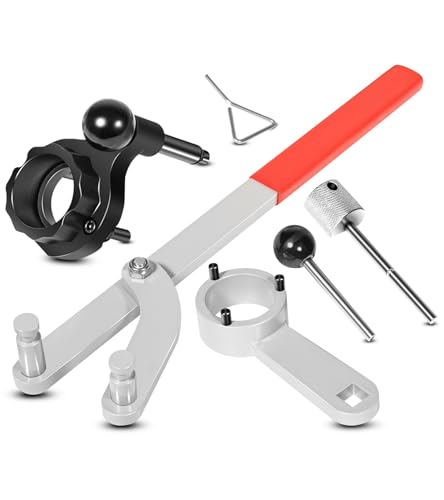
The 3830 kit is the most specifically identified option here for 2015-or-newer VW TDi EA288 engines: its fit names the CVCA and CRUA codes. The maker says the set is designed to lock and time these engines for timing belt and water pump work, and gives replacement references including T10172, T10490 and T10492. It suits owners or technicians working on the Jetta, Golf, Golf Sportwagen, Beetle or Passat TDi applications. Its limitation is narrow coverage: confirm both the engine code and model fit before choosing it for another VW or Audi.
Bottom line: Choose it for a 2015+ VW TDi with a CVCA or CRUA engine.
Yuesstloo Ford Timing Locking Tool Kit

The Yuesstloo kit is the broad Ford-oriented choice, spanning several listed engine families from 1.25L through 2.5L and including selected EcoBoost and TDCi engines. Its 10-piece set is intended to lock camshafts and hold the engine at top dead center during timing service; listed tool references include 303-1097 and 303-748. It suits Ford owners whose engine appears in the compatibility range, including some Fiesta, Focus, Fusion and Escape applications. The important limitation is that displacement alone is not enough: the kit explicitly excludes the 2.3T, so verify the exact engine variant before starting work.
Bottom line: Choose it when your Ford engine variant is within the fit range.
VW Audi SEAT Skoda TDI Timing Kit

This VW-group kit stands apart by naming VW, Audi, SEAT and Skoda 1.4L, 1.6L and 2.0L TDI applications, plus references such as T10265, T10060A, T10051 and T10490. The vehicle coverage includes numerous Audi, SEAT and Volkswagen models, making it relevant when a job falls outside the narrower 2015+ CVCA/CRUA kit’s fit. It suits buyers identifying their engine by the relevant TDI application and tool reference. The vehicle list is extensive but the model-year ranges vary, so check the exact engine and vehicle combination rather than relying on the badge alone.
Bottom line: Choose it for a compatible VW-group TDI application outside the CVCA/CRUA-only fit.
OMT Chevy Fiat Camshaft Locking Kit

The OMT kit is the only option here aimed at Chevrolet, Fiat and Alfa Romeo 16V engines, with 1.6L and 1.8L coverage for 2003–2012 applications. Its parts include heat-treated carbon steel and chrome, plus a powder-metallurgy camshaft gear lock and flywheel spanner. That combination makes it the relevant pick when the vehicle’s engine and service procedure match those applications. The range is narrower than the Ford and VW-group kits, and the fit wording does not identify every specific engine code or model; confirm those match before relying on it for a timing job.
Bottom line: Choose it for a matching 2003–2012 Chevy, Fiat or Alfa Romeo 16V application.
Ford 18-Piece Timing Tool Kit

This 18-piece kit differentiates itself from the other Ford option with a set size and a broad combination of petrol, diesel and EcoBoost applications. The maker says its tools lock and align the camshaft, crankshaft and belt tensioner, and support adjustment of the VTC device. Listed engines include Ford Duratec petrol units from 1.25L to 2.5L, Duratorq diesel units from 1.4L to 2.0L, and selected EcoBoost variants. It suits someone who wants the larger stated set and has one of those engine types. The limitation is fit ambiguity across variants, so verify the exact engine application before selecting it.
Bottom line: Choose it for a matching Ford application when the 18-piece set is the priority.
How to Choose Tools for Timing Belt Work
Choose a timing tool kit by engine code and service-tool reference, not just by vehicle make or engine size. A single vehicle name can cover multiple engine families, and these kits show why: some target Ford engine ranges, while others specify VW-group TDI engines or particular EA288 codes. Compare the code on the engine or service records with the kit’s coverage before buying. Timing tools hold shafts or gears in a prescribed position while the belt is removed and installed; they are not universal substitutes for correct timing procedure. A useful decision rule is to proceed only when both the engine application and at least one referenced tool number match your job. If either does not, identify the engine before selecting a kit.
Why Engine Fit Matters for Timing Tools
Engine fit matters because timing-tool shapes and locating points are designed for particular engines, not simply for a displacement such as 1.6L. Engine codes distinguish variants that may share a vehicle model or size but use different timing layouts. For VW TDi work, the 3830 kit names CVCA and CRUA, while the broader VW-group kit lists several TDI sizes and tool references. Ford coverage also varies by variant, with one kit explicitly excluding 2.3T. Use the engine code, model year, fuel type and tool-reference numbers together when identifying compatibility. If a service procedure calls for a locking pin or holding fixture not named by the kit, verify the required tool before beginning rather than assuming a similar-looking piece will work.
Timing Belt Tools Compared by Application
The application range is the most useful way to separate these kits. This comparison organizes them by the engines named in their fit claims; it is not a substitute for confirming the precise engine code or service-tool number.
| Application | Relevant kit | Fit check |
|---|---|---|
| Ford, multiple petrol and diesel sizes | Ford kits | Verify engine variant and exclusions |
| 2015+ VW TDi EA288 | 3830 kit | CVCA or CRUA code |
| VW, Audi, SEAT or Skoda TDI | VW-group TDI kit | Match vehicle and tool reference |
| Chevy, Fiat or Alfa Romeo 16V | OMT kit | Confirm 2003–2012 engine application |
Do not select solely by brand: model families can span different engines and timing designs. A kit with more pieces is not automatically compatible with more engines.
Timing Belt Service and Safety Checks
Timing belt service intervals are commonly in the 60,000–100,000-mile range, but the required interval depends on the vehicle and engine schedule; use the exact maintenance schedule for the engine rather than treating that range as a replacement target. Many engines are interference designs, where incorrect valve timing can allow valves and pistons to collide, so locking and timing steps matter. During a belt replacement, technicians commonly inspect or replace tensioners and idler pulleys, and may service the water pump when the belt drives it. Keep the engine stationary at the required timing position and do not rotate a crankshaft or camshaft independently unless the service procedure permits it. If timing marks or locking points do not align, stop and recheck the procedure before turning the engine.
Frequently Asked Questions
How do I identify the right timing tool kit for my car?
Use the engine code and service-tool references, not just the model name or displacement. For example, the 3830 kit names CVCA and CRUA EA288 engines, while a Ford kit may cover some variants and exclude others.
Can I use a timing tool kit on different engine sizes?
Only when the kit’s compatibility includes each engine variant. A shared displacement does not establish shared timing-tool fit, so compare the engine code and tool reference for the specific job.
How often should a timing belt be replaced?
Many timing belt schedules fall around 60,000 to 100,000 miles, but the correct interval depends on the engine and vehicle. Use the schedule for the exact engine, since treating the typical range as a universal interval can miss its required service point.
What can happen if engine timing is incorrect?
On an interference engine, incorrect valve timing can allow valves and pistons to collide, causing serious engine damage. Keep the timing components secured as the service procedure requires, and stop if the alignment marks or locking points do not match.
Should the water pump be replaced with a timing belt?
A water pump is often considered during belt service when the timing belt drives it, because access overlaps with the job. Whether replacement is appropriate depends on the engine layout and pump condition, so identify the exact engine before planning the service.