
Emile Henry Bread Bakers: 3 Models Compared by Loaf Type

For long sandwich loaves, choose Emile Henry Ceramic Pullman Baker because its covered, ridged ceramic baker is designed for Pullman-style bread. Choose Emile Henry Artisan Bread Baker for a general artisan bread baker or Emile Henry Ceramic Baguette Baker if you specifically bake baguettes; those shapes and baking features are less suited to standard sandwich loaves.
We earn a commission if you buy through links on this page. As an Amazon Associate I earn from qualifying purchases. Products are compared on manufacturer specifications, not hands-on testing.
- Best overall: Emile Henry Ceramic Pullman Baker – Its covered long-loaf format suits sandwich bread, toast and rustic loaves.
- Best for artisan loaves: Emile Henry Artisan Bread Baker – This is the general-purpose artisan bread baker among the three.
- Best for baguettes: Emile Henry Ceramic Baguette Baker – Its perforated base and lid are designed for baguette shaping and crust.
| Product | Best for | Baker style | Dimensions | Shop |
|---|---|---|---|---|
| Emile Henry Ceramic Pullman Baker | Sandwich loaves | Covered long-loaf baker | 13.4 × 5.3 × 5.5 in | Check Price on Amazon |
| Emile Henry Artisan Bread Baker | Artisan loaves | Artisan bread baker | 13.6 × 8.9 × 3.4 in | Check Price on Amazon |
| Emile Henry Ceramic Baguette Baker | French baguettes | Perforated baguette baker | 15.4 × 9.4 in; height 4.5 in | Check Price on Amazon |
Emile Henry bread bakers compared
Choose by the loaf shape you bake most often and the baker’s footprint in your oven.
Emile Henry Ceramic Pullman Baker

For a long, covered sandwich loaf, this Pullman baker is the most targeted option in the group. It measures 13.4 × 5.3 × 5.5 inches and is made from refractory ceramic in Burgundy, France. The lid retains moisture from the dough during baking, while the ridged base is intended to help release the loaf. The elongated format also suits toast and rustic breads. Its narrow shape is a limitation for round boules or recipes that need a broad baking surface, so match the loaf shape before choosing it.
Bottom line: Choose this for long sandwich loaves and other elongated breads.
Emile Henry Artisan Bread Baker
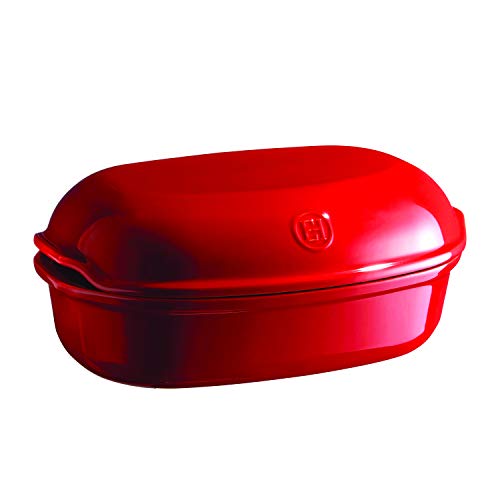
For a broad artisan bread use rather than a dedicated Pullman or baguette shape, this baker is the general-purpose choice. Its dimensions are 13.6 × 8.9 × 3.4 inches, and the maker says its high-resistance Burgundy clay is safe for oven use up to 520°F, as well as broiler and microwave use. It is also described as suitable for moving from freezer or refrigerator to a hot oven. That temperature ceiling is the key constraint: recipes requiring more than 520°F call for another vessel.
Bottom line: Pick this for artisan loaves when your recipe stays within its 520°F oven limit.
Emile Henry Ceramic Baguette Baker

For baguettes rather than a standard sandwich or free-form artisan loaf, this model has the most specialized shape. The baker measures 15.4 × 9.4 inches and uses holes in its base and lid to help dough rise and promote a dry, crisp crust; ribs are intended to reduce sticking. It is made in France using Emile Henry’s Flame technology, and a recipe book is included. The shaped, perforated design is a limitation for other loaf styles, so choose it when baguettes are the priority.
Bottom line: Choose this when baguettes, rather than other loaf shapes, are your regular bake.
How to choose an Emile Henry bread baker
Choose the baker by loaf shape first, then check its footprint against your oven rack. A Pullman-style baker suits long, even sandwich loaves; a baguette baker uses a narrow channel shape and perforations; a broader artisan baker accommodates loaves that do not need either dedicated form. Bread dough expands during proofing and baking, so leave room around the loaf and avoid filling a pan to its rim. For a covered baker, the lid helps hold moisture released by the dough, supporting a softer interior and crust development. If your recipes routinely bake above 520°F, the artisan model’s ceiling rules it out; the other two models have no temperature figure here, so confirm their limit before buying.
How loaf shape changes the choice
Loaf shape determines whether a baker supports your recipe or gets in its way. Pullman bread is baked in a long rectangular pan, often with a lid for a uniform profile suited to sandwich slices. Baguettes are long and narrow, with a crisp exterior; perforations allow more airflow than a solid covered baker. A free-form artisan boule or bâtard typically needs a wider baking surface or a vessel that can contain its shape. Choose Emile Henry Ceramic Pullman Baker for long sandwich loaves, Emile Henry Artisan Bread Baker for general artisan baking, and Emile Henry Ceramic Baguette Baker for baguettes. A practical rule: if you bake baguettes at least once a week and rarely make sandwich loaves, prioritize the dedicated baguette form; otherwise, select the baker that matches your most frequent loaf.
Covered ceramic baking and crust
Covered ceramic bakers work by holding some of the moisture released by dough near the loaf during the early bake. That humid environment delays crust setting, giving the loaf room to expand; removing the cover later lets the surface dry and brown. Many bread recipes use a covered phase followed by an uncovered phase, but exact timings depend on loaf size, dough hydration and oven behavior. Ceramic also retains heat, so handle a hot baker with dry oven mitts and set it on a heat-safe surface rather than a cold or wet counter. Sudden temperature changes can stress ceramic; the artisan model is specifically described as resistant to temperature change, but careful handling remains sensible.
Fit and oven clearance for bread bakers
Measure the usable rack area before choosing a bread baker, accounting for the lid and handles as well as the base. The Pullman baker’s 13.4-inch length and the baguette baker’s 15.4-inch length make front-to-back clearance important in smaller ovens. Leave a gap between the baker and oven walls so hot air can circulate, and check that the rack can be pulled out without tilting the vessel. If your oven has less than 16 inches of usable depth, confirm the complete baker’s fit before ordering; the length alone does not include added room for handles or safe handling. Do not place hot ceramic directly on a cold surface, since a sharp temperature change can cause damage.
Frequently Asked Questions
Does a covered bread baker make a crisp crust?
A covered baker retains moisture early in baking, which delays crust setting and supports loaf expansion. Uncovering the loaf later allows the surface to dry and brown; timing depends on loaf size and recipe.
What is a Pullman loaf pan used for?
A Pullman pan bakes long, rectangular sandwich loaves, and a lid can help create a uniform profile. Choose that shape when even slices for toast or sandwiches matter more than a round artisan loaf.
Why are baguette baking pans perforated?
Perforations let more oven air reach the dough, helping the surface dry for a crisp baguette crust. A baguette pan also supports the narrow loaf shape, unlike a broad artisan baker.
How much room should a bread baker have in an oven?
Leave space between the baker and oven walls so hot air can circulate, and verify rack depth with the complete covered vessel in place. With less than 16 inches of usable depth, confirm the baker’s fit before ordering.
Can ceramic bakeware go from cold to hot?
Some ceramic bakeware is designed to resist temperature change, but abrupt shifts can still stress ceramic. Avoid moving a hot baker onto a cold or wet surface, and use dry oven mitts when handling it.