
Non Weight Bearing Boot Options Compared by Support

For forefoot offloading, BraceAbility Forefoot Offloading Shoe, XL is the closest match because its 15-degree wedge shifts pressure toward the heel; it does not keep all weight off the foot. If your clinician prescribed strict non-weight-bearing, use a mobility aid and follow that restriction rather than walking in a wedge shoe.
Choose United Ortho Short Air Cam Walker, Medium, Jewlri Short Air CAM Walker Boot, Medium or Honprodu Adjustable Air Walking Boot, Medium only when a walking CAM boot fits your care plan: these are supportive boots, not devices that guarantee zero weight on the injured foot.
We earn a commission if you buy through links on this page. As an Amazon Associate I earn from qualifying purchases. Products are compared on manufacturer specifications, not hands-on testing.
- Best overall: BraceAbility Forefoot Offloading Shoe, XL – Its 15-degree wedge shifts pressure away from the forefoot and toes.
- Best for shorter coverage: United Ortho Short Air Cam Walker, Medium – The short CAM walker has a 5.4-inch height and a rocker sole.
- Best for adjustable air support: Honprodu Adjustable Air Walking Boot, Medium – Its pneumatic cushion lets the wearer adjust air pressure.
| Product | Best for | Type | Height | Weight | Shop |
|---|---|---|---|---|---|
| BraceAbility Forefoot Offloading Shoe, XL | Forefoot offloading | Wedge post-op shoe | 4 in | 1 lb | Check Price on Amazon |
| United Ortho Short Air Cam Walker, Medium | Short CAM coverage | Short CAM walker | 5.4 in | 2.3 lb | Check Price on Amazon |
| Honprodu Adjustable Air Walking Boot, Medium | Air pressure adjustment | Air CAM walker | — | 1.9 lb | Check Price on Amazon |
| Jewlri Short Air CAM Walker Boot, Medium | Washable liner | Short air CAM walker | 11 in | 1.7 lb | Check Price on Amazon |
Non Weight Bearing Boot Options
Match the device to the exact weight-bearing restriction and injured area your clinician identified.
BraceAbility Forefoot Offloading Shoe, XL

Unlike the CAM walkers, this post-op wedge shoe is designed to shift pressure away from the forefoot and toes. Its 15-degree dorsi-angle bottom encourages heel loading, and the open square-toe shape leaves room for bandaging. The maker identifies uses including forefoot surgery, broken toes, metatarsal fractures and diabetic foot ulcers. The shoe fits either foot, and the XL weighs 1 pound. This is for forefoot offloading, not strict non-weight-bearing: anyone instructed to keep all weight off the injured foot needs a different mobility plan. Heavy bandaging may also affect sizing.
Bottom line: Choose this for forefoot offloading only when heel loading is permitted.
United Ortho Short Air Cam Walker, Medium

This is the shortest CAM walker, with a 5.4-inch height, compared with the 11-inch Jewlri boot. Its rocker sole and shock-absorbing insole are intended to support a more natural walking motion, while molded uprights reinforced with steel provide structure. Medium fits men’s shoe sizes 8–11 and women’s 9–12, and the boot can be worn on either foot. It is intended for injuries including ankle sprains and stable fractures. A CAM walker is still a walking boot, so it does not satisfy a strict no-weight-bearing order by itself.
Bottom line: Choose it when a clinician recommends a short CAM walker and the Medium size fits.
Honprodu Adjustable Air Walking Boot, Medium

The distinguishing feature here is an adjustable pneumatic cushion, which lets the wearer change air pressure as swelling changes. The maker also describes adjustable straps, a non-slip sole and a lightweight design; the weight converts to about 1.9 pounds. Medium sizing requires measuring the foot and checking the size chart. This is a CAM walking boot for injury support, not a way to keep all weight off the foot. Air adjustment can change the feel of the fit, but it does not replace clinician guidance on safe loading.
Bottom line: Choose it when an adjustable air cushion is the priority and walking is allowed.
Jewlri Short Air CAM Walker Boot, Medium
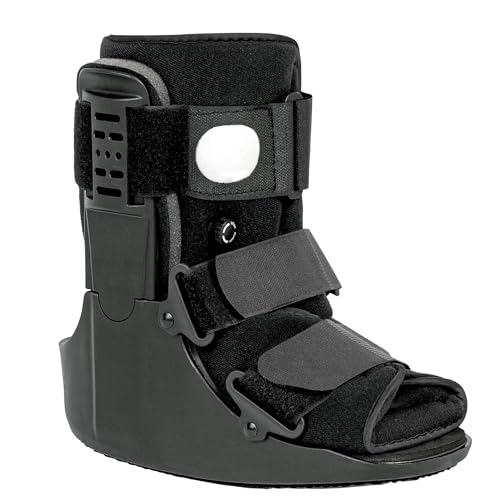
This boot stands out for its removable liner, which the maker says can be washed in cold water. It also has a soft, thick insole and a rigid plastic frame, and fits either foot. The maker suggests measuring the injured foot length and ankle width because swelling can change fit. At 11 inches tall, it is taller than the United Ortho short walker, though both are CAM-style boots. It is intended for walking support during recovery, not strict non-weight-bearing; confirm the intended loading plan with a medical professional before relying on it.
Bottom line: Choose it when a removable, washable liner matters and a CAM boot is appropriate.
What non-weight-bearing means for a boot
Strict non-weight-bearing means placing no body weight through the affected foot, not merely shifting pressure to another part of that foot. A forefoot wedge shoe redirects load toward the heel, so it is an offloading option only when heel contact is allowed. CAM walkers protect and support an injury during permitted walking, but a boot alone does not make walking non-weight-bearing. If your care instructions say “toe-touch” or “partial weight-bearing,” those are different limits; get the permitted amount and whether the heel may touch clarified before choosing footwear.
For strict non-weight-bearing, clinicians commonly use crutches, a walker or a wheelchair to keep the foot unloaded. The right aid depends on balance, strength, stairs and the setting. Do not treat pain reduction or a comfortable fit as evidence that loading is safe.
How to choose by injury location and loading rule
Choose by the body area being protected and the load your clinician permits. A wedge shoe is designed to offload the forefoot, while a CAM walker surrounds more of the foot and ankle; neither automatically means zero loading. For forefoot surgery or toe injuries, the wedge shape may be relevant when heel loading is allowed. For ankle or lower-leg support, a CAM walker may be the prescribed type.
Use this decision rule: if the instruction is strict non-weight-bearing, do not walk in any of these products as a substitute for a mobility aid. If heel weight-bearing is specifically permitted and the issue is at the forefoot, a wedge shoe may suit that plan. Confirm the exact loading restriction and fit with the treating clinician, especially when swelling or bulky bandaging changes shoe fit.
| Need | Device type | Loading distinction |
|---|---|---|
| No load on injured foot | Mobility aid plus prescribed support | Keep the foot off the ground |
| Forefoot pressure reduction | Wedge post-op shoe | Shifts pressure toward heel |
| Foot-and-ankle support while walking | CAM walker | Use only with permitted loading |
Getting the size and fit right
Measure the injured foot while accounting for the dressing or swelling that will be present in the shoe. A half-size increase may be needed when bulky bandaging is expected, but a boot that is too loose can shift and rub. Check both length and width when the maker calls for them; shoe size alone may not capture ankle or swelling differences.
Straps should secure the foot without creating pressure points, and toes should not be forced against the front. Recheck fit after swelling changes and after removing or replacing a liner. For a product with an assigned size chart, use that specific chart rather than assuming the same “Medium” means the same fit across brands.
Using a boot without increasing injury risk
A prescribed boot should be used with the exact weight-bearing status given by the treating clinician. Strict non-weight-bearing means no foot contact for support; partial or heel weight-bearing allows only the contact and load. A non-slip sole may help with traction, but it does not remove fall risk, particularly on stairs, wet floors or uneven ground.
Inspect the skin and padding regularly, and seek clinical advice for new numbness, worsening pain, unusual color changes or pressure sores. Keep the boot dry unless its materials and care guidance permit washing; a removable liner can be washed separately when allowed. Do not inflate or tighten an air cushion until the foot feels numb or painful.
Frequently Asked Questions
Can I walk in a boot while non-weight-bearing?
No, not if your instruction is strict non-weight-bearing. Use a crutch, walker or wheelchair plan that keeps the affected foot off the ground, and clarify any permitted toe contact with your clinician.
Does a wedge shoe keep all weight off my foot?
No, a forefoot wedge shoe shifts pressure toward the heel. It is unsuitable for strict non-weight-bearing unless a clinician specifically allows heel loading.
How should I measure for an injured foot boot?
Measure the foot length and width with the dressing or swelling expected during wear, then compare those measurements with that model’s chart. Extra bandaging can change fit, so allow room without letting the foot slide.
Can swelling change how a walking boot fits?
Yes, swelling can alter both foot length and ankle width. Recheck strap tension and pressure points as swelling changes, and ask the clinician about fit if numbness or increasing pain appears.