
Portable Scuba Lung Tanks: 5 Models Compared

TUDIVING 1.9L Mini Scuba Tank stands out for its 1.9L tank and maker-claimed 115 breaths at 33 feet, while smaller models trade capacity for a more compact format. Choose another option if you need a mask-integrated system, a hand-pump setup, or a smaller backup bottle.
Portable scuba tanks hold compressed breathing air for underwater use; they are not a substitute for training, a suitable regulator, or a planned dive.
We earn a commission if you buy through links on this page. As an Amazon Associate I earn from qualifying purchases. Products are compared on manufacturer specifications, not hands-on testing.
- Best overall: TUDIVING 1.9L Mini Scuba Tank – Its 1.9L tank is the largest listed, and the maker claims about 115 breaths at 33 feet.
- Best for mask integration: Portable Lung Tank 0.5L Mask Kit – The 0.5L tank is paired with a full-face mask and adapter.
- Best for hand-pump refills: DIDEEP 1L Mini Scuba Tank – The product name specifies a high-pressure hand pump with its 1L tank.
| Product | Best for | Tank capacity | Maker-claimed air time | Included setup | Shop |
|---|---|---|---|---|---|
| TUDIVING 1.9L Mini Scuba Tank | Larger tank capacity | 1.9L | About 115 breaths at 33 ft | Regulator, backpack | Check Price on Amazon |
| DIDEEP 1L Mini Scuba Tank | Hand-pump kit | 1L | 15–20 minutes | High-pressure hand pump | Check Price on Amazon |
| GOYOJO 0.5L Mini Scuba Tank | DOT-certified backup | 0.5L | About 4–8 minutes | — | Check Price on Amazon |
| OCEADIVEO 0.5L Mini Scuba Tank | Breath-count estimate | 0.5L | Up to 35 breaths | — | Check Price on Amazon |
| Portable Lung Tank 0.5L Mask Kit | Integrated mask setup | 0.5L | 6–10 minutes | Full-face mask, adapter | Check Price on Amazon |
Portable scuba lung tanks compared
Compare tank capacity and the setup each model is described with before choosing one for its intended use.
TUDIVING 1.9L Mini Scuba Tank
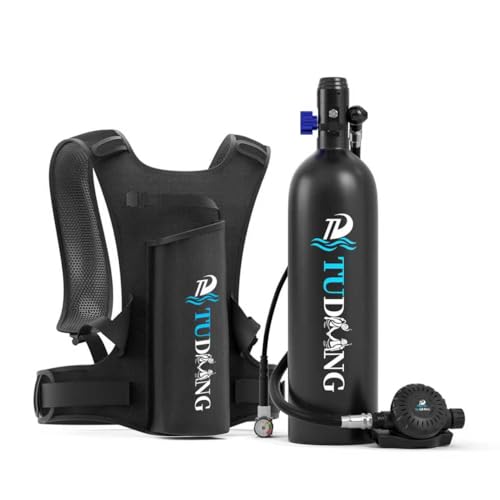
The 1.9L capacity sets this model apart from the smaller tanks here. TUDIVING says it delivers about 115 breaths at 200 bar when used at 33 feet; actual air use changes with depth, exertion, and breathing rate. The kit includes a regulator and diving backpack, plus a safety valve, pressure gauge, and 8mm fill port. The seawater-resistant 6061 aluminum cylinder suits someone seeking a larger portable tank. Its size and need for an appropriate fill source make it less suited to a minimal mask-integrated setup.
Bottom line: Choose it if you want the largest tank capacity among these options.
DIDEEP 1L Mini Scuba Tank

The 1L DIDEEP package is the option here whose name specifically includes a high-pressure hand pump. DIDEEP claims 15–20 minutes underwater at 1–10 meters, with time dependent on lung capacity and depth. The tank body is aviation aluminum, and the mouthpiece is food-grade silicone. This suits a buyer prioritizing the named pump and a 1L cylinder for emergency or recreational use. The claimed duration is not a planning guarantee: divers with higher air consumption or greater depth should expect less time and should not rely on a compact tank as their sole safety plan.
Bottom line: Choose it if the included hand-pump setup is your priority.
GOYOJO 0.5L Mini Scuba Tank

The GOYOJO is presented specifically as a refillable emergency backup pony bottle, distinguishing it from the mask-integrated device and larger-capacity cylinders. It has a 0.5L capacity, a maximum pressure of 3,000 PSI, and DOT certification; the maker estimates about 4–8 minutes of breathing time, depending on conditions. That role suits trained divers seeking a compact backup source, not a stand-alone plan for an underwater emergency. At 0.5L, its capacity is much smaller than the 1L and 1.9L options, so choose it only when a compact backup format fits your dive plan.
Bottom line: Choose it for a compact, DOT-certified backup bottle.
OCEADIVEO 0.5L Mini Scuba Tank

The OCEADIVEO uses a breath-count estimate rather than the minute range given for some other compact models: its maker claims up to 35 breaths from the 0.5L tank. The maker also describes an anti-corrosion aluminum build, a breathing valve core, and triple-layer filtration. The small size may suit a buyer comparing compact tanks by claimed breath count. Breath counts do not translate directly into a reliable dive duration because depth, exertion, and individual breathing rates change air use; do not treat 35 breaths as guaranteed time or as a substitute for a proper dive plan.
Bottom line: Choose it if a compact tank with a breath-count claim fits your comparison.
Portable Lung Tank 0.5L Mask Kit

The integrated full-face mask makes this 0.5L model different from the separate tank-and-regulator formats. The product name claims 6–10 minutes of breathing time, and the kit includes an adapter. Its 6061 aluminum tank weighs 1.1 kg and has a 3,000 PSI pressure rating. This setup may appeal to someone seeking a mask-and-tank combination for snorkeling. Its small capacity and specific integrated format are limitations for buyers who need a conventional backup pony bottle or longer underwater duration; the maker’s time estimate should not be treated as guaranteed.
Bottom line: Choose it if you specifically want a mask-integrated tank kit.
How to choose a portable scuba tank
Choose by intended role, air capacity, and the regulator or mask setup—not by a claimed number of minutes alone. A compact pony bottle is typically a backup air source for a trained diver, while a mask-integrated device is a different configuration. Tank capacity does not directly predict dive time: depth, exertion, and breathing rate all change air use. A practical rule is to reject any option whose included setup cannot connect to the equipment your dive plan requires. Check that the tank’s pressure rating and fill connection match the intended fill source before use; pressure values such as 3,000 PSI are not interchangeable with a compatible fill fitting.
Tank size and claimed breathing time
A larger tank generally holds more air at the same pressure, but no advertised duration is universal. The models here range from 0.5L to 1.9L, and their maker claims use different measures: minutes, breaths, or a depth and pressure. For example, a breath-count claim cannot be fairly converted to minutes without knowing the diver’s breathing rate and conditions. Use the product’s capacity and setup to narrow choices, then plan air use conservatively with a qualified dive professional. Do not choose solely from a minutes estimate if your intended depth, workload, or escape plan differs from the maker’s conditions.
| Need | Compare | Key consideration |
|---|---|---|
| Mask-and-tank combination | Integrated mask format | Confirm it suits the intended activity and breathing setup |
| Compact backup | 0.5L pony bottle | Use as part of a trained diver’s planned backup system |
| More tank capacity | 1L or 1.9L cylinder | Capacity alone does not set usable time |
Safety rules for portable scuba tanks
Scuba tanks contain compressed breathing gas, so use a compatible regulator and have the cylinder and valve inspected and maintained by qualified professionals. A small tank is not an emergency plan by itself: a diver needs appropriate training, a buddy, a depth and air plan, and a safe ascent. Never hold your breath while ascending; expanding air can injure the lungs. Do not use an unfamiliar tank or mask system underwater without training in that configuration. Before a dive, confirm the cylinder’s fill pressure, valve condition, and remaining air, and stop the dive with a reserve rather than using the last available air.
Refilling and planning around capacity
Refilling depends on the cylinder’s valve, fill port, pressure rating, and an appropriate compressor or fill station; a hand pump is not automatically compatible with every tank. Dive shops may have rules for filling cylinders and may require inspection or certification, so confirm acceptance before depending on a specific fill source. A regulator, adapter, or pump only helps when its connection matches the cylinder. Avoid improvising fittings or exceeding the tank’s rated pressure. Plan the dive so the available air covers descent, activity, ascent, and a reserve; the advertised breathing time should never be the whole dive plan.
Frequently Asked Questions
How deep can a portable scuba tank be used?
A tank’s safe depth depends on its cylinder, regulator, training, and dive plan, not capacity alone. The TUDIVING claim is tied to 33 feet, but that does not establish a safe depth for other models.
How long does a 0.5L scuba tank last?
There is no fixed duration because depth, exertion, and breathing rate change air use. The 0.5L models here have maker claims ranging from about 4–8 minutes to 6–10 minutes, while another gives up to 35 breaths.
Can a portable scuba tank replace a regular scuba tank?
A compact cylinder should not be assumed to replace a full scuba setup or a planned reserve. Its usable air is limited, and safe use requires compatible breathing equipment, training, and an appropriate dive plan.
Do portable scuba tanks need inspection?
Yes, compressed-gas cylinders and their valves need inspection and maintenance by qualified professionals. Follow applicable local requirements and the cylinder maker’s service schedule, and do not dive with a damaged or overdue tank.
Can I refill a mini scuba tank at home?
Only use a fill source and connection rated for the cylinder’s pressure and valve. A hand pump or adapter must be compatible, and never exceed the tank’s rated pressure.