
Coaxial Cable Surge Protector: 3 Models Compared

For a dedicated coaxial cable surge protector, VCE 75-Ohm Coaxial Surge Protector is the strongest fit because it is an inline 75-ohm unit rated across 5–2,500 MHz with 6 kV all-port protection. Choose Proxicast ProGrade 230V Coax Arrester instead if the 0–3 GHz range, gas-discharge design or stated ground wire size better matches your installation; a power strip with coaxial protection is a different option for people also needing AC outlets.
We earn a commission if you buy through links on this page. As an Amazon Associate I earn from qualifying purchases. Products are compared on manufacturer specifications, not hands-on testing.
- Best overall: VCE 75-Ohm Coaxial Surge Protector – Dedicated 75-ohm inline protection covers 5–2,500 MHz and supports 18 V/2 A power passing.
- Best for wider range: Proxicast ProGrade 230V Coax Arrester – Its 75-ohm gas-discharge design covers 0–3 GHz.
- Best for two locations: Voluty Tek 75-Ohm Coax Protector, 2-Pack – The package includes two 75-ohm F-type inline protectors and a grounding wire.
| Product | Best for | Frequency range | Connection or grounding | Shop |
|---|---|---|---|---|
| VCE 75-Ohm Coaxial Surge Protector | Modems and satellite | 5–2,500 MHz | F-ports; 18 V/2 A pass | Check Price on Amazon |
| Proxicast ProGrade 230V Coax Arrester | Wide frequency range | 0–3 GHz | F-male/F-female; 6 AWG | Check Price on Amazon |
| Voluty Tek 75-Ohm Coax Protector, 2-Pack | Two coax runs | Up to 2,400 MHz | F-type; grounding wire | Check Price on Amazon |
Coaxial Cable Surge Protectors Compared
Match the inline protector’s signal range, connector style and grounding approach to the cable run and equipment.
VCE 75-Ohm Coaxial Surge Protector
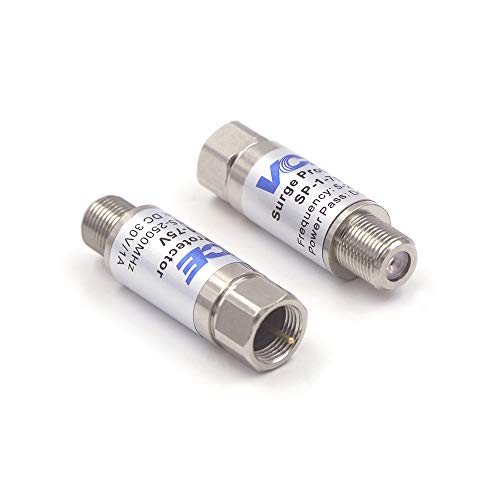
VCE 75-Ohm Coaxial Surge Protector is the dedicated inline choice here with 6 kV all-port protection and a 5–2,500 MHz operating range. The 75-ohm unit supports DC power passing at 18 V/2 A, which matters for satellite systems that send power along the coax. Its metal housing and sealed F-ports are intended for indoor or outdoor placement. The maker also specifies 5 kA nominal and 10 kA maximum discharge current. Choose it when those signal and power limits suit the connected equipment; the frequency ceiling is lower than the 3 GHz range of Proxicast ProGrade 230V Coax Arrester.
Bottom line: Pick this when your 75-ohm system needs power pass-through and operates within 5–2,500 MHz.
Proxicast ProGrade 230V Coax Arrester
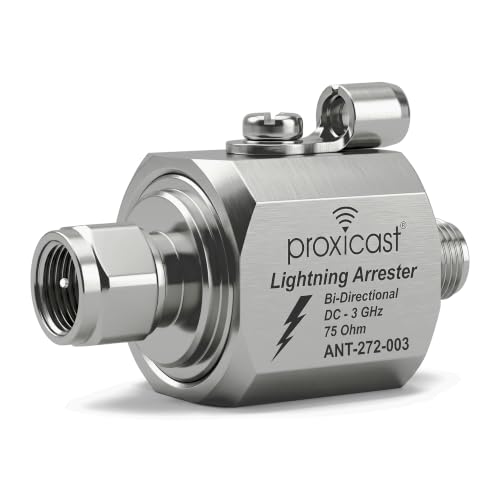
Proxicast ProGrade 230V Coax Arrester stands apart with a 0–3 GHz range and a 230 V gas-discharge tube. Its F-male/F-female connections are specified for RG6, RG59, RG8X and RG11, and DC passes through the unit. The 6 AWG size in the maker refers to its grounding connection, so plan a compatible bond to the building grounding system rather than treating the cable shield as the only ground. It is marked for outdoor use and listed for antenna, cable internet and satellite applications. The voltage rating and connector gender should be checked against the installation before choosing it.
Bottom line: Choose this for a compatible 75-ohm F-connector run needing coverage through 3 GHz.
Voluty Tek 75-Ohm Coax Protector, 2-Pack

Voluty Tek 75-Ohm Coax Protector, 2-Pack is the only exact-fit option supplied as a two-piece set, making it suited to protecting two separate coax runs. Each unit uses standard 75-ohm F-type connections and supports frequencies up to 2,400 MHz. A grounding wire is included, so installation needs a suitable bond point; the protector must be connected in-line rather than left floating on the cable. The maker describes it for TV antennas, satellite receivers, modems, routers and amplifiers. The frequency limit is lower than Proxicast ProGrade 230V Coax Arrester’s 3 GHz ceiling, so check the operating band of equipment on the protected run.
Bottom line: Pick this set when you need two 75-ohm F-type inline units and your signal stays below 2,400 MHz.
How to choose a coaxial cable surge protector
Choose by impedance, connector fit, signal band and grounding path, in that order. Television and cable systems commonly use 75-ohm coax with F-type connectors; 50-ohm arresters are for a different class of radio equipment and are not interchangeable. Match the protector’s frequency ceiling to every service on the line, including satellite IF or an antenna amplifier’s passband. For a dedicated unit, an inline design belongs between the incoming coax and protected equipment, with its grounding terminal bonded to the building grounding system. A protector without a sound ground path cannot divert surge current as intended. If the maker does not establish a needed ground arrangement or band, confirm compatibility before installation.
Grounding a coaxial surge protector
A coax arrester needs a short, direct bond to the premises grounding system; a long, looping lead adds impedance and weakens the surge path. Bonding blocks and grounding conductors should connect to the same grounding electrode system used by the electrical service, not an isolated ground rod. National electrical rules cover grounding and bonding of communications circuits, but exact conductor routing depends on the installation and local code. Keep the grounding path mechanically secure and protected from corrosion, and do not work on outdoor cable during a storm. A protector’s included wire or stated gauge does not by itself establish a compliant installation; verify the correct bonding point and conductor requirements for the site.
Power strips versus inline coax protectors
A power strip with coax protection combines AC outlets and a pass-through coax feature, while a dedicated inline arrester focuses on the coax line and often gives a clearer frequency, voltage or discharge specification. The two formats solve different placement needs and should not be treated as equivalent. Use a purpose-built grounded arrester where the coax service’s signal band and installation ground matter; select a strip when consolidating several AC plugs is also central. Neither device replaces proper building grounding, and no surge protector guarantees protection from a direct lightning strike. For exposed outdoor antennas, installation quality and a bonded grounding system matter as much as the protector’s connector fit.
Check cable and signal compatibility
Match F-connector gender to the cable and equipment ends, and keep impedance at 75 ohms throughout a TV or cable-modem run. RG6 is common for residential satellite and broadband wiring; older RG59 has greater loss over long runs, so replacing a poor cable segment may matter more than adding another connector. Confirm that the protector passes any DC voltage required by an LNB, mast amplifier or powered antenna, and stay within its voltage and current limits. Extra adapters add joints and possible signal loss. If a system has a powered component or an operating band near the protector’s upper limit, confirm those two compatibility points before connecting it.
Frequently Asked Questions
Does a coaxial surge protector need grounding?
Yes, a dedicated coax arrester needs a low-impedance bond to the building grounding system to divert surge current. Keep the bonding path short and direct, and use a suitable grounding block or approved bonding point.
Can a coax surge protector pass satellite power?
Some units pass DC power, but the required voltage and current depend on the satellite equipment. Check that the protector’s pass-through rating meets the LNB or switch requirement before installing it.
Where should an inline coax surge protector go?
Install the arrester in-line where the incoming coax enters the building, before the protected equipment, and bond it at that entry point. Keep the unprotected cable run inside as short as practical.
Will a coax protector stop a direct lightning strike?
No surge protector can guarantee protection from a direct strike. Grounding, bonding and disconnecting equipment during severe storms remain important risk-reduction steps.
Are 50-ohm and 75-ohm coax protectors interchangeable?
No, use the impedance required by the connected system; TV, satellite and cable-modem installations generally use 75-ohm coax. A mismatched arrester can disrupt signal performance.