
Best 2 Meter Mobile Antenna: 5 Models Compared

The Comet CA-2X4SR is the best 2 meter mobile antenna for most drivers here because it combines a 38-inch whip with 3.8 dBi gain on 2 meters and broad 140–160 MHz coverage. Choose another option if you need a magnetic base, a compact whip, or a specific NMO mount.
We earn a commission if you buy through links on this page. As an Amazon Associate I earn from qualifying purchases. Products are compared on manufacturer specifications, not hands-on testing.
- Best overall: Comet CA-2X4SR – Its 38-inch height, 3.8 dBi 2-meter gain and 140–160 MHz coverage suit varied mobile installations.
- Best for magnetic mounting: Dual-Band Magnetic Antenna – The 18-inch dual-band whip includes a magnetic base and 10-foot RG58 cable.
- Best for NMO mounts: Comet SBB-5NMO – This 38-inch antenna uses an NMO mount and covers 144–148 MHz on 2 meters.
| Product | Best for | 2-meter coverage | 2-meter gain | Mount / height | Shop |
|---|---|---|---|---|---|
| Comet CA-2X4SR | Wide coverage | 140–160 MHz | 3.8 dBi | PL-259 / 38 in. | Check Price on Amazon |
| Dual-Band Magnetic Antenna | Quick installation | 137–149 MHz | 2 dBi | Magnetic / 18 in. | Check Price on Amazon |
| Comet SBB-5NMO | NMO installation | 144–148 MHz | 3 dBi | NMO / 38 in. | Check Price on Amazon |
| Comet CA-2X4SRNMO | Broad NMO coverage | 144 / 440 MHz | — | NMO / 40 in. | Check Price on Amazon |
| Eifagur 2M/70cm NMO Kit | Cable included | 136–174 MHz | 2.15 dBi | NMO / 17.3 in. | Check Price on Amazon |
Best 2 Meter Mobile Antennas
Compare the band coverage, 2-meter gain and mounting needs before choosing a mobile whip.
Comet CA-2X4SR

The Comet CA-2X4SR offers the broadest 2-meter range here, spanning 140–160 MHz, and pairs it with a 38-inch fiberglass whip. Its stainless-steel base and PL-259 connector suit a compatible SO-239 mount, and the maker gives a 200-watt power rating. This dual-band antenna also covers 430–470 MHz, with 6.2 dBi gain on 70 cm. The 38-inch height may be a poor fit for garages or other low-clearance routes, so measure the vehicle and mount before choosing it.
Bottom line: Choose it if broad VHF coverage matters more than a short whip.
Dual-Band Magnetic Antenna
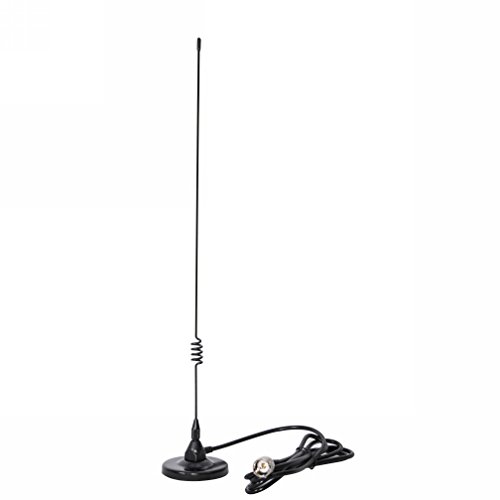
The magnetic-base antenna is the compact choice, with an 18-inch dual-band whip, a 2.95-inch magnet and 10 feet of RG58 cable. Its maker gives 2 dBi gain on VHF, 3 dBi on UHF, and VSWR figures below 1.4 at 145 MHz and below 1.2 at 455 MHz. The frequency span is 137–149 MHz on VHF and 437–480 MHz on UHF. A magnetic mount needs a clean, flat steel surface for secure contact; drivers who need a permanent NMO installation should choose another type.
Bottom line: Choose it for a short whip and a no-drill magnetic base.
Comet SBB-5NMO
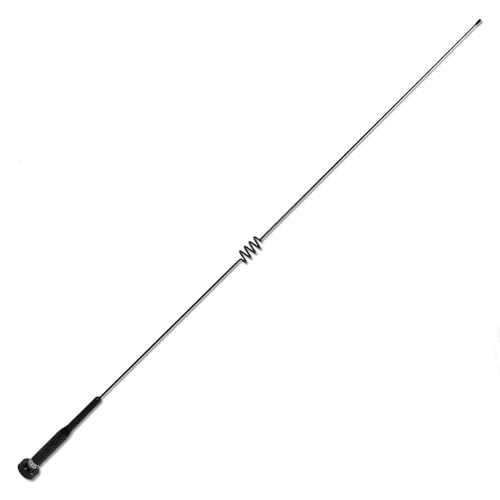
The Comet SBB-5NMO is the NMO-mounted option with coverage centered on the amateur 2-meter band, 144–148 MHz, and a 38-inch whip. It provides 3 dBi gain on VHF and 5.5 dBi on UHF, with dual-band coverage of 430–450 MHz. The specifications specify a stainless-steel whip and fiberglass construction, and the maker gives a 200-watt PEP rating. The antenna is intended for an NMO base rather than a direct PL-259 mount, so confirm the vehicle base uses the matching NMO connection.
Bottom line: Pick it when the vehicle already has a compatible NMO base.
Comet CA-2X4SRNMO

The Comet CA-2X4SRNMO pairs an NMO mount with a 40-inch whip, making it the taller NMO option among these antennas. Its specifications describe broad dual-band coverage across 2 meters and 70 centimeters, plus extended VHF and UHF use, but give no numeric frequency span or gain figure. That makes it harder to compare performance with the models that provide specific band limits and gain. Consider this antenna if your priority is its NMO format and broad-band purpose; buyers needing confirmed numeric coverage should verify those figures before ordering.
Bottom line: Choose it for a taller NMO antenna when exact gain is not your deciding factor.
Eifagur 2M/70cm NMO Kit

The Eifagur kit combines a 17.3-inch antenna, NMO connection, L-shaped stainless-steel bracket and 16.5 feet of RG58 cable ending in a PL-259 plug. It covers 136–174 MHz and 400–470 MHz, with 2.15 dBi gain, a maximum 100-watt input and VSWR below 1.5. The broad VHF range makes it less narrowly specified to the amateur 2-meter band than the 144–148 MHz option. Its included bracket and cable may simplify a new installation, but the buyer must have a suitable mounting point for the bracket.
Bottom line: Select it if you need a longer cable and included mounting bracket.
How 2 meter mobile antenna gain and length compare
A quarter-wave whip for 144–148 MHz is about 19 inches long, while a half-wave is about 38 inches; loading coils can shorten an antenna, but the design and mounting ground plane affect efficiency. Gain figures also need careful comparison: dBi is referenced to an ideal isotropic radiator, while dBd is referenced to a half-wave dipole, with dBi about 2.15 dB higher for the same antenna. A roof-center location generally offers a more even pattern than a low body mount. For a garage opening under 40 inches above the antenna base, choose a shorter whip or plan to remove the antenna before entering.
Choosing a mobile mount and coax route
Match the antenna connection to the base: NMO antennas require an NMO mount, while PL-259 connectors mate with SO-239 sockets. A magnetic base needs a flat ferromagnetic steel surface; magnets do not hold to aluminum, and a curved or dirty roof can reduce contact. Coax length should reach the radio without tension or a tight coil, and a typical mobile installation routes cable through a door seal or an existing body grommet while avoiding hinges and sharp metal edges. Keep the antenna clear of roof racks and other metal obstacles where possible, since nearby structures can detune it or distort its radiation pattern.
2 meter antenna frequency and radio fit
The US amateur 2-meter allocation is 144–148 MHz, so check that the antenna’s VHF range includes the frequencies you plan to use; broad coverage alone does not guarantee a good match at every point. SWR is a measure of how well the antenna system matches the feed line and radio, with 1:1 ideal and readings below 2:1 commonly treated as workable for many setups. Tune or verify SWR after mounting because the vehicle roof, trunk, and antenna position affect resonance. Transmitting outside your license privileges is not permitted, even when a whip’s frequency span reaches commercial or public-safety channels.
Mobile antenna installation safety and upkeep
A vehicle whip can strike garage doors, tree limbs, and overhead wires, so measure total height from the ground and remove or fold the antenna where clearance is uncertain. Before transmitting, confirm the coax connector is secure and the antenna base has a solid electrical ground through its mount; a poor connection can raise SWR and stress a transmitter. Inspect coax for crushed sections or worn insulation at least seasonally, especially where it passes through a door or hatch. Stainless steel resists corrosion, but road salt and grime still warrant rinsing the whip and mount periodically; do not transmit with a damaged cable or loose mount.
Frequently Asked Questions
Does a longer mobile antenna always improve range?
A longer whip can allow a more efficient mobile antenna, but height alone does not establish range. Mount location, ground plane, coax losses, terrain and line of sight also affect coverage; a roof-center mount generally gives a more even pattern than a low bumper mount.
What frequency is the 2 meter amateur band?
The US amateur 2-meter band spans 144–148 MHz. A dual-band antenna may also cover 70 centimeters, commonly 420–450 MHz for US amateur operation, but the radio, antenna tuning and license privileges still need to match the frequency used.
Can a magnetic antenna go on an aluminum roof?
A magnetic base requires a ferromagnetic surface such as steel, so it will not attach magnetically to aluminum. Use a suitable fixed mount and ground plane instead, and route coax away from hinges or sharp edges to reduce wear.
How much clearance does a mobile whip need?
Allow clearance for the full antenna length above its mounting surface, plus movement and any flexible whip deflection. For a 38-inch whip, measure at least 38 inches from the base to the garage or obstruction, with extra margin where the vehicle roof flexes or the antenna can strike branches.