
Golf Wrist Training Aid: 5 Swing Tools Compared

WhyGolf Wrist-X suits golfers who want a customizable wrist-hinge cue, with an adjustable threshold from 0 to 70 degrees and audible feedback. Choose a brace or cradle instead if you want physical wrist positioning or an arm-connection aid rather than a click-based cue.
We earn a commission if you buy through links on this page. As an Amazon Associate I earn from qualifying purchases. Products are compared on manufacturer specifications, not hands-on testing.
- Best overall: WhyGolf Wrist-X – Its audible feedback and 0–70-degree hinge adjustment make it the most configurable practice cue here.
- Best for arm connection: CUBEDAY Wrist Brace and Arm Band Kit – The kit pairs a wrist brace with an elastic arm band.
- Best for a wrist cradle: ProSENDR Wrist Cradle, Right-Handed – The carbon-fiber cradle is set to approximately 51 degrees of trail-wrist extension and is right-handed.
| Product | Best for | Training approach | Fit or orientation | Angle or size | Shop |
|---|---|---|---|---|---|
| WhyGolf Wrist-X | Hinge feedback | Audible hinge trainer | Left- or right-handed | 0–70° adjustable | Check Price on Amazon |
| CUBEDAY Wrist Brace and Arm Band Kit | Arm connection | Wrist brace and arm band | Adjustable | 15.8 × 7.2 × 0.32 in | Check Price on Amazon |
| Golf Wrist Brace, Medium | Medium-size brace | Rigid-support wrist brace | Medium | Medium | Check Price on Amazon |
| ALLCIFP Breathable Mesh Wrist Trainer | Left-right flexibility | Mesh wrist trainer | Left- or right-handed | — | Check Price on Amazon |
| ProSENDR Wrist Cradle, Right-Handed | Cradle positioning | Carbon-fiber wrist cradle | Right-handed | About 51° trail-wrist extension | Check Price on Amazon |
Golf wrist training aids compared
The main distinction is whether you want wrist support, arm connection, or a cue that responds to your hinge angle.
WhyGolf Wrist-X

Unlike a brace that holds the wrist in position, this trainer signals when the wrist crosses a chosen hinge threshold. The maker says its audible click provides feedback during full swings, chips and putts, and the threshold adjusts from 0 to 70 degrees. That range suits golfers who want to vary the cue rather than practice at one fixed angle. It is adjustable for left- and right-handed golfers. Its distinct limitation is that it cues movement instead of physically supporting the wrist, so golfers seeking a brace-style position should compare the support designs.
Bottom line: Choose this if you want an adjustable hinge cue with audible feedback.
CUBEDAY Wrist Brace and Arm Band Kit

This kit combines a wrist brace with an elastic arm band, unlike the standalone wrist trainers. The maker says the support strip helps hold the lead wrist in a flat position and the band encourages the arms to move together. Its dimensions are 15.8 inches long, 7.2 inches wide and 0.32 inch high; stated weight is 0.12 pounds. The combination may suit golfers addressing both wrist position and arm separation in practice. The trade-off is a two-part setup; golfers who only want a wrist-hinge signal may prefer the audible trainer.
Bottom line: Pick this if your practice goal includes keeping the arms connected.
Golf Wrist Brace, Medium

This medium wrist brace uses a rigid carbon-fiber support frame, distinguishing it from adjustable-angle feedback tools. The maker says the frame is intended to limit premature wrist release and assist with wrist alignment during swings. Its size is medium, and the color is black. This option fits a golfer looking for a brace-style aid rather than a sound cue or arm band.
Bottom line: Choose this if a medium, rigid-support wrist brace matches your fit needs.
ALLCIFP Breathable Mesh Wrist Trainer
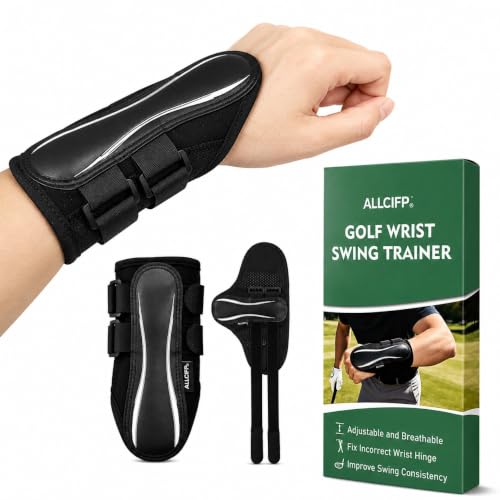
This breathable mesh wrist trainer is specified for either left- or right-handed golfers, a useful distinction when choosing a wrist aid for a particular swing hand. The maker says it is adjustable and designed to encourage wrist alignment through the swing, with repeated practice intended to reinforce hand positioning. Its black color and mesh construction set it apart from rigid-support and cradle styles. The facts identify no angle scale, so golfers who want a numerical hinge threshold should choose an adjustable-angle trainer instead.
Bottom line: Pick this if you want a mesh wrist trainer intended for either handedness.
ProSENDR Wrist Cradle, Right-Handed

This right-handed system centers on a carbon-fiber wrist cradle and a separate compression sphere; the maker says each can be used alone or together. The cradle is set to approximately 51 degrees of trail-wrist extension, making it distinct from a brace or a trainer that clicks at a selected threshold. The maker says the package includes five training videos. This design suits golfers looking for a cradle-based practice aid, but it is specified for right-handed use, so left-handed golfers need another option.
Bottom line: Choose this if you are right-handed and want a cradle-based practice aid.
How to choose a golf wrist training aid
Choose by the kind of cue you want: physical support, arm connection, or feedback on wrist hinge. A brace or cradle gives a positioning aid, while an audible trainer signals when the wrist crosses a chosen angle. Wrist hinge and wrist bend are different motions; a hinge cue does not by itself assess every part of a swing. If you want to change the cue numerically, select a trainer with an adjustable angle range; if you want both wrist and arm prompts, look for a kit with an arm band. Avoid forcing a joint into a position that causes pain, and stop practice if discomfort develops.
Wrist angle and hand fit
Match the aid to the hand and the position you intend to practice. Lead- and trail-hand roles differ, so check whether a product specifies right-handed use, left- or right-handed use, or a size such as medium. A fixed cradle angle and an adjustable threshold are not interchangeable: the former sets a position, while the latter changes when feedback occurs. For a numerical cue, WhyGolf Wrist-X offers a 0–70-degree adjustment; ProSENDR Wrist Cradle, Right-Handed is set to about 51 degrees of trail-wrist extension and is right-handed. Use the table to compare the form of cue before choosing.
| Practice need | Design to consider | Fit or cue |
|---|---|---|
| Adjust hinge cue | Audible trainer | 0–70° range |
| Wrist and arm connection | Brace and band kit | Wrist support plus arm band |
| Cradle position | Wrist cradle | Right-handed; about 51° trail-wrist extension |
| Single wrist brace | Rigid-support brace | Medium |
How to practice with a wrist trainer
Start with slow, short rehearsals rather than making a full-speed swing the first repetition. Use a few swings to notice the cue, then rehearse the same motion without the aid so the feedback does not become the only signal you rely on. Audible feedback can identify when a set hinge threshold is crossed, but it does not measure contact quality or ball flight. A brace or cradle instead emphasizes a position, so avoid treating its setting as a universal target for every golfer. Keep practice pain-free and reduce repetitions if the aid pinches, restricts circulation, or causes joint discomfort.
Frequently Asked Questions
Does a wrist trainer fix a slice by itself?
No wrist trainer can guarantee a ball-flight change on its own. A slice can involve clubface orientation and swing path, so use the aid as a practice cue and assess the resulting shots rather than assuming wrist position is the only cause.
What does a 0–70-degree wrist trainer adjust?
The WhyGolf Wrist-X sets the hinge threshold at which its audible click occurs, with adjustment from 0 to 70 degrees. The setting is a cue for practice, not a universal wrist position every golfer should use.
Is a wrist cradle the same as a wrist brace?
No: a cradle sets a particular wrist position, while a brace supports or limits movement in a different way. The ProSENDR cradle is set to about 51 degrees of trail-wrist extension and is right-handed.
Can left-handed golfers use these golf wrist aids?
Hand fit depends on the specific design: the WhyGolf Wrist-X and ALLCIFP trainer are described for left- or right-handed golfers, while ProSENDR is specified as right-handed. Check handedness before choosing any fixed-orientation cradle.
Should I keep practicing if a wrist brace hurts?
No; stop if an aid causes pain, numbness, or restricted circulation. A practice cue should not force the wrist through discomfort, and persistent symptoms warrant professional medical advice.