
12V to 110V Converter: 5 Inverters Compared

For most car trips, BESTEK 300W Car Inverter is the closest fit because it combines 300W continuous output, two AC outlets, and two USB ports in a cigarette-lighter-plug design. Choose a different model if you need a lower output for smaller loads or a high-output inverter for larger equipment.
A 12V to 110V converter, also called a power inverter, changes a vehicle battery’s DC power into AC power for compatible devices.
We earn a commission if you buy through links on this page. As an Amazon Associate I earn from qualifying purchases. Products are compared on manufacturer specifications, not hands-on testing.
- Best overall: BESTEK 300W Car Inverter – Its 300W continuous output, two AC outlets, and two USB ports suit common travel charging needs.
- Best for higher car-plug output: Pro Chaser 400W Vehicle Inverter – It offers 400W continuous output and 800W peak output in a vehicle inverter.
- Best for high-wattage setups: Cantonape 3,000W Inverter – Its 3,000W continuous output and four AC outlets target substantially larger loads.
| Product | Best for | Continuous output | AC outlets | USB ports | Shop |
|---|---|---|---|---|---|
| BESTEK 300W Car Inverter | Everyday car charging | 300W | 2 | 2 | Check Price on Amazon |
| Pro Chaser 400W Vehicle Inverter | More car-plug output | 400W | 2 | 2 | Check Price on Amazon |
| PiSFAU 200W Car Inverter | Multiple USB devices | 200W | 2 | 4 | Check Price on Amazon |
| FOVAL 150W Car Inverter | Small AC loads | 150W | 1 | 2 | Check Price on Amazon |
| Cantonape 3,000W Inverter | High-wattage loads | 3,000W | 4 | 4 | Check Price on Amazon |
12V to 110V converters
Compare continuous output and connection style against the power needs of your devices.
BESTEK 300W Car Inverter
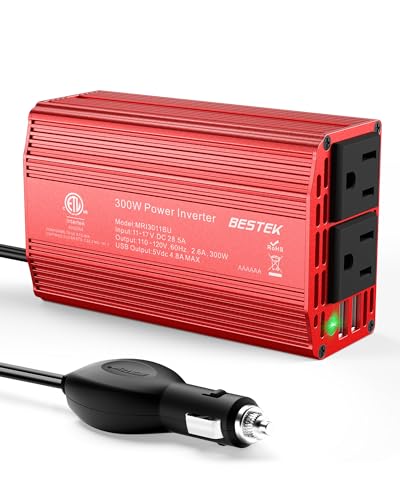
For everyday car charging, this 300W inverter pairs two AC outlets with two USB ports in a compact cigarette-lighter-plug design. BESTEK says it accepts 11–17V input and provides 700W instantaneous output; the 32-inch cord gives some flexibility in where the unit sits. It suits travelers charging a laptop alongside smaller USB devices. The main limitation is its 300W continuous ceiling, so it is not the choice for equipment whose running load exceeds that amount. Check the device’s rated wattage before connecting it.
Bottom line: Choose this for a mix of modest AC and USB loads on a road trip.
Pro Chaser 400W Vehicle Inverter
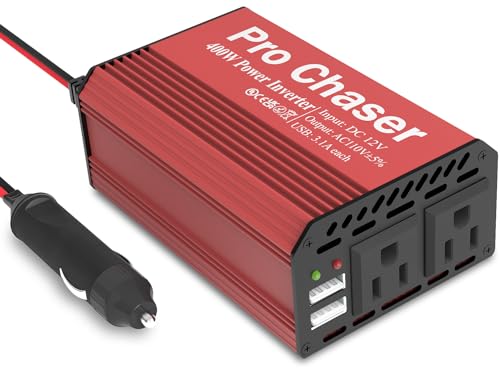
The 400W continuous rating is higher than the other car-plug models here, making this a better match when a compatible device draws more than 300W but no more than 400W. Pro Chaser gives it two AC sockets, two USB ports, and an 800W peak output, with a 30-inch cord. That combination suits travelers who need more headroom for short peaks. The limit remains the continuous rating: peak output does not mean a device can draw 800W continuously. Confirm both running and startup wattage for the equipment you intend to power.
Bottom line: Pick this when a car-plug inverter needs to cover a load up to 400W continuous.
PiSFAU 200W Car Inverter

Four USB charging ports distinguish this 200W car inverter from the other compact options, while two AC outlets allow a mix of plug-in and USB devices. The product identifies its input as 12V DC and its AC output as 110V; its ABS shell is fully insulated. PiSFAU also describes a quiet, heat-dissipating circuit design. This model fits lower-wattage charging needs where several USB devices matter more than maximizing AC capacity. Its 200W continuous rating is lower than the 300W and 400W alternatives, so larger AC loads may rule it out.
Bottom line: Choose this for several USB devices and AC loads within 200W.
FOVAL 150W Car Inverter
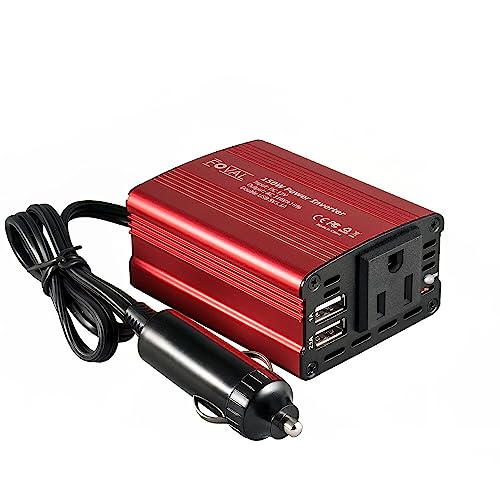
The FOVAL’s 150W continuous rating makes it the lowest-output car-plug option in this group, and it has one AC outlet rather than two. It also includes two USB ports with a combined maximum output of 3.1A. Its small footprint suits buyers who want a simple vehicle charging setup for modest loads, not several AC appliances. FOVAL names a broad range of possible devices, but the 150W limit is the deciding constraint: add the actual wattage of simultaneous AC loads and leave room below the limit.
Bottom line: Pick this for a compact setup with one AC device under 150W.
Cantonape 3,000W Inverter

Unlike the cigarette-lighter models, this 3,000W inverter is aimed at high-wattage 12V-to-AC setups and provides four AC outlets plus four USB ports. Cantonape specifies modified sine wave output, a 6,000W surge rating, and an LCD that displays input and output voltage, battery capacity, load capacity, and frequency. The high continuous rating is the key distinction for larger combined loads. Modified sine wave output may not suit every AC device, and 3,000W at 12V can demand very high current; verify the required battery connection, cable gauge, and fuse before purchase.
Bottom line: Choose this for high-wattage loads when the device supports modified sine wave power.
How to choose a 12V to 110V converter
Choose by continuous wattage first, then check the device’s startup demand and output type. Add the running watts of everything that may operate at once; keep the total below the inverter’s continuous rating, because a surge rating is for brief peaks rather than ongoing use. For example, a 350W load rules out 150W, 200W, and 300W models, but falls within a 400W continuous rating if startup demand also fits. USB ports serve USB-powered devices directly, while AC outlets are for equipment with a compatible household-style plug. A modified sine wave inverter can be incompatible with some sensitive electronics, motors, or chargers, so check the device maker’s power requirements before choosing that output type.
Car plug or battery-connected inverter
Car-plug inverters are intended for lower-power vehicle loads, while high-output inverters need a suitable battery connection. A 12V system delivering 3,000W would draw at least 250A in an ideal calculation (3,000W ÷ 12V); real draw is higher because conversion is not perfectly efficient. That current is far beyond what a typical cigarette-lighter socket is meant to carry, so never run a high-output inverter through that socket. Before selecting a high-wattage unit, verify its connection method, required cable gauge, and fuse against the vehicle or battery setup. For loads below 400W, the car-plug models here are the more relevant category; choose by the continuous rating, not the biggest peak figure.
| Need | What to prioritize |
|---|---|
| Several low-power USB devices | USB port count and rated USB output |
| One or two modest AC devices in a vehicle | Car-plug design and adequate continuous watts |
| Combined loads above 400W | High-output inverter with suitable battery wiring |
Wattage, startup loads, and safe use
Motor-driven and compressor-based devices can draw more power at startup than they use while running, so a running-watt figure alone may not prove an inverter is suitable. Check both values on the device label or its manual, and choose an inverter whose continuous and surge ratings cover them. Keep ventilation openings clear: inverters turn some input energy into heat, and blocked airflow can trigger overheating protection or damage equipment. A 12V battery can also deliver dangerous fault current; use the specified fuse and correctly sized cables for a battery-connected model, and stop using a unit with damaged cords or loose plugs. Do not use the peak rating as a substitute for the continuous rating.
AC waveform and device compatibility
Modified sine wave output is not identical to utility power, and some devices may run poorly, buzz, overheat, or fail to operate with it. This matters especially for equipment with motors, certain chargers, and electronics that require a particular waveform. Check the device’s power requirements before connecting it; if it calls for pure sine wave, a modified sine wave inverter is the wrong type. Also check whether the device expects 110V AC and whether its plug and frequency requirements match the inverter output. One AC outlet does not limit the inverter’s total watts, and several outlets do not increase its total rating: the combined connected load still has to remain within the continuous output.
Frequently Asked Questions
Can a 12V inverter run a laptop safely?
A laptop can run from an inverter if its power adapter accepts the inverter’s AC output and the combined load stays below the continuous rating. Check the adapter’s input label for watts or volts and amps; avoid modified sine wave output if the laptop power supply requires a different waveform.
How many watts can a car cigarette lighter inverter provide?
The practical limit depends on the vehicle’s socket fuse and wiring, so check the owner’s manual and fuse rating rather than assuming every socket is alike. Many vehicle accessory sockets are fused around 10A to 15A, which at 12V corresponds to roughly 120W to 180W before conversion losses; higher-output inverters generally need a battery connection.
What does an inverter surge rating mean?
A surge rating is the maximum output an inverter can supply briefly, often to handle startup demand. It does not replace the continuous rating, so compare a device’s running watts with continuous output and its startup watts with the inverter’s surge capacity.
Can I plug a 3000W inverter into a 12V car outlet?
No; a 3,000W load at 12V represents at least 250A before conversion losses, far beyond a typical accessory socket. A high-output inverter needs a suitable battery connection, correctly sized cables, and proper fuse protection.
What is the difference between modified and pure sine wave?
Pure sine wave output more closely matches household AC, while modified sine wave output can be incompatible with some motors, chargers, and sensitive electronics. Check the device’s power requirements; a device that calls for pure sine wave needs an inverter with that output type.