
TRS Jack to RCA Cables Compared by Fit and Length

For a 1/4-inch TRS jack to dual RCA connection, CableCreation 1/4-inch TRS to Dual RCA, 10 ft is the most versatile pick because its 10-foot cable reaches farther than the 6.6-foot alternative. Choose MOSWAG 1/4-inch to Dual RCA, 6.6 ft instead if 6.6 feet is enough; choose Poyiccot RCA to 1/4-inch TRS Female Adapter only when your source already has RCA cables and your destination needs a 1/4-inch TRS input.
We earn a commission if you buy through links on this page. As an Amazon Associate I earn from qualifying purchases. Products are compared on manufacturer specifications, not hands-on testing.
- Best overall: CableCreation 1/4-inch TRS to Dual RCA, 10 ft – The 10-foot cable offers more reach than the 6.6-foot cable options.
- Best for shorter runs: MOSWAG 1/4-inch to Dual RCA, 6.6 ft – Its 6.6-foot length suits nearby equipment.
- Best for RCA cable reuse: Poyiccot RCA to 1/4-inch TRS Female Adapter – The female 1/4-inch TRS end accepts an existing cable while two RCA plugs connect to an RCA source.
| Product | Best for | Connector configuration | Length | Cable construction | Shop |
|---|---|---|---|---|---|
| CableCreation 1/4-inch TRS to Dual RCA, 10 ft | Longer cable runs | 1/4-inch TRS male to 2 RCA male | 10 ft | Braided; dual-shielded | Check Price on Amazon |
| MOSWAG 1/4-inch to Dual RCA, 6.6 ft | Nearby equipment | 1/4-inch to 2 RCA male | 6.6 ft | Dual-shielded | Check Price on Amazon |
| Poyiccot RCA to 1/4-inch TRS Female Adapter | RCA cable reuse | 2 RCA male to 1/4-inch TRS female | 10 in | Shielded; adapter cable | Check Price on Amazon |
TRS Jack to RCA Cables and Adapters
Compare the plug direction and cable length with the ports on both devices before choosing.
CableCreation 1/4-inch TRS to Dual RCA, 10 ft
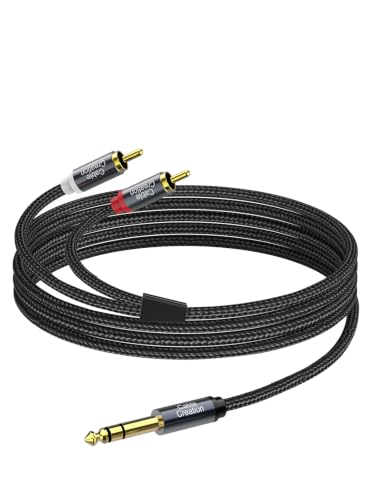
For a longer run, this 10-foot cable reaches farther than the 6.6-foot alternatives. Its 1/4-inch TRS male plug connects to a compatible jack, while the two RCA male plugs carry the left and right connections. The maker says its oxygen-free copper conductors and dual shielding help reduce interference and signal loss; the nylon-braided jacket is another distinguishing feature. Choose it when the equipment is farther apart and both ends match those ports. Its length can leave extra cable to manage in a compact setup.
Bottom line: Choose this when you need up to 10 feet of reach and matching TRS and dual RCA ports.
MOSWAG 1/4-inch to Dual RCA, 6.6 ft

For a shorter connection, this 6.6-foot cable is half the length of the 10-foot option. It connects a 1/4-inch audio jack to two RCA inputs, making it suitable for compatible mixers, receivers, amplifiers, or speakers. The maker says its oxygen-free copper conductors and dual shielding help suppress interference and signal loss. Pick it when the devices sit close together and a shorter cable will keep the installation neater. It offers less reach than a 10-foot cable, so measure the route around furniture or racks before settling on it.
Bottom line: Choose this for a nearby stereo setup that needs a 6.6-foot cable.
Poyiccot RCA to 1/4-inch TRS Female Adapter

Unlike the male-to-male cables, this short adapter has two RCA male plugs and a 1/4-inch TRS female jack. It is intended to connect an RCA-output device to equipment with a 1/4-inch TRS input, using an existing RCA cable; that direction is the reverse of a 1/4-inch output feeding RCA inputs. The adapter measures 10 inches and has shielded construction. Choose it when you need to reuse an RCA cable and the destination has a 1/4-inch TRS input. It is not a stand-alone long cable and does not provide a 3.5mm microphone connection.
Bottom line: Choose this only when adapting RCA outputs toward a 1/4-inch TRS input.
How to choose a TRS jack to RCA cable
Start by matching the plug at each end, then check whether your gear uses stereo or balanced audio. A 1/4-inch TRS plug has tip, ring, and sleeve contacts; two RCA plugs commonly carry separate left and right stereo channels. A TRS-to-dual RCA cable is not automatically a balanced-to-unbalanced converter: the TRS connector can carry either stereo or balanced mono, depending on the equipment. Read the device labels or manual to confirm the jack’s role. For a stereo connection, connect the left and right RCA plugs to their matching inputs. Pick a length that follows the actual cable route, not just the straight-line gap.
TRS stereo and balanced audio are different
A TRS connector describes three contacts, not one fixed audio format. In stereo headphone wiring, tip is left, ring is right, and sleeve is common; in balanced mono wiring, tip and ring carry the signal pair and sleeve is ground or shield. RCA connections are normally unbalanced, with one signal contact and an outer ground. That means a cable with one TRS end and two RCA ends can serve a stereo split, but it does not make an unbalanced RCA input balanced. Check whether the TRS port is labeled stereo, phones, balanced, or mono before connecting equipment; the same plug shape may serve different functions.
Match the cable direction and length
For a 1/4-inch TRS output feeding RCA inputs, choose a cable with a 1/4-inch male plug at the source end and two RCA male plugs at the destination end. A short adapter with a 1/4-inch female jack and RCA plugs is a different arrangement: it accepts a 1/4-inch plug at one end of an existing cable and sends the connection toward RCA equipment, or in this case routes an RCA source toward a TRS input according to its design. Measure the full route, including turns around equipment. Leave a little slack, but avoid coiling several extra feet behind hot or tightly packed components.
| Need | Connector choice | What to verify |
|---|---|---|
| 1/4-inch output to stereo RCA inputs | 1/4-inch TRS male to two RCA male plugs | TRS jack is stereo output |
| RCA source to 1/4-inch input using existing cable | Two RCA plugs to 1/4-inch TRS female jack | TRS destination accepts the signal type |
| Balanced mono output | Use a cable suited to the device’s balanced wiring | Both devices’ input/output requirements |
Connect RCA left and right correctly
Two RCA plugs usually represent separate stereo channels, so keep left connected to left and right to right. Consumer RCA plugs are commonly white for left and red for right, though equipment labels are the more reliable guide. A single 1/4-inch TRS plug can instead represent balanced mono, so do not assume two RCA plugs always preserve balanced operation or produce a stereo signal. Turn down amplifier or mixer levels before connecting or disconnecting audio cables to reduce pops. If a device has a dedicated balanced output and the receiving RCA input hums or behaves unexpectedly, use a connection method specified for those devices rather than treating TRS and RCA as interchangeable formats.
Frequently Asked Questions
Can a 1/4-inch TRS plug carry stereo audio?
Yes, a 1/4-inch TRS plug can carry stereo headphone audio, with tip and ring carrying left and right and sleeve as common. The same connector can also carry balanced mono, so confirm the port’s function before wiring it to RCA inputs.
Are TRS to RCA cables balanced?
Not necessarily. RCA connections are normally unbalanced, and the TRS end may be wired for stereo or balanced mono; the cable alone does not make an RCA connection balanced.
Which RCA plug is left and right audio?
RCA audio plugs are commonly white for left and red for right. Follow the L and R labels on the equipment if the colors are absent or different.
How much slack should an audio cable have?
Measure the route around the equipment and allow a small amount of slack for movement and strain relief. Avoid pulling plugs taut or leaving large coils next to power supplies, since tightly packed cable runs can complicate setup and troubleshooting.
Can I connect a microphone with a TRS to RCA cable?
A standard TRS-to-dual RCA stereo cable is not a general microphone connection. Microphones can require a specific balanced input and, for some types, phantom power, so use an input designed for that microphone instead.