
Boost AFM Disabler: Modes, Fit and Alternatives

BOOST AFM Disabler is the closest match for drivers seeking a Boost AFM disabler that keeps a GM vehicle in V8 or V6 mode continuously. Choose Boost DFM Disabler instead if you have a supported newer Silverado, Sierra, or GM SUV and prefer its 40-mph activation behavior; its DFM can still engage before that point.
AFM and DFM are GM cylinder-deactivation systems that let some engines operate on fewer cylinders under certain conditions.
We earn a commission if you buy through links on this page. As an Amazon Associate I earn from qualifying purchases. Products are compared on manufacturer specifications, not hands-on testing.
- Best overall: BOOST AFM Disabler – Its maker says it keeps the vehicle in V8 or V6 mode all the time.
- Best for newer GM vehicles: Boost DFM Disabler – It activates after reaching 40 mph and is specified for particular newer GM vehicle ranges.
- Best for start/stop control: Carbyte AFM/DFM and Start/Stop Eliminator – It combines AFM/DFM disabling with an auto start/stop eliminator.
| Product | Best for | Vehicle coverage | Operating behavior | Added function | Shop |
|---|---|---|---|---|---|
| BOOST AFM Disabler | Continuous V8 mode | GM V6 and V8 vehicles | V8/V6 mode all the time | — | Check Price on Amazon |
| Boost DFM Disabler | Newer GM vehicles | 2022.5–2026 Silverado/Sierra | Activates at 40 mph | Auto start/stop off after activation | Check Price on Amazon |
| Carbyte AFM/DFM and Start/Stop Eliminator | Start/stop control | 2005–2024; select 2025 GM vehicles | Full-time V8 mode | Auto start/stop disable | Check Price on Amazon |
| OBDCAR AFM/DFM Disabler | Basic plug-in use | GM V6 and V8 vehicles | Plug in to activate | — | Check Price on Amazon |
| OBDDFM AFM/DFM Disabler | Non-invasive setup | GM V6 and V8 vehicles | Plug in to activate | — | Check Price on Amazon |
Boost AFM Disablers and Alternatives
Compare each device’s vehicle fit and operating behavior before choosing one for your GM vehicle.
BOOST AFM Disabler
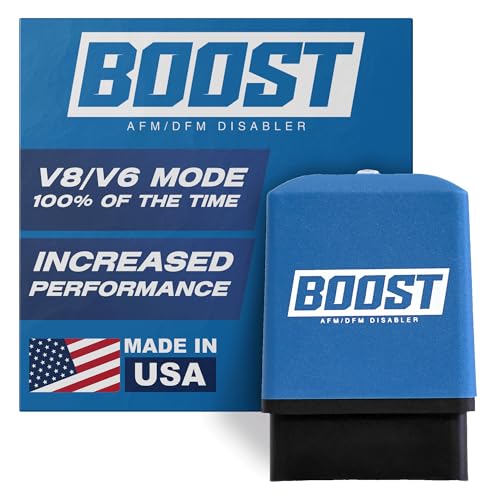
Unlike the model with a 40-mph activation point, this BOOST device is described as keeping a GM vehicle in V8 or V6 mode all the time. The maker says it disables AFM and DFM, and reports a low-power draw of 0.71 mA. It suits drivers who want continuous cylinder-deactivation control rather than a device that waits until a speed threshold. The maker also claims improved throttle response and reduced lifter-failure risk; those are performance and reliability claims, not guarantees. Confirm your exact vehicle compatibility before choosing it.
Bottom line: Choose this if continuous V8 or V6 operation is your priority.
Boost DFM Disabler

This BOOST device differs from the continuous-mode option because DFM and auto start/stop may operate normally until the first time you reach 40 mph on a drive. After that, the maker says the engine stays in V8 mode and zero-cylinder coasting is disabled. Its vehicle range is limited to 2022.5–2026 Silverado/Sierra and 2021–2024 GM SUVs, so it is a more targeted choice than a broadly described GM device. The 40-mph threshold matters if you want DFM disabled immediately after startup; this model does not promise that behavior.
Bottom line: Pick this for a newer GM vehicle if delayed activation works for your driving.
Carbyte AFM/DFM and Start/Stop Eliminator

Carbyte adds auto start/stop control to its AFM/DFM disabling, unlike the BOOST choices here, which focus on cylinder-deactivation behavior. The maker says it provides full-time V8 operation and plugs into the OBD-II port without an app for these functions. Its compatibility range includes 2005–2024 GM vehicles and select 2025 models, with specific coverage noted for newer SUVs, trucks, and 10-speed transmission vehicles. This combination may suit drivers who want both functions addressed by one device. The broad year range does not establish fit for every GM vehicle, so confirm the supported-vehicle match.
Bottom line: Choose this if you want start/stop control alongside full-time V8 mode.
OBDCAR AFM/DFM Disabler

OBDCAR is a basic plug-in alternative described for GM V6 and V8 vehicles with active or dynamic fuel management; unlike the BOOST models, the product features do not describe a speed threshold or a specific operating mode. The maker says setup is fast and that unplugging returns the vehicle to factory settings without reprogramming the ECU. That reversible, non-reprogramming approach may appeal to drivers seeking a simple device rather than added start/stop control. The specifications cautions buyers to verify fit, so check compatibility with your exact vehicle before purchase.
Bottom line: Consider this if you want a simple plug-in device and can verify exact fit.
OBDDFM AFM/DFM Disabler

OBDDFM also targets GM V6 and V8 vehicles, but its distinction is a non-invasive plug-in design that does not modify factory ECU programming. The maker says the device begins working immediately and that removing it restores factory settings. Those traits make it relevant for drivers seeking a reversible option without an added start/stop function. Its features do not establish vehicle-specific compatibility, so it is less clearly targeted than the newer-vehicle BOOST DFM model or Carbyte’s year coverage. Verify fit for your vehicle before choosing it.
Bottom line: Choose this if a reversible plug-in design matters more than added controls.
How to Choose an AFM Disabler
Choose by vehicle compatibility first, then by when the device changes cylinder-deactivation behavior. AFM and DFM are not interchangeable names for every GM vehicle: the correct system and supported model depend on the engine and vehicle configuration. A continuous-mode device aims to keep the engine in V8 or V6 mode throughout a drive, while a threshold-based model may allow DFM to operate until its trigger condition is met. For example, a 40-mph threshold means the system may still engage below that speed. Decide whether auto start/stop control is also a requirement; some devices combine that function with cylinder-deactivation control and others do not. Match the vehicle range and behavior to your actual priorities rather than choosing by brand alone.
Vehicle Fit and OBD-II Port Checks
Confirm the exact year, model, engine, and fuel-management system before selecting a plug-in device. A broad claim of GM V6 or V8 compatibility does not mean every GM vehicle is supported, and a device with a defined year range may still have exceptions. OBD-II diagnostic ports are generally inside the passenger compartment, commonly beneath the dashboard near the steering column; the device occupies that port while connected. If you regularly use a scan tool, check whether your setup allows access when the disabler is installed. Never force a connector into the port. A poor fit or wrong configuration can prevent intended operation, so verify the match with the vehicle-specific compatibility criteria before ordering.
Continuous Mode Versus Speed-Triggered Operation
Continuous-mode and speed-triggered AFM/DFM devices differ in when cylinder deactivation can remain active. A continuous-mode product is intended to keep the engine in its V8 or V6 mode from the start, while a threshold-based device may allow DFM operation before reaching its trigger speed. That distinction matters most on short trips or routes where the vehicle rarely reaches the threshold. The table compares the basic behavior and added control described for these devices.
| Device approach | Behavior to look for | Choose when |
|---|---|---|
| Continuous mode | V8/V6 mode all the time | You want no stated speed trigger |
| Speed-triggered | May allow DFM until trigger | The threshold suits your routes |
| Combined control | AFM/DFM and start/stop functions | You want both functions addressed |
Do not assume that all disablers use the same activation logic merely because they plug into the diagnostic port.
Fuel Economy, Emissions, and Safe Use
Disabling cylinder deactivation can affect fuel economy because the engine may operate on more cylinders instead of using its fuel-saving mode. The size of any change depends on the vehicle, route, and driving pattern, so do not treat a maker’s performance claims as a guaranteed outcome. Emissions and vehicle-modification rules vary by location; check your state and local requirements before changing engine-control behavior, especially where inspection or emissions testing applies. Keep the device and connector clear of pedals and moving parts, and do not attempt installation while driving. If a warning light appears or the vehicle behaves unexpectedly after installation, disconnect the device only when safely parked and seek qualified diagnosis rather than assuming the cause.
Frequently Asked Questions
Can an AFM disabler improve fuel economy?
Usually, disabling cylinder deactivation can reduce the fuel-saving benefit of operating on fewer cylinders. The actual effect depends on the vehicle, route, and driving pattern.
Does a plug-in disabler reprogram the ECU?
Some plug-in devices are described as non-reprogramming and reversible when unplugged. Verify that behavior for the specific device and vehicle before installation.
Will a disabler work with every GM V8?
No; fit depends on the vehicle, engine, model year, and AFM or DFM system. Check the exact compatibility range rather than relying on a general GM V8 description.
What does a 40 mph activation point mean?
A device with that trigger may allow DFM to operate until the vehicle reaches 40 mph on a drive. That matters for short trips or routes that do not reach the threshold.
Can I still use an OBD-II scan tool?
A plug-in disabler uses the vehicle’s OBD-II port, so it may occupy the connector while installed. Check how your scan tool will connect before leaving a device in the port.