
Diesel Fuel Primer Pumps: 4 Models Compared by Fit

For a diesel fuel primer pump with a 3-gallon tank and 6-foot hose, start with OTC 5869 Diesel Fuel Priming Pump; its included Compu-check quick-connect is the deciding feature for compatible systems. Choose another pump if your engine is outside its selective fit or you need a pressure gauge, which several alternatives include.
A primer pump pressurizes fuel to help purge air after fuel-system service, but the engine connection must match your application.
We earn a commission if you buy through links on this page. As an Amazon Associate I earn from qualifying purchases. Products are compared on manufacturer specifications, not hands-on testing.
- Best overall: OTC 5869 Diesel Fuel Priming Pump – A 3-gallon stainless tank, 6-foot hose and Compu-check quick-connect are specified.
- Best for gauge monitoring: J-47912 Stainless Steel Primer with Gauge – Includes a pressure gauge and names several Detroit Diesel and MaxxForce engine families.
- Best for a carry strap: J-47912 Upgraded 3-Gallon Primer – Pairs a 3-gallon tank with a pressure gauge and shoulder strap.
- Best for a complete kit: CarBole J-47912 3-Gallon Primer Kit – Specifies a 3-gallon tank, 6-foot hose, pressure gauge and shoulder strap.
| Product | Best for | Tank capacity | Hose / gauge | Shop |
|---|---|---|---|---|
| OTC 5869 Diesel Fuel Priming Pump | Compu-check connection | 3 gal | 6 ft hose; no gauge stated | Check Price on Amazon |
| J-47912 Stainless Steel Primer with Gauge | Gauge monitoring | — | — / gauge included | Check Price on Amazon |
| J-47912 Upgraded 3-Gallon Primer | Strap-assisted carrying | 3 gal | — / gauge included | Check Price on Amazon |
| CarBole J-47912 3-Gallon Primer Kit | Kit accessories | 3 gal | 6 ft hose; gauge included | Check Price on Amazon |
Diesel fuel primer pumps
Match the pump’s engine fit and connections to your service procedure before choosing by tank and monitoring features.
OTC 5869 Diesel Fuel Priming Pump

The OTC 5869 stands apart with a specified Compu-check quick-connect fitting on its 6-foot pressure hose. Its stainless steel tank holds 3 gallons, and a hand pump pressurizes the tank to supply diesel fuel while air is purged from a compatible system. The maker identifies select Detroit Diesel Series 60 and Mercedes-Benz MBE900 and MBE4000 applications, so this is a fit-led choice rather than a universal primer. Choose it when the fitting and engine application match your service setup; the available features do not include a pressure gauge, which matters if you want to monitor pressure visually.
Bottom line: Pick this when its Compu-check fitting matches your connection and you do not need a gauge.
J-47912 Stainless Steel Primer with Gauge
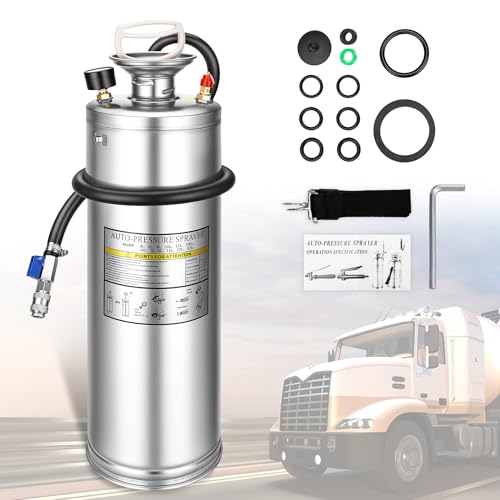
The distinguishing feature of this J-47912-style pump is its included pressure gauge, which provides a visual reading during priming. The maker names Detroit Diesel DD13, DD15, Series 60, MBE900 and MBE4000 engines, plus MaxxForce 11, 13 and N13 with specified emissions-system conditions. Choose this model when the named engine family and gauge are priorities; confirm the connection and working capacity for your application before ordering.
Bottom line: Choose this if your engine is among the named applications and you want a gauge.
J-47912 Upgraded 3-Gallon Primer

This upgraded J-47912-style pump specifies a 3-gallon tank and a pressure gauge, plus a shoulder strap for carrying. Its maker names Detroit Diesel Series 60, MBE900, MBE4000, DD13, DD15 and N13 with SCR technology, as well as MaxxForce 11 and 13 with post-SCR implementation. The gauge and reinforced stainless steel construction distinguish it from a simpler hand-pump setup, while the tank volume supports longer purge sessions than a smaller container would. Choose it when the fit and carrying strap suit the job; no hose length or connector type is given, which matters when planning reach and hookup.
Bottom line: Pick this for its 3-gallon tank and strap when the engine fit matches.
CarBole J-47912 3-Gallon Primer Kit

The CarBole kit combines a specified 3-gallon stainless steel tank with a 6-foot hose, pressure gauge and adjustable shoulder strap. Its maker describes it as an alternative for Detroit Diesel Series 60, MBE900, MBE4000, DD13 and DD15, and named MaxxForce families, including N13 with SCR. That accessory set makes it useful when transport and pressure monitoring are both part of the job. Match the engine and connector to your system before use; the hose length alone does not establish that its end fitting matches a particular vehicle.
Bottom line: Choose this when you want the specified hose, gauge and carry strap together.
How to choose a diesel fuel primer pump
Choose by engine application and connector first, then compare tank capacity and monitoring features. Priming pumps supply fuel pressure to help move air out after service; they do not replace the engine’s specified service procedure. A 3-gallon tank is useful for extended purge sessions, while hose reach and fitting compatibility determine whether the pump can connect conveniently. A gauge gives a visible pressure reading, but the correct target pressure is application-specific. Before ordering, match the engine family and connector to the service procedure, and verify any required pressure range rather than assuming a gauge makes every pump suitable.
For common-rail diesel engines, fuel on the high-pressure side can cause severe injection injuries. Never loosen a high-pressure line while the engine is running or use a hand to search for a leak; follow the manufacturer’s depressurization and priming procedure.
Engine fit and connection compatibility
Engine-family fit is the first compatibility check because a primer’s hose end must mate with the system’s service connection. These pumps name Detroit Diesel Series 60, MBE900, MBE4000, DD13 and DD15 applications in varying combinations; MaxxForce coverage also depends on the model and emissions configuration. A shared J-47912 reference does not by itself prove that every connector, pressure range or included accessory is identical. Check the exact engine designation and connection at the intended priming point. When application notes say “select” engines or specify post-SCR models, use that limitation as a reason to confirm fit, not as a guarantee for every engine in the family.
Tank capacity, hose reach and gauge
Tank capacity sets how much fuel is available during a priming session, while hose length controls where the container can sit relative to the connection. Three gallons equals 12 quarts, a useful conversion when comparing stated capacity with a service procedure. A longer hose can ease positioning, but the connector still has to match. A pressure gauge lets you observe the reading as you pressurize the system; it does not establish the correct target on its own. This comparison summarizes the differences stated for these pumps.
| Need | Choose a pump with |
|---|---|
| Longer purge session | Stated 3-gallon tank |
| Known connection reach | Stated 6-foot hose |
| Visible pressure reading | Included gauge |
| Carry between work areas | Shoulder strap |
Safe priming and common mistakes
Use the primer only at the designated low-pressure service connection and keep high-pressure fuel lines closed during operation. Diesel fuel from an injection leak can penetrate skin, so never test a suspected leak with fingers; shut down and use the engine maker’s inspection procedure. A common mistake is cranking repeatedly before air has been purged, which can prolong starting and put unnecessary demand on the starter. Another is choosing by engine name alone while overlooking connector type or required pressure. Keep fuel clean and use a clean container and hose; contamination introduced during priming can enter the fuel system.
Frequently Asked Questions
When should I use a diesel fuel primer pump?
Use a primer after work that introduces air into the low-pressure fuel system, such as replacing a filter, when the engine procedure calls for it. Purging before cranking helps avoid extended dry cranking.
How much fuel does a 3-gallon primer hold?
A 3-gallon tank holds 12 quarts. The amount needed for a priming session depends on the system and service procedure, so tank capacity alone does not determine how long to pump.
Can one primer pump fit every diesel engine?
No; engine family and service-connection type determine compatibility. Confirm the exact engine designation and fitting, especially when a pump’s application is limited to select engines or emissions configurations.
Is it safe to loosen a diesel fuel line while priming?
Do not loosen a high-pressure fuel line while an engine is running. High-pressure diesel can penetrate skin; use the engine maker’s depressurization and priming procedure at the designated connection.
What does a pressure gauge tell me during priming?
A gauge provides a visible pressure reading while the tank is pressurized. The correct target is specific to the engine, so use the procedure for that application rather than assuming a general pressure value.