
Spiral Ear Wax Removal Tools Compared by Design

For a spiral ear wax removal tool, QGrips Spiral Ear Wax Tool is the closest match because it has a twist-style handle and 16 washable replacement tips. Smart Swab Spiral Ear Cleaner also has soft silicone spiral tips, while Stainless Steel Spiral-and-Scraper Tool is a stainless steel spiral-and-scraper tool rather than a soft-tip kit.
However, inserting any tool into the ear canal can push wax deeper or injure the canal or eardrum. Choose a non-inserting approach if you have ear pain, drainage, prior ear surgery, a perforated eardrum, or tubes.
We earn a commission if you buy through links on this page. As an Amazon Associate I earn from qualifying purchases. Products are compared on manufacturer specifications, not hands-on testing.
- Best overall: QGrips Spiral Ear Wax Tool – A twist-style spiral handle comes with 16 washable replacement tips.
- Best for a carry case: Smart Swab Spiral Ear Cleaner – A reusable handle and 16 soft silicone tips are paired with a portable case.
- Best for a metal tool: Stainless Steel Spiral-and-Scraper Tool – The stainless steel tool has both a rotating spiral-and a scraper.
| Product | Best for | Tip or tool material | Reusable tips or count | Design | Shop |
|---|---|---|---|---|---|
| QGrips Spiral Ear Wax Tool | Washable spiral tips | Soft, flexible tips | 16 washable tips | Twist handle | Check Price on Amazon |
| Smart Swab Spiral Ear Cleaner | Portable tip storage | Soft silicone | 16 replacement tips | Spiral with stopper | Check Price on Amazon |
| Stainless Steel Spiral-and-Scraper Tool | Two-ended metal tool | Stainless steel | Single tool | Spiral and scraper | Check Price on Amazon |
Spiral Ear Wax Removal Tools
Compare the tip materials and tool designs, and weigh the risks of inserting any implement into the ear canal.
QGrips Spiral Ear Wax Tool

QGrips Spiral Ear Wax Tool is the clearest match for a reusable spiral tool with replacement tips: it comes with 16 washable tips and a handle marked for the direction of twisting. The maker says the tips can be rinsed with water and replaced by pressing the sides of a tip. Its mixed tool set is intended for different earwax types and ear canal sizes, though that does not establish a safe fit for every person. The limitation is important: washable tips do not make insertion risk-free. Avoid placing the tool in the canal if you have ear symptoms or a history of ear problems.
Bottom line: Choose this if washable replacement tips are your priority and you have no ear-related risk factors.
Smart Swab Spiral Ear Cleaner
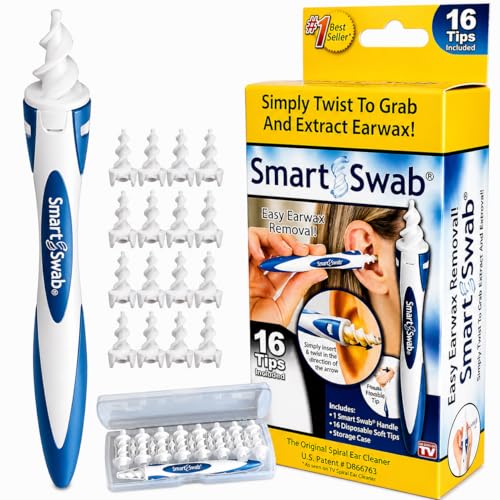
Smart Swab Spiral Ear Cleaner is the only option here that pairs 16 soft silicone tips with a portable case and a built-in safety stopper. Its reusable handle uses a twist-style spiral design, and the maker says the flexible tips are intended for adults and children. The stopper may limit insertion, but it cannot eliminate the risk of injury or wax being pushed deeper. Confirm the stopper’s fit and use only as directed; do not use a canal tool on a child without medical guidance. The specifications describe the replacement tips as both disposable and reusable, so their intended reuse should be confirmed before purchase.
Bottom line: Choose this if portable storage and an insertion stop matter most.
Stainless Steel Spiral-and-Scraper Tool

Stainless Steel Spiral-and-Scraper Tool differs from the soft-tip options by combining a rotating spiral head and a scraper on one 5-inch stainless steel tool. The two ends give it distinct shapes for removal, but the rigid metal construction makes careful handling especially important around the delicate ear canal. The maker describes the surface as polished and corrosion-resistant; those qualities do not establish that the tool is safe to insert. This is a poor fit for anyone who needs a flexible, soft tip or has ear pain, drainage, a perforated eardrum, tubes, or prior ear surgery.
Bottom line: Choose this only if you specifically want a double-ended metal tool and understand the insertion risks.
How to choose an earwax removal tool
For most people, the safest choice is not to insert a tool into the ear canal: earwax usually migrates outward on its own. A spiral tip, a scoop, and a rigid scraper work by contact, so each can irritate the canal or push wax toward the eardrum. A useful decision rule is to skip all canal tools if you have ear pain, drainage, a history of eardrum perforation or ear tubes, or prior ear surgery; ask a clinician instead. If you are choosing among these designs despite that risk, distinguish flexible silicone tips from rigid metal, then check whether a replacement tip is washable or disposable. A soft tip does not make deep insertion safe.
Spiral tips, scrapers, and flexible scoops
Spiral tools use ridges or a coiled head to collect wax as the handle turns; scraper designs remove wax by contact, and scoop-and-fin tools use a different profile. This distinction matters because none reaches a dependable safe depth just because its tip is narrow or flexible. The table summarizes what separates the tool types in this selection; the design is not a safety ranking.
| Tool type | Construction | Key distinction |
|---|---|---|
| Spiral replacement-tip tool | Flexible silicone or similar tip | Twist-style use; replacement tips |
| Spiral-and scraper | Stainless steel | Two different ends on one tool |
| Scoop and fin | Flexible tool | Non-spiral profile |
Never treat a stopper, flexible material, or polished surface as permission to push a tool farther into the ear.
When home earwax care is appropriate
For mild blockage without pain, drainage, or a history of eardrum problems, clinicians commonly recommend wax-softening drops or irrigation only when appropriate for the person. Drops such as carbamide peroxide may be unsuitable when there is a perforated eardrum, ear tubes, or prior ear surgery, so those conditions call for professional advice rather than home canal tools. Do not use drops or flush an ear that is painful or draining without medical guidance. A cotton swab is not a safer substitute inside the canal; it can push wax deeper. If hearing loss or a blocked feeling persists after a few days, arrange an examination instead of escalating tool use.
Cleaning and replacing reusable tips
Reusable tips need cleaning between uses, but cleaning does not make a tip safe for sharing. One person’s canal can carry microbes or irritation risks, so keep personal ear tools to one user and replace damaged or loosened tips. Follow the maker’s cleaning directions for washable tips; do not assume all silicone or metal tools tolerate boiling, alcohol, or dishwasher cycles. A tip that cracks, deforms, or detaches should not be used. For shared family care, safer practice is to avoid inserting a common tool and seek professional guidance when wax causes symptoms.
Frequently Asked Questions
Can spiral earwax tools damage the eardrum?
Yes, an inserted tool can injure the ear canal or eardrum, especially if pushed deeply or used during sudden movement. A stopper may limit insertion but cannot guarantee protection.
How often should I remove earwax at home?
Most ears do not need routine wax removal because wax normally moves outward on its own. For recurring blockage, seek clinical advice rather than using a spiral tool on a schedule.
Can I use a spiral ear cleaner on a child?
Do not insert a spiral cleaner into a child’s ear without guidance from a clinician. A child can move unexpectedly, and a soft tip does not prevent canal or eardrum injury.
What should I do if earwax blocks my hearing?
Arrange an ear examination if blockage or reduced hearing persists, particularly with pain, drainage, dizziness, or ringing. Avoid tools and home flushing when you have ear tubes, a perforation, or prior ear surgery.
Are washable silicone ear tips safe to share?
No, keep reusable ear tips for one person even if the maker says they can be washed. Cleaning can reduce residue but does not establish that sharing a canal tool is safe.