
50 Amp Power Supply Options Compared by Output and Fit

For a bench setup that needs adjustable output and several connection options, Jesverty SPS-50II is the most versatile fit, with 9–15V adjustment, screw terminals and auxiliary outputs. Choose another model if you need USB charging, Anderson Powerpole connections or an enclosed supply for a fixed installation.
We earn a commission if you buy through links on this page. As an Amazon Associate I earn from qualifying purchases. Products are compared on manufacturer specifications, not hands-on testing.
- Best overall: Jesverty SPS-50II – Combines 9–15V adjustment with screw terminals, auxiliary terminals and a cigarette lighter socket.
- Best for Powerpole connections: BTECH RPS-50PRO – Offers Anderson Powerpole connectors, USB-C and a cigarette plug alongside a 50A back terminal.
- Best for fixed 12V projects: VAYALT 12V 600W Switching Supply – Provides a 12V output and up to 600W in an enclosed switching supply.
- Best for USB charging: Pyramid PSV500 – Pairs a 12–15V adjustable output with dual USB ports and screw terminals.
| Product | Best for | Output voltage | Main connections | Dimensions (inches) | Shop |
|---|---|---|---|---|---|
| Jesverty SPS-50II | Flexible bench setups | 9–15V; fixed 13.8V option | Screw terminals; auxiliary snap-in terminals | 11.02 × 5.11 × 6.69 | Check Price on Amazon |
| BTECH RPS-50PRO | Powerpole connections | Adjustable 9–15V; fixed 13.8V option | 45A Powerpole; 50A back terminal | 11.0 × 7.5 × 3.5 | Check Price on Amazon |
| VAYALT 12V 600W Switching Supply | Fixed 12V projects | 12V ±10% adjustment | Terminal output; connection type not given | 8.46 × 1.97 × 4.52 | Check Price on Amazon |
| TekPower TP50SW | Radio bench use | 9–15V adjustment | Cigarette plug | — | Check Price on Amazon |
| Pyramid PSV500 | USB-equipped benches | 12–15V adjustment | Screw terminals; dual USB ports | 10.83 × 11.06 × 3.35 | Check Price on Amazon |
50 Amp Power Supplies Compared
Compare each supply’s voltage adjustment and output connections with the equipment you plan to power.
Jesverty SPS-50II

The SPS-50II stands out for its broad front-panel connection choices and adjustable output. It has large screw-type main terminals, two pairs of auxiliary snap-in terminals, a cigarette lighter socket and analog voltage and current meters. The output adjusts from 9 to 15V or can be set to 13.8V, which suits a bench with different DC devices. Jesverty says its noise offset circuit shifts switching noise to another frequency. The features do not give a continuous-output rating, so confirm that rating if your equipment must draw 50A continuously.
Bottom line: Choose this for a bench that needs several connection styles and adjustable voltage.
BTECH RPS-50PRO

The RPS-50PRO separates itself with an Anderson Powerpole output and USB-C, alongside a back terminal rated to 50A. Its Powerpole connector is rated to 45A, while the cigarette output is rated to 10A; those limits matter when choosing which connection to use for a load. BTECH says the supply provides 50A continuous output and has adjustable noise offset. The voltage is adjustable from 9 to 15V, with a fixed 13.8V option. Its lower 45A Powerpole rating means a device requiring the full 50A should use the back terminal instead.
Bottom line: Pick this if Powerpole and USB-C outputs matter, and use the back terminal for a 50A load.
VAYALT 12V 600W Switching Supply

The VAYALT differs from the bench-style radio supplies by offering a compact enclosed switching supply format for fixed 12V projects. Its output adjusts by ±10%, and its maximum is 600W or 50A; at 12V, 50A corresponds to 600W. The maker recommends sizing for at least 1.25 times the load’s power for resistive devices and more than twice motor power, and says variable-speed motors are not applicable. This is a poor match for a motor project that needs variable-speed control, and its output connection style should be confirmed for your wiring plan.
Bottom line: Choose this for a 12V project that fits its power and load-type guidance.
TekPower TP50SW

The TP50SW keeps the feature set straightforward: adjustable 9–15V output, a cigarette plug and a 50A maximum-current figure. TekPower positions it for ham and CB radio use and describes the output as high-stability 13.8V DC. That focus may suit a radio bench where the cigarette connection matches the equipment. The specifications do not establish the type or rating of a separate main terminal, so this is less clear a fit when your setup requires a particular high-current connector. Check the connection and continuous-output ratings before relying on it for a 50A draw.
Bottom line: Pick this for a radio setup that uses a cigarette plug and does not require an unverified connector.
Pyramid PSV500
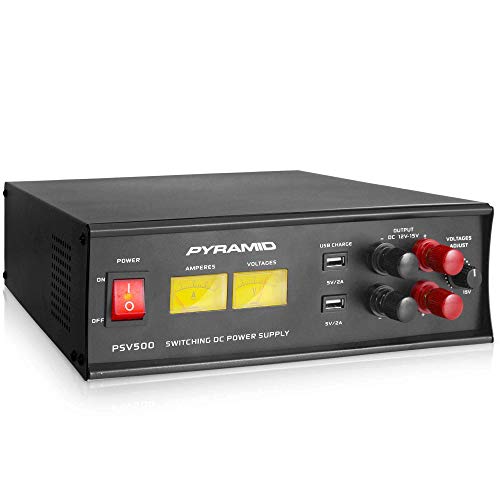
The PSV500 adds two USB ports to a bench supply with 12–15V adjustable output and screw terminals. That combination is useful when a workbench needs both a variable DC connection and USB charging without relying solely on the main output terminals. Pyramid describes the unit as a variable linear / regulated supply and includes overload protection. Its voltage range starts at 12V, unlike models here that extend down to 9V, so equipment requiring less than 12V is outside its adjustment range. Choose it when USB ports are useful and the connected DC gear accepts 12–15V.
Bottom line: Choose this when dual USB ports and 12–15V adjustment fit your bench needs.
How to Choose a 50 Amp Power Supply
Start with the load’s voltage and current, then match the connection and supply format. A 12V device drawing 50A requires 600W of DC output; at 13.8V, 50A corresponds to 690W. Those calculations describe output power, not the supply’s AC input needs. A bench supply is convenient when equipment changes or needs front-panel controls, while an enclosed switching supply can suit a fixed installation. At loads near 50A, compare the rating of each individual connector—not just the supply’s headline current—and choose a connection rated for the load. If you need a 9V setting, exclude models whose range begins at 12V.
Understanding Voltage and Current Ratings
Voltage must match the device’s accepted input range; current is the amount the device draws, not a current the supply forces into every load. A regulated 12V supply can power a device rated for 12V if the supply can provide its required current. The 600W relationship at 12V and 50A helps identify loads that exceed the output rating: watts equal volts multiplied by amps. For example, a 700W load at 12V would require about 58.3A, above a 50A limit. Allow headroom rather than choosing a supply exactly at a load’s maximum, especially for equipment with startup surges.
Compare Bench and Enclosed Supply Types
Bench supplies put controls and access to output connections in a convenient package, while enclosed switching supplies are often used as components in a larger installation. The products here differ in connector types and voltage adjustment, so choose by wiring compatibility and load rather than form factor alone. This quick guide separates the main use cases:
| Need | Supply style | Check before choosing |
|---|---|---|
| Changing bench equipment | Bench supply | Voltage range and connector rating |
| Fixed 12V installation | Enclosed switching supply | Load type, mounting and wiring plan |
| Radio gear with accessory plugs | Bench supply with plug output | Current limit of that individual output |
An enclosure alone does not establish that a supply is suitable for outdoor, dusty or wet locations; verify environmental suitability for the installation.
Wiring a High-Current DC Supply Safely
A 50A low-voltage output can still overheat undersized wiring or create a short-circuit hazard. Disconnect AC power before wiring, prevent tools or loose conductors from bridging output terminals, and use wire and overcurrent protection sized for the current, conductor length and installation conditions. Longer runs have more voltage drop, so they may need larger conductors than short bench leads. Keep exposed terminals from contacting metal surfaces, and secure connections to reduce loosening under heat or vibration. Mains AC can cause fatal shock; enclosed supplies should be installed and wired with the input side de-energized and protected against accidental contact.
Frequently Asked Questions
How many watts does a 12V 50A supply provide?
A 12V supply delivering 50A provides 600W of DC output because watts equal volts multiplied by amps. At 13.8V and 50A, the output is 690W.
Can a 50A supply power a 12V device?
Yes, if the device accepts 12V and the supply can provide the device’s current draw. A device drawing 20A at 12V uses 240W, below a 50A supply’s 600W output at that voltage.
Does a 50A power supply force 50 amps into equipment?
No, a regulated supply provides voltage and the connected device draws current according to its load. The supply’s current rating is its maximum available output, not a fixed current sent into every device.
What wire size is needed for a 50A DC supply?
There is no single wire size for every 50A setup because conductor length, insulation temperature rating, bundling and installation rules affect ampacity and voltage drop. Use a conductor and fuse or breaker sized for the actual run and conditions, and avoid selecting wire from current alone.
Can I run a motor from a 50A switching supply?
A motor’s startup current can exceed its running current, so compare the supply’s capacity with both values. The VAYALT maker recommends supply peak power above twice motor power and says variable-speed motors are not applicable.