
Best Automatic Fly Fishing Reels Compared by Retrieval

The Aventik automatic fly reel suits most anglers who want a lighter setup, weighing 4.52 ounces and holding 2- to 4-weight line. Choose the Pflueger instead for an aluminum frame and spool, or the Bigchub if you prefer lever retrieval and adjustable drag.
Automatic reels retrieve line with a spring mechanism, reducing the hand work needed to gather slack; they are distinct from conventional manual fly reels.
We earn a commission if you buy through links on this page. As an Amazon Associate I earn from qualifying purchases. Products are compared on manufacturer specifications, not hands-on testing.
- Best overall: Aventik Automatic Fly Reel – At 4.52 ounces, it is the lightest option and fits 2- to 4-weight line.
- Best for aluminum construction: Pflueger Size 44385 Automatic Fly Reel – Its aluminum alloy frame and spool are described as corrosion-resistant.
- Best for adjustable drag: Bigchub 75 mm Semi-Automatic Reel – The semi-automatic reel pairs lever retrieval with adjustable drag.
| Product | Best for | Weight | Retrieval | Shop |
|---|---|---|---|---|
| Aventik Automatic Fly Reel | Lightweight trout setups | 4.52 oz | Automatic trigger | Check Price on Amazon |
| Pflueger Size 44385 Automatic Fly Reel | Aluminum frame and spool | 11.2 oz | Automatic line trigger | Check Price on Amazon |
| Bigchub 75 mm Semi-Automatic Reel | Lever retrieval and drag | 6.1 oz | Semi-automatic lever | Check Price on Amazon |
Automatic Fly Fishing Reels Compared
Compare retrieval style, weight, and capacity to match a reel to your fishing setup.
Aventik Automatic Fly Reel

The Aventik is the lightest of these options at 4.52 ounces, making it a fit for anglers prioritizing a lighter reel for freshwater trout. Its maker describes a rapid automatic trigger system and a large-arbor design; the 76 mm outer diameter is sized for 2- to 4-weight fly line with 25 meters of 20-pound backing. The reel also has adjustable drag. Its line-weight range is narrower than a general-purpose reel choice, so anglers using heavier line should choose a different setup.
Bottom line: Choose this for a lighter reel matched to 2- to 4-weight line.
Pflueger Size 44385 Automatic Fly Reel
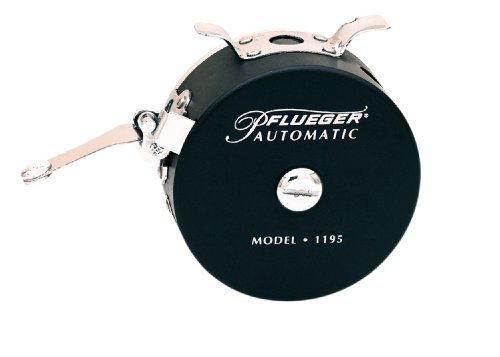
The Pflueger stands apart with an aluminum alloy frame and spool, while the other choices emphasize a lightweight graphite build or CNC-machined aluminum construction. Its maker describes the alloy as corrosion-resistant and says a quick pull of the line trigger winds line. The reel weighs 11.2 ounces and has a right handle position, making the configuration suitable for anglers who fish with the right hand. Its higher weight may matter to someone trying to keep a light rod-and-reel setup.
Bottom line: Pick this if an aluminum alloy frame and spool matter more than low weight.
Bigchub 75 mm Semi-Automatic Reel

The Bigchub differs from the automatic-trigger models because it is semi-automatic: pulling its lever retrieves line. It weighs 6.1 ounces and has a 75 mm CNC-machined aluminum body, adjustable drag, and quick spool removal for line changes and maintenance. The maker describes the reel as intended for freshwater lake, stream, and pond fishing. Its semi-automatic operation is a different choice from a fully automatic trigger mechanism, so buyers specifically seeking a fully automatic reel should favor one of the other options.
Bottom line: Choose this if lever retrieval and adjustable drag suit your preference.
How to choose an automatic fly reel
Choose by the line weight your rod uses, then compare retrieval style and reel weight. Automatic reels use a spring-loaded mechanism to retrieve slack when you operate a trigger; semi-automatic reels typically retrieve line through a lever pull, while standard fly reels use a hand-operated spool. The mechanism can gather line quickly, but it does not replace stripping line by hand during a cast or fighting a fish. Match the reel to the rod’s line-weight rating rather than assuming one reel fits every setup. A practical decision rule is to choose a reel with an explicitly matching line-weight range when available; the Aventik’s 2- to 4-weight capacity is a clear fit for that range.
Fly reels are commonly classified by line weight, and spool capacity depends on both line diameter and backing. A large-arbor design can reduce line memory compared with a small arbor, but the frame’s outside diameter alone does not establish how much line it holds.
Automatic and semi-automatic reel types
Automatic and semi-automatic reels differ in how the angler initiates retrieval. A spring-powered automatic mechanism winds line after trigger activation, while a semi-automatic mechanism uses a lever to retrieve line; either can reduce hand winding between casts. Manual reels remain the common baseline for fly fishing, with the angler controlling line pickup directly at the spool. This comparison includes two automatic-trigger choices and one semi-automatic choice, so the latter is a related alternative rather than the same mechanism.
Fly reel drag controls resistance on a running fish, but it does not replace keeping the rod and line under control. Use the drag to avoid an overly loose spool while retaining enough line tension for the fish and tippet. For lighter trout line, check that the reel’s line capacity and drag adjustment suit the line setup; a specified adjustable drag is useful, but it does not alone establish a drag range or maximum force.
Fly line, backing, and reel fit
Match the reel’s intended line weight to the rod before comparing arbor size. Fly line is rated by weight, and the rod’s rating is the key compatibility cue; backing adds reserve line but does not change the fly line weight. Reel capacity varies with line profile, backing thickness, and how tightly the spool is filled, so a capacity stated for a specific line and backing combination is more useful than diameter alone.
The Aventik specifies a setup of 2- to 4-weight line with 25 meters of 20-pound backing. Bigchub’s 75 mm and Pflueger’s size designation do not establish line-weight capacity by themselves, so confirm capacity against the exact line and backing you plan to use before ordering either one. A correct fit keeps line from overfilling the spool or leaving too little room for backing.
Care and safe reel handling
Rinse a reel with fresh water after saltwater exposure and dry it before storage; freshwater use still calls for removing grit that can interfere with a spool or spring mechanism. Keep sand and loose line away from moving parts, since debris can impede a trigger, lever, or drag. Do not force a jammed mechanism: unload tension and inspect for trapped line before operating it again.
Automatic mechanisms store spring energy, so avoid opening the housing unless the maker provides service instructions. Check drag and retrieval function before a fishing trip, and confirm the reel is securely attached to the rod. A smooth retrieval check with the line slack can reveal tangles without putting unnecessary strain on the line or mechanism.
Frequently Asked Questions
How does an automatic fly reel retrieve line?
An automatic reel uses a spring mechanism activated by a trigger to wind line onto the spool. The mechanism is for gathering slack, not a substitute for controlling line during a cast or fish run.
What line weight fits a small trout reel?
A 2- to 4-weight reel setup suits lighter trout tackle when the rod carries the same rating. The Aventik specifies that range with 25 meters of 20-pound backing.
What is the difference between automatic and semi-automatic fly reels?
An automatic reel winds line through a trigger-activated spring mechanism, while a semi-automatic reel retrieves line through a lever action. Choose by the mechanism you prefer to operate between casts.
How much backing should a fly reel hold?
Backing capacity depends on fly-line diameter, backing thickness, and spool fill, so there is no single amount for every reel. One stated setup here pairs 2- to 4-weight line with 25 meters of 20-pound backing.
How should I clean a fly reel after fishing?
After saltwater exposure, rinse the reel with fresh water and dry it before storage; after freshwater use, remove grit and debris. Keep sand away from the trigger, lever, and spool so the mechanism can move freely.