
12 Volt RV Air Conditioner: 4 Models Compared

For a 12 volt RV air conditioner with a 10,000 BTU cooling rating and supplementary heat, 12V 10,000 BTU Rooftop AC with Heater is a straightforward match. Choose Gidrox 12V 12,000 BTU Inverter AC instead if you want the highest cooling rating here, or EROMMY 12V 10,000 BTU AC if LED lighting and auto-swing airflow matter more than a lower unit weight.
These rooftop units use a 12-volt DC power supply, so match the unit to your roof opening and confirm your battery and wiring can support its electrical requirements before buying.
We earn a commission if you buy through links on this page. As an Amazon Associate I earn from qualifying purchases. Products are compared on manufacturer specifications, not hands-on testing.
- Best overall: 12V 10,000 BTU Rooftop AC with Heater – It pairs 10,000 BTU cooling with 4,500 BTU of supplementary heat in a 45-pound unit.
- Best for higher capacity: Gidrox 12V 12,000 BTU Inverter AC – Its 12,000 BTU cooling rating is the highest among these options.
- Best for airflow control: EROMMY 12V 10,000 BTU AC – It combines auto-swing airflow with an LED light.
| Product | Best for | Cooling capacity | Weight | Unit height | Shop |
|---|---|---|---|---|---|
| 12V 10,000 BTU Rooftop AC with Heater | Cooling plus heat | 10,000 BTU | 45 lb | 6.3 in | Check Price on Amazon |
| Gidrox 12V 12,000 BTU Inverter AC | Higher cooling capacity | 12,000 BTU | 52 lb | 7.0 in | Check Price on Amazon |
| EROMMY 12V 10,000 BTU AC | Adjustable airflow | 10,000 BTU | 72.75 lb | 7.7 in | Check Price on Amazon |
| Xenjum 12V 11,000 BTU AC with Heater | Soft-start feature | 11,000 BTU | 50 lb | 28.6 in | Check Price on Amazon |
12 Volt RV Air Conditioners
Compare cooling capacity, weight and features, then check roof fit and electrical compatibility for your RV.
12V 10,000 BTU Rooftop AC with Heater

Supplementary heat sets this unit apart from the cooling-only options here: it combines 10,000 BTU cooling with a 4,500 BTU PTC heater. The heater is intended for mild temperatures and small spaces, not as a primary heat source in extreme cold or a very large space. Its 45-pound weight is the lightest among these four units, and the 6.3-inch height may suit buyers prioritizing a low-profile rooftop unit. The maker says its brushless copper motor fans and spring-supported mounts are designed for quiet operation. Its cooling capacity is lower than Gidrox 12V 12,000 BTU Inverter AC’s 12,000 BTU rating.
Bottom line: Choose this unit if you want a lighter rooftop AC with supplementary heat.
Gidrox 12V 12,000 BTU Inverter AC

At 12,000 BTU, this unit has the highest cooling rating among these options and also includes a heat pump. The maker gives its heating capacity as 9,000 BTU and says the unit can run directly from an RV battery without an inverter. It reports average nighttime power use of about 350 watts in a 30°C ambient temperature; actual use depends on conditions and setup. At 52 pounds, it is heavier than 12V 10,000 BTU Rooftop AC with Heater but lighter than EROMMY 12V 10,000 BTU AC. The maker’s quiet-operation figures differ by mode, so check which mode a figure refers to when comparing noise claims.
Bottom line: Choose this option if the 12,000 BTU rating and heat pump fit your needs.
EROMMY 12V 10,000 BTU AC

Auto-swing airflow and an LED light distinguish this 10,000 BTU unit from the other models. The maker says its indoor noise level is 49 dB and that its airflow can be adjusted to avoid directing air straight at occupants. At 72.75 pounds, it is the heaviest of these four, so roof load and installation handling deserve extra attention. It is 7.7 inches tall, taller than 12V 10,000 BTU Rooftop AC with Heater and Gidrox 12V 12,000 BTU Inverter AC. Choose it for its airflow features rather than a lighter rooftop package or the largest cooling rating.
Bottom line: Pick this unit if adjustable swing airflow and an integrated LED light are priorities.
Xenjum 12V 11,000 BTU AC with Heater
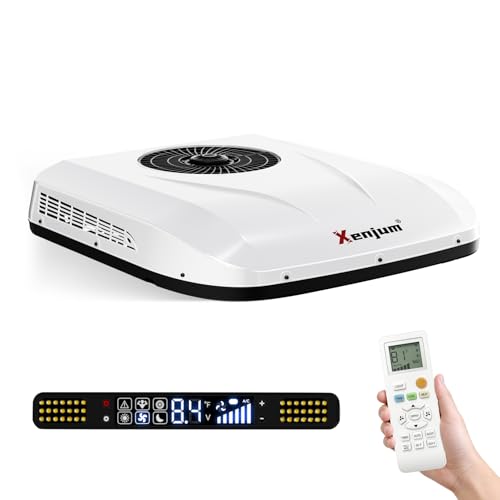
A built-in soft-start feature and 4,500 BTU of supplementary heat set this 11,000 BTU unit apart. The maker says soft start reduces startup power surge by 70% and claims up to 10 hours of continuous cooling with a 600 Ah battery; runtime depends on conditions and system setup. Its 50-pound weight falls between 12V 10,000 BTU Rooftop AC with Heater and EROMMY 12V 10,000 BTU AC. The height value is 28.6 inches, which is unusually large for a rooftop AC dimension, so confirm the unit’s actual orientation and installed clearance before ordering. The heat output is supplemental, not a substitute for a primary heater in severe cold.
Bottom line: Choose it if the soft-start feature and supplementary heat match your setup.
How to Choose a 12 Volt RV Air Conditioner
Start with cooling capacity, roof fit and the electrical system; a larger BTU rating alone does not establish compatibility. Cooling capacity is measured in BTU per hour, and 1,000 BTU/h is about 293 watts of cooling output, not electrical draw. Actual electrical demand depends on efficiency, compressor cycling, outside temperature and insulation. A rooftop unit also adds weight high on the vehicle, so compare its weight with your RV’s roof and vehicle limits. Before choosing, match the unit’s power requirements to the battery, wiring, and protection specified by its maker. If you cannot confirm those requirements, verify them before purchase rather than assuming any 12-volt battery setup will work.
Check Roof Opening and Installed Clearance
Many RV rooftop air conditioners are designed around a 14-by-14-inch roof opening, but that common size does not guarantee a match for every unit or RV. Measure the opening, roof thickness, interior clearance and space around rooftop obstructions before choosing. Also account for added height: rooftop equipment can affect clearance at garages, branches and low bridges. The dimensions in product specs use the height values, but the unusually large height value for Xenjum 12V 11,000 BTU AC with Heater needs confirmation in its intended orientation. Check the roof’s load limits and the unit’s installation requirements together; a physical fit is not proof that the roof can carry the load.
Compare 12 Volt RV AC Features
For these options, the clearest trade-offs are cooling rating, added heat, unit weight and airflow features. A heat pump or PTC heater can provide supplemental warmth, but neither should be treated as a primary heat source in extreme cold. A soft-start feature is intended to reduce startup surge, while actual battery runtime depends on the unit’s draw and the rest of the electrical system. Use this comparison to narrow the options, then confirm electrical compatibility and roof fit.
| Need | Compare | Decision point |
|---|---|---|
| More cooling capacity | 12,000 BTU versus 10,000 BTU | Compare the rating with RV size and insulation |
| Supplementary warmth | PTC heater or heat pump | Do not substitute for primary heat in severe cold |
| Lower unit weight | 45 lb to 72.75 lb | Check roof and vehicle limits |
| More directional airflow | Auto-swing airflow | Consider whether adjustable sweep is useful |
Plan Battery Use and Installation
Battery runtime is determined by usable battery capacity and the air conditioner’s actual electrical draw, not its 12-volt label alone. A simple estimate divides usable watt-hours by average watts, then allows for conversion losses and other loads; compressor cycling and hot weather can change the result. Battery capacity in amp-hours is meaningful only alongside system voltage, and wiring size, fuse protection and connection quality must meet the unit maker’s requirements. Rooftop AC installation also involves a sealed roof opening: a poor seal can allow water intrusion. Confirm the correct opening, mounting method and electrical protection before installation, and use qualified help if you cannot safely verify the system.
Frequently Asked Questions
How many BTU should an RV air conditioner have?
These options range from 10,000 to 12,000 BTU of cooling capacity. Choose by RV size, insulation, climate and sun exposure; the highest rating alone does not establish the right fit.
Can a 12 volt RV air conditioner run all night?
It can only run as long as the usable battery energy supports its average draw and other loads. Estimate runtime from usable watt-hours divided by average watts, then allow for losses and changing cooling demand.
What size roof opening does an RV rooftop AC need?
A 14-by-14-inch opening is common for RV rooftop air conditioners, but verify the specific unit’s fit and your roof thickness before installation. Measure interior clearance and nearby rooftop obstacles as well.
Does a 12 volt RV air conditioner need an inverter?
A 12-volt DC unit is designed to use a 12-volt battery system, but electrical requirements vary by unit. Gidrox 12V 12,000 BTU Inverter AC’s maker says it runs directly from an RV battery without an inverter; verify the required wiring and protection for any model.
Can an RV air conditioner heater replace a furnace?
Supplementary heat is not a reliable replacement for primary heating in extreme cold or a large space. For example, the 4,500 BTU PTC heater in 12V 10,000 BTU Rooftop AC with Heater is intended for mild temperatures and small spaces.