
RC Electric Motor Cooler: 4 Fans Compared by Fit

For most RC car setups, 30 mm 540/550 Motor Cooling Fan is the most versatile starting point because it fits 24 mm mounting-hole brackets and lists compatibility with 540 and 550 motors across three scales. An RC electric motor cooler uses airflow to help carry heat away from a motor or ESC.
Choose 25 mm Aluminum RC Fan instead when a 25 mm fan and 5–7.4 V supply suit your mount; pick JOYSOG F76 V8 Dual-Fan Heatsink for its specified TRX4, TRX6, G500, SCX10, or D90 body fit, or Surpass Hobby 40 mm Cooling Fan when a 40 mm fan is needed.
We earn a commission if you buy through links on this page. As an Amazon Associate I earn from qualifying purchases. Products are compared on manufacturer specifications, not hands-on testing.
- Best overall: 30 mm 540/550 Motor Cooling Fan – Its 24 mm mounting-hole compatibility and 540/550 motor fit cover several common RC car scales.
- Best for compact mounts: 25 mm Aluminum RC Fan – The 25 × 25 × 10 mm fan supports 5–7.4 V DC.
- Best for scale detail: JOYSOG F76 V8 Dual-Fan Heatsink – The dual-fan heatsink is designed for named 1/10-scale truck bodies.
- Best for 40 mm mounts: Surpass Hobby 40 mm Cooling Fan – The aluminum fan measures 40 × 40 × 10 mm and lists speeds up to 16,000 RPM.
| Product | Best for | Fan size | Voltage or speed | Fit | Shop |
|---|---|---|---|---|---|
| 30 mm 540/550 Motor Cooling Fan | General RC fit | 30 mm | Up to 28,000 RPM | 540/550; 1/8, 1/10, 1/12 scale | Check Price on Amazon |
| 25 mm Aluminum RC Fan | Tight mounting spaces | 25 × 25 × 10 mm | 5–7.4 V DC | Most brushless motor setups | Check Price on Amazon |
| JOYSOG F76 V8 Dual-Fan Heatsink | Named 1/10 trucks | Dual fans; size not given | — | 1/10 TRX4, TRX6, G500, SCX10, D90 | Check Price on Amazon |
| Surpass Hobby 40 mm Cooling Fan | Larger fan mounts | 40 × 40 × 10 mm | Up to 16,000 RPM | 1/10 and 1/8 RC cars | Check Price on Amazon |
RC electric motor coolers compared
Match fan dimensions and mounting points to your chassis before choosing by motor or scale compatibility.
30 mm 540/550 Motor Cooling Fan
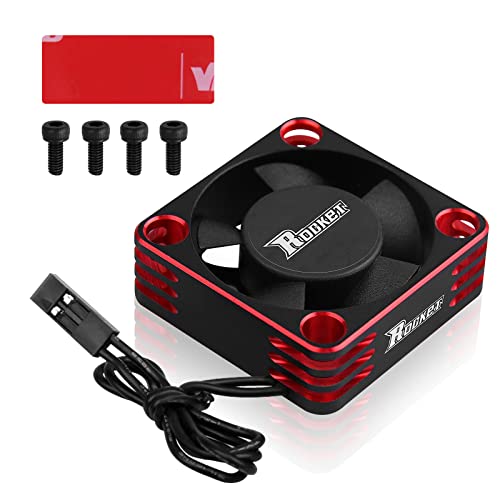
Bracket compatibility is the key distinction for this 30 mm fan: it fits brackets with 24 mm mounting holes. The maker says its speed reaches up to 28,000 RPM and describes it for 540 and 550 brushless motors and ESC cooling in 1/8-, 1/10-, and 1/12-scale cars. The black-and-red heatsink measures 1.18 inches square and 0.39 inch high. It suits buyers whose bracket and motor match those dimensions and fit claims. Check bracket hole spacing before ordering; the claimed scale range does not guarantee chassis clearance.
Bottom line: Choose this when your 24 mm bracket holes and 540/550 setup match.
25 mm Aluminum RC Fan

Voltage is the distinguishing specification here: this compact fan supports 5–7.4 V DC, unlike the other options, whose specs focus on size, speed, or vehicle fit. It measures 25 × 25 × 10 mm and has an aluminum-alloy construction with a brushless motor. The maker says its airflow is intended to limit motor and ESC overheating during racing. It suits a confined mount where those dimensions and voltage are appropriate. Its compatibility wording is broad rather than tied to named chassis, so confirm the mounting pattern and power connection for your model.
Bottom line: Pick this for a compact mount when your supply is within 5–7.4 V DC.
JOYSOG F76 V8 Dual-Fan Heatsink

Named truck compatibility sets this kit apart: it is designed for 1/10-scale TRX4, TRX6, G500, SCX10, and D90 RC cars. The F76 V8-style assembly uses dual fans and an aluminum-alloy and plastic heatsink, with a simulated engine appearance for added scale detail. The maker says the cooling effect is intended to protect the motor and extend its service life. This is the targeted choice for those listed chassis rather than a universal fan.
Bottom line: Choose it for a 1/10 truck when the simulated engine look also suits your build.
Surpass Hobby 40 mm Cooling Fan
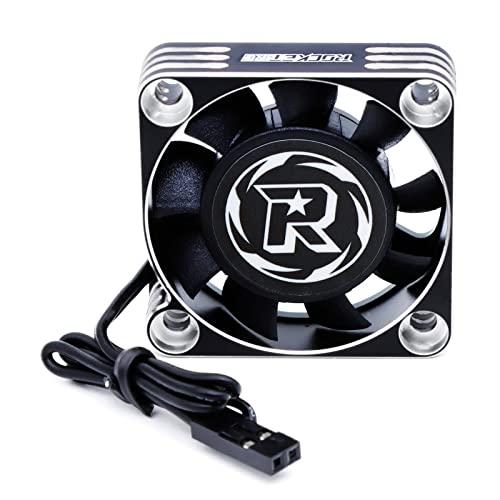
The 40 mm footprint makes this the largest specified fan in the group, so it suits mounts designed around that size rather than a compact 25 mm opening. Its aluminum body is CNC-machined and anodized; the dimensions are 40 × 40 × 10 mm. The maker says it reaches up to 16,000 RPM and is designed for 1/10- and 1/8-scale electric vehicles. A JST connector is included, and the wiring has positive and negative poles. Confirm polarity and connector compatibility with your power source before installation.
Bottom line: Pick this when your chassis has room for a 40 mm fan and compatible wiring.
How to choose an RC electric motor cooler
Start with the mounting pattern and available clearance, then check voltage and connector compatibility. Fan diameter alone does not establish fit: a bracket may require particular hole spacing, and a body or chassis can obstruct airflow even when the fan bolts on. Measure the mount in millimeters and compare it with the fan footprint; also check the height under the body. A practical decision rule is to select a 25 mm fan only when the mount accepts that footprint and has at least 10 mm of vertical clearance, plus room for its wiring. Larger fans need correspondingly larger openings. For the options here, 30 mm 540/550 Motor Cooling Fan specifies 24 mm bracket holes, while 25 mm Aluminum RC Fan specifies voltage as well as dimensions.
Fan size, airflow, and motor cooling
Fan diameter and RPM are useful comparison points, but neither alone tells you how much cooling a particular installation will deliver. Airflow depends on blade design, obstructions, distance from the motor, and whether hot air can escape the body. A heatsink spreads heat from the motor casing into the moving air; a fan helps move that air, but cannot correct a poor gear mesh or an overloaded drivetrain. Keep openings clear and route wires away from blades. For a table you can use to narrow the fit, compare the size and intended vehicle or motor range rather than treating scale as a guaranteed mounting standard.
| Need | Useful match | Fit check |
|---|---|---|
| Compact mount with known voltage | 25 mm fan | Footprint and 5–7.4 V DC supply |
| 24 mm bracket holes, 540/550 motor | 30 mm fan | Hole spacing and chassis clearance |
| Named 1/10-scale truck body | Dual-fan heatsink | Vehicle model and mounting space |
| 40 mm mount | 40 mm fan | Connector and polarity |
Installation and electrical checks
Disconnect the battery before installing or adjusting a motor fan, and keep fingers, loose leads, and bodywork clear of the blades. Match the fan supply to the voltage it supports; a fan intended for a different voltage can fail or be damaged. Connector shape does not by itself confirm voltage or polarity. Surpass Hobby 40 mm Cooling Fan specifies positive and negative wiring, while 30 mm 540/550 Motor Cooling Fan says its plug is not divided into positive and negative poles. Secure wires so vibration cannot pull them into the fan, then rotate the motor by hand to check for rubbing before powering up. Leave an air path through the body: sealing every opening can trap warm air instead of exhausting it.
Frequently Asked Questions
How do I measure an RC motor fan mount?
Measure the fan footprint and the center-to-center spacing between mounting holes in millimeters. Also measure vertical clearance to the body, since a fan can fit the holes yet hit the shell.
Does a higher RPM fan always cool better?
No; RPM alone does not establish airflow or cooling at the motor. Blade design, obstruction, and whether warm air can leave the body also affect heat removal.
Can I power an RC cooling fan from the receiver?
Only if the fan’s voltage range matches the receiver output and the connector and wiring are compatible. For the 25 mm option here, the range is 5–7.4 V DC; check your receiver’s output before connecting.
How much space should an RC motor cooler have?
Allow the fan’s full footprint and enough height to clear the body and nearby wiring; a 10 mm-tall fan needs at least 10 mm of vertical space. More open space around the intake and exhaust helps avoid restricting airflow.
When should I stop running an RC motor?
Stop if the motor becomes too hot to touch briefly or the vehicle loses power, then let the system cool before checking for binding, excessive gear mesh tightness, or blocked airflow. A cooling fan is not a substitute for correcting drivetrain load.