
Tactacam Reveal X Pro GPS Tracking: Models Compared

The TACTACAM Reveal X-Pro Camera is the named model, but its maker does not confirm GPS tracking; verify that feature before choosing it. If GPS is essential, compare alternatives with GPS explicitly identified, such as REVEAL X 3.0 or REVEAL Ultra.
Cellular trail cameras use a mobile network to send captures, while GPS determines location; GPS coordinates alone do not guarantee that a camera can transmit them from a weak-signal site.
We earn a commission if you buy through links on this page. As an Amazon Associate I earn from qualifying purchases. Products are compared on manufacturer specifications, not hands-on testing.
- Best overall: TACTACAM Reveal X-Pro Camera – It is the exact Reveal X-Pro model in the search, though GPS tracking needs verification.
- Best for built-in GPS: REVEAL X 3.0 – Its features identify built-in GPS and onboard storage.
- Best for solar power: REVEAL Pro 4.0 Solar – It includes an adjustable solar panel and a 5,000 mAh rechargeable battery.
| Product | Best for | GPS feature | Cellular or remote features | Power or storage | Shop |
|---|---|---|---|---|---|
| TACTACAM Reveal X-Pro Camera | Exact model match | Not confirmed | — | — | Check Price on Amazon |
| REVEAL X 3.0 | Onboard storage | Built-in GPS | Auto-connect multi-carrier LTE | Onboard storage | Check Price on Amazon |
| REVEAL Pro 4.0 Solar | Solar field setup | Built-in GPS | Live View, no-WiFi LTE | Solar panel, 5,000 mAh battery | Check Price on Amazon |
| REVEAL Ultra | Active GPS alerts | Active GPS tracking | Live video, photo requests, LTE | — | Check Price on Amazon |
| REVEAL Pro 3.0 | Long standby claims | GPS in product name | On-demand photos and video, 4G LTE | microSD up to 512 GB | Check Price on Amazon |
Tactacam Reveal X Pro GPS Tracking Cameras
Compare the named model with related REVEAL cameras that identify GPS or remote features.
TACTACAM Reveal X-Pro Camera

The Reveal X-Pro Camera is the exact model named in the search, but its maker only gives dimensions: 9 inches long, 5 inches wide, and 3 inches high. They do not confirm GPS tracking, cellular transmission, or a power arrangement, so those features should not be assumed from the model name. This is the clearest choice when matching the requested model matters more than a confirmed GPS feature. Buyers who need the camera’s location in an app should verify GPS capability before ordering; another model may be a better fit if GPS is a requirement.
Bottom line: Choose it when the X-Pro model name is the priority and GPS capability is confirmed before purchase.
REVEAL X 3.0

Unlike the named X-Pro, the REVEAL X 3.0 explicitly identifies built-in GPS and onboard storage that transfers photos to a phone. Its feature set also names automatic connection to AT&T or Verizon LTE, which may suit a location where one carrier is stronger than the other. The product name specifies 4K photos and 1080p video, and the camera is rated IP66. This is a related X-series alternative rather than the named X-Pro. Choose it when built-in GPS and storage without a separate SD card are useful; the features do not describe active location tracking if the camera loses power.
Bottom line: Pick it for built-in GPS, onboard photo storage, and multi-carrier LTE.
REVEAL Pro 4.0 Solar
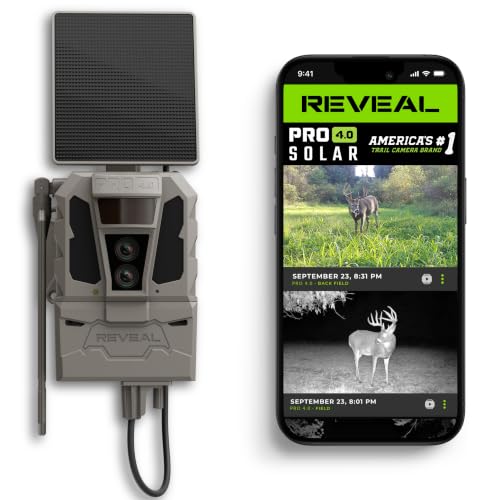
The REVEAL Pro 4.0 Solar stands apart with an included adjustable solar panel and FlexPack R5 rechargeable battery rated at 5,000 mAh. It also identifies built-in GPS, Live View, LTE operation without Wi-Fi, 4K photos, and 1080p video. Its IP66 rating is a useful specification for outdoor placement, but the features do not establish how much sunlight a particular site needs to maintain charge. This larger solar-equipped option suits a longer deployment where panel placement is practical. At 13.87 inches high, it is also taller than the 11.9-inch models in this set.
Bottom line: Choose it when the included solar panel and rechargeable battery suit the site.
REVEAL Ultra

The REVEAL Ultra is the alternative here that explicitly describes active GPS tracking for theft protection, including coordinate transmission if the camera is off or its battery is removed. It also identifies live video, remote HD photo requests, LTE connectivity, and switchable low-glow or no-glow infrared flash. The feature set gives flash ranges of 96 feet for low-glow and 80 feet for no-glow. Its stronger focus is remote monitoring and location alerts rather than a solar power package. Choose it when those GPS and remote-viewing features matter; it is not the exact Reveal X-Pro model sought.
Bottom line: Pick it when active GPS location alerts and remote viewing are priorities.
REVEAL Pro 3.0

The REVEAL Pro 3.0 is a related Pro model with a pre-installed antenna and pre-activated SIM, plus remote requests for photos and video over 4G LTE. Its product name includes GPS, and its features say battery standby is rated for up to 6+ months, with usage and temperature affecting that figure. It accepts Class 10 or higher microSD cards up to 512 GB. This may suit buyers who want remote capture requests and removable storage. The features do not spell out active GPS tracking, so this is a less explicit GPS choice than the Ultra.
Bottom line: Choose it for remote capture requests and microSD support, not confirmed active tracking.
How GPS and cellular service work on trail cameras
GPS and cellular service do different jobs: GPS determines coordinates, while LTE carries images or location updates to a phone. A camera can have GPS and still fail to send updates where its cellular signal is poor. GPS reception also depends on satellite visibility, so dense canopy, terrain, and placement against a structure can interfere. Before selecting a camera, separate the need to find its last reported position from the need for ongoing theft alerts; the product features distinguish those capabilities. For locations with unreliable service, plan for the possibility that remote updates may be delayed or unavailable. A camera’s GPS feature is not a substitute for confirming cellular coverage at the intended site.
Choosing a trail camera for GPS tracking
For active theft alerts, prioritize an explicit active-tracking feature rather than a model name that merely includes GPS. The REVEAL Ultra describes location alerts if the camera moves more than a half-mile from its last known location and coordinate transmission if power is removed; that is a different use case from simply finding a camera in an app. For occasional locating, built-in GPS may be sufficient, but verify how the chosen model reports coordinates. A useful decision rule is: if alerts after movement or battery removal are essential, choose a model whose features expressly describe those events. If you only need location alongside photos, app-based GPS may fit better.
| Need | Feature to prioritize | Model in this set |
|---|---|---|
| Active movement alerts | Tracking with explicit alert conditions | REVEAL Ultra |
| GPS and onboard photo storage | Built-in GPS and onboard storage | REVEAL X 3.0 |
| Solar-assisted deployment | Included panel and rechargeable battery | REVEAL Pro 4.0 Solar |
Mounting and aiming a cellular trail camera
Aim a trail camera across a trail rather than straight down its length when possible; a crossing path gives the motion sensor more time to detect an animal in the frame. A typical mounting height is about 3 to 4 feet, adjusted for the target species and slope. Keep the lens clear of branches that can move in wind and trigger captures, and avoid pointing toward the rising or setting sun to reduce glare. For GPS and LTE reporting, place the camera where it has an open view of the sky and usable cellular coverage. Test remote reporting at the final location before leaving equipment unattended, since a setup that captures images locally may not transmit them reliably.
Power and storage tradeoffs in the field
Power planning matters because cellular transmission and remote requests draw energy beyond simple standby. A solar setup can reduce battery changes only when the panel receives adequate light and is aimed appropriately; shade, short winter days, and heavy use can change the result. A claimed standby duration is not a guaranteed field runtime, particularly when temperature and capture volume differ. Storage also changes the workflow: onboard storage or a microSD card can preserve captures locally, while cellular delivery depends on network availability. For remote sites, compare both the power source and the local storage method, and do not treat LTE delivery as a backup copy unless the camera’s storage arrangement supports it.
Frequently Asked Questions
Does GPS work when a trail camera has no cell signal?
GPS can determine coordinates without a cellular connection, but LTE is needed to transmit those coordinates to a phone. A camera may therefore record or know a position without sending a current update.
What does active GPS tracking mean on a trail camera?
Active GPS tracking means the camera can send location updates or alerts rather than only identifying a location in an app. Check the alert condition; the REVEAL Ultra feature describes an alert when the camera moves more than a half-mile from its last known location.
How high should I mount a trail camera?
About 3 to 4 feet is a typical starting height for general wildlife monitoring. Adjust for the target animal and terrain, then aim across the travel path to give the sensor time to capture movement.
Can a trail camera send photos without Wi-Fi?
A cellular trail camera can send captures over LTE without home Wi-Fi when it has cellular service and an active data plan. GPS alone does not provide the connection needed to deliver images.
Does cold weather affect cellular camera battery life?
Yes; cold temperatures can reduce battery performance, and frequent photo or video transmission also changes runtime. Treat a standby-life rating as conditional rather than a promise for a high-activity or cold site.