
Olympus Stylus Film Cameras Compared by Lens and Fit

The Olympus Stylus 105 suits most buyers who want an Olympus Stylus film camera because its 38–105mm zoom and weather resistance cover more situations than the fixed-lens option. Choose a fixed-lens model if a compact camera with a 35mm lens matters more than zoom reach.
We earn a commission if you buy through links on this page. As an Amazon Associate I earn from qualifying purchases. Products are compared on manufacturer specifications, not hands-on testing.
- Best overall: Olympus Stylus 105 – Combines a 38–105mm zoom, all-weather protection and automatic film loading, advance and rewind.
- Best for long zoom reach: Olympus Stylus 140 QD – Its 37.5–150mm zoom reaches farther than the 38–105mm model.
- Best for a fast fixed lens: Olympus Stylus MJU-II – Pairs a 35mm f/2.8 lens with autofocus and a built-in flash.
| Product | Best for | Lens | Weather / date feature | Camera type | Shop |
|---|---|---|---|---|---|
| Olympus Stylus 105 | All-weather zoom | 38–105mm zoom | All-weather; date imprint | 35mm zoom camera | Check Price on Amazon |
| Olympus Stylus 140 QD | Longer zoom reach | 37.5–150mm zoom | Date imprint; flash | 35mm zoom camera | Check Price on Amazon |
| Olympus Stylus AF | Simple fixed lens | 35mm lens | Built-in flash | 35mm fixed-lens camera | Check Price on Amazon |
| Olympus Stylus MJU-II | Fast 35mm lens | 35mm f/2.8 | Weather-resistant; date stamp | 35mm fixed-lens camera | Check Price on Amazon |
| Olympus Stylus Epic 80 Zoom | Compact zoom | 35–80mm zoom | Built-in flash | 35mm zoom camera | Check Price on Amazon |
Olympus Stylus Film Cameras
Compare the lens ranges and distinguishing features to find the Stylus format that fits your priorities.
Olympus Stylus 105

Unlike the fixed-lens options, the Stylus 105 offers a 38–105mm zoom and all-weather protection. Automatic film loading, advance and rewind simplify film handling, while the pop-up flash adds red-eye reduction and automatic color balancing. Quartz date imprinting is included. Its reach suits travel and everyday scenes where framing changes, and the weather protection is useful around rain, snow, sea spray and blowing sand.
The zoom does not reach as far as the 150mm option, so choose that alternative if distant subjects are the priority.
Bottom line: Choose this if you want a weather-resistant zoom and automated film handling.
Olympus Stylus 140 QD

The Stylus 140 QD reaches 150mm, giving it more telephoto reach than the 105mm zoom model. This renewed 35mm point-and-shoot includes a built-in flash, film autoloader and date feature, with a silver body measuring 2.5 × 4.75 × 1.5 inches. That longer range suits buyers who want tighter framing of subjects farther away without switching lenses.
Its features do not include the weather protection specified for the Stylus 105, so it is a less suitable choice for use around spray or blowing sand.
Bottom line: Choose it when maximum zoom reach matters more than weather protection.
Olympus Stylus AF

The Stylus AF uses a fixed 35mm lens rather than a zoom, keeping the framing simple. This renewed 35mm point-and-shoot has autofocus, a built-in flash and a film loader; its weight is 0.35 pounds. It suits buyers who prefer a straightforward fixed-lens camera and do not need to zoom in on distant subjects.
Unlike the zoom models, the lens cannot change focal length, so framing requires moving closer or farther away. Choose one of the zoom versions if you need flexible composition without changing your position.
Bottom line: Pick this for a lightweight-feeling fixed-lens setup and basic autofocus.
Olympus Stylus MJU-II

The MJU-II stands apart with its 35mm f/2.8 autofocus lens, a brighter fixed lens than the other fixed-lens option. It includes a built-in flash, red-eye reduction and date/time stamping, plus a weather-resistant design. Its multi-point autofocus is described as supporting sharp focus in low light. The camera runs on one CR123A battery, which is described as lasting up to 10 rolls of film.
There is no zoom, so buyers who need to change framing from a distance should choose a zoom model instead.
Bottom line: Choose it for a fixed 35mm lens with f/2.8 aperture and weather resistance.
Olympus Stylus Epic 80 Zoom
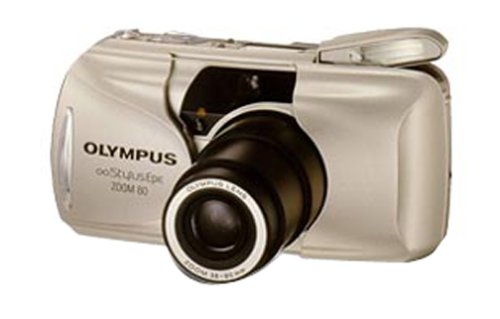
The Stylus Epic 80 Zoom has a shorter 35–80mm range than the other zoom cameras, making it the option for buyers who want a more modest zoom span. This renewed compact 35mm point-and-shoot includes a power zoom, built-in flash and automatic film loading. The champagne-gold finish distinguishes it from the black and silver bodies among these choices.
Its 80mm maximum gives less telephoto reach than either the 105mm or 150mm zoom, so it is not the right fit when distant subjects are a priority.
Bottom line: Pick it if a compact zoom matters more than longer telephoto reach.
How to choose an Olympus Stylus film camera
Start with lens range: a 35mm fixed lens keeps framing simple, while a zoom lets you adjust composition without changing position. On a 35mm camera, a 50mm lens is considered a normal perspective; shorter focal lengths take in a wider view, and longer ones frame a narrower scene. Choose a zoom reaching at least 105mm if distant subjects are common, and choose fixed 35mm if you mainly photograph nearby scenes.
Film format also matters: all five models here use 35mm film, whose frame measures 24 × 36mm. A longer lens does not increase film detail; it narrows the view. For indoor or evening photography, aperture matters alongside flash: the MJU-II’s f/2.8 lens admits more light than a smaller maximum aperture, but flash range and focusing still limit dim scenes.
Zoom range and fixed-lens fit
Zoom range determines how much framing flexibility you get from one lens. The available zooms span 35–80mm, 38–105mm and 37.5–150mm; those ranges cover wide-to-short-telephoto framing, with the 150mm maximum best suited to distant subjects. A fixed 35mm lens offers no zoom, but a 35mm focal length is a useful everyday wide-normal view for travel and group scenes.
Use this guide to match the camera type to the scene you photograph most often. A 35mm film frame is the same size across these cameras, so lens range—not film format—is the main framing difference.
| Need | Lens choice |
|---|---|
| One broad everyday view | Fixed 35mm |
| Flexible general framing | Zoom reaching 105mm |
| More distant subjects | Zoom reaching 150mm |
Weather resistance and camera care
Weather-resistant does not mean waterproof: rain resistance cannot be treated as permission to submerge a camera. Keep film cameras dry inside the film compartment, and wipe moisture from the exterior promptly; salt spray should be cleaned off with a lightly damp cloth before storage. The MJU-II is described as weather-resistant, while the Stylus 105’s all-weather protection covers rain, snow, sea spray and blowing sand.
Film storage affects image quality: keep unused rolls cool, dry and away from direct sunlight, and let cold film warm to room temperature before opening its canister to reduce condensation. Battery life and flash readiness depend on battery condition; carry a spare compatible battery for longer outings, and never force the film door while a roll is loaded.
Frequently Asked Questions
What film does an Olympus Stylus camera use?
These listed Olympus Stylus models use 35mm film, which produces 24 × 36mm frames. A standard 36-exposure roll is a common choice for general use; confirm the camera’s film transport is working before loading a valuable roll.
Is the Olympus Stylus 105 waterproof?
No camera should be treated as waterproof based on weather resistance alone. The Stylus 105 is described as protected against rain, snow, sea spray and blowing sand, but keep it out of standing water and rinse salt from the exterior with a damp cloth.
What does a 35mm camera lens mean?
A 35mm lens is a focal length, not the film format; the 35mm film frame measures 24 × 36mm. On that format, 35mm gives a wider view than a 50mm normal lens, making it useful for groups and travel scenes.
How often should film camera batteries be replaced?
Replace a film camera battery when the flash recycles slowly, the camera fails to advance film, or the battery has been stored for a long period. The MJU-II uses one CR123A battery and is described as lasting up to 10 rolls, but flash use and battery condition affect runtime.