
Soft Volleyball for Beginners: 3 Models Compared

For a beginner who wants a softer feel, Safe Sport Gear Softy Volleyball, Teal is the clearest fit because it is designed for kids, teens and beginners. Choose an official-size option instead if you want to practice with the standard adult ball size; the small version may feel different from regulation equipment.
We earn a commission if you buy through links on this page. As an Amazon Associate I earn from qualifying purchases. Products are compared on manufacturer specifications, not hands-on testing.
- Best overall: Safe Sport Gear Softy Volleyball, Teal – Its soft feel and realistic bounce are aimed at kids, teens and beginners.
- Best for indoor and outdoor play: Wilson Soft Play Volleyball, Pink – It has a foam cover and is designated for indoor and outdoor surfaces.
- Best for cushioned touches: Baden Soft Strike Volleyball – Its foam backing and cushioned synthetic leather cover are designed to soften contact.
| Product | Best for | Size | Weight | Playing surface | Shop |
|---|---|---|---|---|---|
| Safe Sport Gear Softy Volleyball, Teal | Younger beginners | Small | 7.75 oz | Indoor, all surfaces | Check Price on Amazon |
| Wilson Soft Play Volleyball, Pink | Indoor-outdoor practice | Official | 9.45 oz | Indoor/outdoor | Check Price on Amazon |
| Baden Soft Strike Volleyball | Cushioned practice | Official | — | Indoor/outdoor | Check Price on Amazon |
Soft volleyballs for beginners
Compare the ball size, weight and stated playing surface before choosing a beginner-friendly volleyball.
Safe Sport Gear Softy Volleyball, Teal
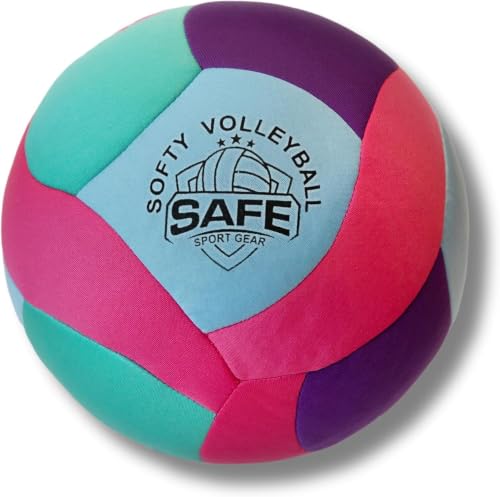
Unlike the official-size options here, this small Softy Volleyball is aimed at kids, teens and beginners who want a softer-feeling ball. The manufacturer says it combines a soft feel with realistic bounce and is suitable for indoor surfaces ranging from hardwood to carpet. Its weight is 7.75 ounces. The small size is the key tradeoff: players preparing for standard adult volleyball may prefer an official-size ball, so this model is better suited to early practice than size-matched training.
Bottom line: Choose this for a softer-feeling small ball for younger or newer players.
Wilson Soft Play Volleyball, Pink

The Wilson Soft Play stands out for its indoor-and-outdoor use and official size, rather than a specifically beginner-oriented design. It has a sewn cover, foam construction and a pressure-retention lining; the maker says the lining helps the ball retain air longer. At 9.45 ounces, it is close to the standard indoor volleyball weight range. The official size can make it a more familiar practice choice, but the features do not describe a particular cushioning level or beginner-specific construction.
Bottom line: Pick this if you want an official-size foam ball designated for indoor and outdoor play.
Baden Soft Strike Volleyball

The Baden Soft Strike pairs official size with a cushioned synthetic leather cover and an extra foam backing layer, giving it a different construction from the other options. The manufacturer says the cover is designed to minimize sting, and the 18-panel ball is intended for recreational play, practice and training indoors or outdoors. A pump is included.
Bottom line: Choose this when an official-size ball with a cushioned cover is your priority.
How to choose a soft volleyball for beginners
Start with the player’s intended ball size, then compare construction and playing surface. Indoor regulation volleyballs are 25.5 to 26.5 inches in circumference and weigh 9.2 to 9.9 ounces; those figures are useful benchmarks, not proof that a ball meets a league’s rules. A small ball can feel easier to handle, but it will not match the size of standard adult equipment. Foam-backed or foam-covered balls offer a softer contact design, while surface guidance matters if practice moves between a gym and a yard. For players preparing for adult-size play, choose an official-size model; for younger beginners, prioritize a comfortable feel and manageable size.
Soft volleyball size and fit
Official-size indoor volleyballs use a circumference of 25.5 to 26.5 inches, while a smaller ball can differ in feel and handling. Size labels are more useful than color when matching a ball to practice goals, but an “official” label alone does not establish that a ball is approved for a particular league. Ask a coach or organizer which size is required for the player’s age group before buying for organized play. A useful decision rule is to select an official-size ball when the goal is practice that mirrors adult-size volleyball; choose a small ball when beginner comfort and handling matter more than regulation-size practice. Weight is another useful comparison: standard indoor balls generally fall between 9.2 and 9.9 ounces.
Foam, soft covers and playing surfaces
Soft volleyballs use different constructions, so “soft” does not describe one uniform feel. Foam covers and foam backing are two approaches: one puts foam at the outside of the ball, while the other adds a cushioning layer beneath the cover. Cover material and panel construction also differ, and those differences can affect touch and durability. For recreational play, match the manufacturer’s surface designation to where the ball will be used; indoor/outdoor labeling is not the same as a guarantee of identical performance on every surface. Keep play away from breakable objects and overhead hazards, and avoid treating a soft cover as protection from injury or hard impacts.
Frequently Asked Questions
What size volleyball should an adult beginner use?
Most adults learning standard indoor volleyball should practice with an official-size ball measuring 25.5 to 26.5 inches in circumference. The usual indoor weight range is 9.2 to 9.9 ounces, though organized play may set its own equipment requirements.
Are soft volleyballs easier on your arms?
Foam covers or foam backing are designed to create a softer feel, but they do not remove the impact of a volleyball. Beginners should build contact gradually and stop if they feel pain or numbness.
Can a soft volleyball be used outdoors?
Use an outdoor or indoor/outdoor designation as your guide, since surfaces vary in roughness and moisture. A ball meant for outdoor play should still be kept away from sharp edges and standing water.
How often should I inflate a volleyball?
Check pressure before play if the ball feels noticeably soft or changes shape, and use the pressure range printed on the ball or given by its maker. A gauge is more reliable than squeezing, because hand feel varies.
Does official size mean a ball is competition approved?
No; official size refers to dimensions and does not by itself confirm league approval. Standard indoor size is 25.5 to 26.5 inches in circumference, so check the competition’s rules for other requirements.