
Dog Carts for Pulling People: 3 Seats Compared

Detachable Iron-Frame Dog Cart suits most buyers seeking a dog cart for pulling people because its maker gives a 330-pound capacity and describes a twin-brake setup. Choose 26-Inch-Wide Seat Dog Cart for a wider seat, or Four-Wheel Orange-Seat Dog Cart if bicycle-style steering and a handbrake matter more.
These carts pair a dog harness and pulling connection with a seat for people; confirm the dog’s fit and the cart’s rated capacity before carrying riders.
We earn a commission if you buy through links on this page. As an Amazon Associate I earn from qualifying purchases. Products are compared on manufacturer specifications, not hands-on testing.
- Best overall: Detachable Iron-Frame Dog Cart – Its maker gives a 330-pound capacity and describes a rear foot brake paired with a harness-linked handlebar.
- Best for a wider seat: 26-Inch-Wide Seat Dog Cart – The maker gives a 16-by-26-inch seat and says it fits two children.
- Best for steering control: Four-Wheel Orange-Seat Dog Cart – Its bicycle-style steering handle includes an integrated handbrake.
| Product | Best for | Capacity | Shop |
|---|---|---|---|
| Detachable Iron-Frame Dog Cart | Brake-focused outings | 330 lb | Check Price on Amazon |
| 26-Inch-Wide Seat Dog Cart | Wider seating | 330 lb | Check Price on Amazon |
| Four-Wheel Orange-Seat Dog Cart | Steering control | — | Check Price on Amazon |
Dog Carts for Pulling People
Compare rated load, seat dimensions and steering before choosing a cart for riders and a dog.
Detachable Iron-Frame Dog Cart

Detachable Iron-Frame Dog Cart stands out for its described twin-brake arrangement: a harness-linked handlebar works with a rear foot brake. Its maker gives a 330-pound capacity and describes a fully welded iron frame, detachable wheels and extension rods, and buckle-adjustable harness and rod spacing. The maker also describes armrests and a seat for family outings. This option suits buyers who prioritize stopping controls and a removable frame setup. The dimensions are inconsistent, so confirm the assembled size and dog fit before ordering.
Bottom line: Choose this if coordinated braking and detachable components are priorities.
26-Inch-Wide Seat Dog Cart
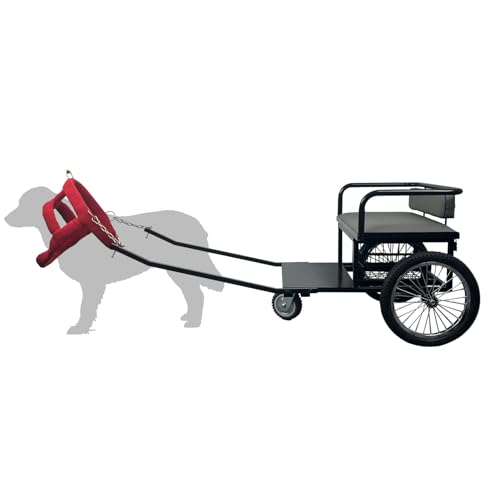
26-Inch-Wide Seat Dog Cart is distinguished by its 16-by-26-inch seat, which its maker says can fit two children. Its maker gives a 330-pound capacity and describes a metal frame, metal foot deck, 16-inch wheels and a wrap-around design. The overall dimensions are 60 inches long by 25 inches wide, useful measurements to compare with available storage and turning space. This cart suits buyers who want a broad seat and footrest.
Bottom line: Pick this when a 26-inch-wide seat and foot deck are the main priorities.
Four-Wheel Orange-Seat Dog Cart

Four-Wheel Orange-Seat Dog Cart differs from the other seat carts with a bicycle-style steering handle and integrated handbrake, rather than a described fixed pulling-pole arrangement. Its maker presents it for large dogs and owner-dog activity, and gives dimensions of 39.37 inches long, 29.53 inches wide and 29.53 inches high. The four-wheel layout is part of its name. This option suits buyers who prioritize steering and hand-operated braking. No load rating is included in the specifications, so confirm the maximum rider-and-cargo load and dog-size fit before use.
Bottom line: Choose this if steering and a handbrake matter more than a published capacity.
How to choose a dog cart for riders
Start with the load rating, then check seat size and stopping control. Add the weight of every rider, footwear and anything carried; keep the total within the cart’s rated load rather than treating seat space as proof of capacity. A wider seat can fit more than one child, but it does not establish the safe load or restraint arrangement. Check whether the dog’s harness attaches to the cart’s pulling shafts or another designed connection, not to a rider’s handhold. On routes with hills or traffic, favor a control setup that lets the handler stop without relying on the dog alone. Avoid fast descents and abrupt turns: a high or shifting rider load can destabilize a narrow wheeled cart.
Match the dog and harness to the cart
Fit the harness to the dog’s chest and body before adjusting shaft spacing; a pulling harness should distribute force across the chest rather than concentrate it on the neck. Leave enough room for the dog to stride naturally, and stop if the harness rubs, slips or restricts movement. Introduce pulling gradually on flat, quiet ground, beginning with an empty cart before adding a rider. Do not assume that a cart’s seat capacity means a dog can safely tow the full rated load; terrain, slope, surface and the dog’s conditioning all change effort. Measure the dog while standing and compare those measurements with the cart’s adjustable harness range before committing to a fit.
Use and stopping safety for dog-pulled carts
Keep initial outings short, slow and on level ground, with an adult controlling the cart and a second adult available to supervise children. Test the brake and steering while the cart is empty before adding a rider, and recheck them after assembly. Use a flat, uncluttered route; gravel, grass, curbs and slopes increase rolling resistance or make stopping less predictable. Riders should sit centered, keep hands and feet inside the cart, and avoid standing or leaning over the side. Stop immediately if a fastener loosens, a wheel wobbles, the dog shows distress, or the cart begins to pull unevenly. Never leave a child unattended in a cart, even when the dog is harnessed.
Compare cart layouts by intended use
Seat carts and cargo carts serve different jobs: a seat cart carries people, while a basket wagon carries supplies. This distinction matters because a cargo basket does not provide a passenger seat or rider restraint. For people-pulling, check the total load rating, passenger seating dimensions and steering or braking controls together rather than choosing on wheel count alone. A cart with more wheels may handle differently, but the wheel count does not establish a safe load or braking distance. Match the cart to the surface and route, and avoid modifying the harness or shafts to fit a different purpose.
| Need | What to compare | Decision rule |
|---|---|---|
| One or more riders | Rated capacity and seat width | Stay within the rating and confirm each rider fits securely. |
| Frequent turns | Steering control and turning clearance | Choose a steerable design only if the route has room to maneuver. |
| Hilly routes | Brake access and route grade | Prefer an accessible brake and avoid steep descents. |
Frequently Asked Questions
Can any dog pull a cart with people in it?
No; the dog must be physically mature, comfortable in a properly fitted pulling harness and gradually conditioned. Begin with an empty cart on level ground, and do not add riders unless the cart is rated for their combined load.
How do I calculate a dog cart’s total load?
Add the weight of every rider and all carried items, then compare that sum with the cart’s rated capacity. A 330-pound rating is a maximum load, not a target for every dog or route.
What harness should a dog wear for pulling?
Use a correctly fitted pulling harness that spreads force across the chest rather than a collar. Check for rubbing and unrestricted shoulder movement before every outing, and introduce the cart gradually.
Is a handbrake necessary on a dog-pulled cart?
A handler-operated brake can help control a loaded cart, especially where stopping is frequent, but it does not make steep descents safe. Test brake engagement with the empty cart and keep to slow, level routes while learning its response.
How should children ride in a dog-pulled cart?
Children should remain seated, keep hands and feet inside the cart, and have an adult supervising at all times. Confirm the total rider load is within the cart’s rating and never leave a child alone in the cart.