
Best Fishing Bait Boat Remote Control Picks Compared

For most anglers, SINJEE GPS Sonar Bait Boat is the strongest choice because its sonar, GPS waypoint storage and auto-return features combine fish-finding with repeatable bait drops. Choose OBIOCKIDAY V050 GPS Bait Boat or Dual-Motor LED Screen Bait Boat instead if you want a simpler remote-controlled boat and do not need an integrated sonar display.
A bait boat is a small remote-controlled craft that carries bait and tackle beyond casting range; match its capacity and navigation features to your usual fishing spots.
We earn a commission if you buy through links on this page. As an Amazon Associate I earn from qualifying purchases. Products are compared on manufacturer specifications, not hands-on testing.
- Best overall: SINJEE GPS Sonar Bait Boat – Combines sonar, 200 GPS waypoints and automatic return features.
- Best for bait capacity: GPS Bait Boat with 4.41-lb Hopper – Its bait box is rated for 4.41 pounds.
- Best for separate trays: CRESEAPRODUCTS 807S Bait Boat – Three independently controlled trays carry more than 5.5 pounds total.
- Best for GPS positioning: OBIOCKIDAY V050 GPS Bait Boat – Offers GPS positioning, cruise control and a 500-meter remote range.
| Product | Best for | Bait capacity | Remote range | Navigation | Shop |
|---|---|---|---|---|---|
| SINJEE GPS Sonar Bait Boat | Sonar and GPS | 6.6 lb | 547 yd | 200 waypoints | Check Price on Amazon |
| GPS Bait Boat with 4.41-lb Hopper | Measured capacity | 4.41 lb | — | 16 GPS points | Check Price on Amazon |
| CRESEAPRODUCTS 807S Bait Boat | Separate bait trays | More than 5.5 lb | 547 yd | Auto cruise | Check Price on Amazon |
| OBIOCKIDAY V050 GPS Bait Boat | Cruise control | — | 547 yd | GPS positioning | Check Price on Amazon |
| Dual-Motor LED Screen Bait Boat | Dual motors | — | 656 yd | — | Check Price on Amazon |
Remote Control Fishing Bait Boats Compared
Compare carrying capacity, control range and navigation before choosing a boat for your fishing water.
SINJEE GPS Sonar Bait Boat

For anglers who want sonar and repeatable navigation in one boat, this model pairs a fish finder with GPS/Beidou waypoint storage. The maker says its sonar reports fish, depth, water temperature and bottom terrain down to 328 feet, and that GPS stores 200 waypoints across four zones. Its bait capacity is 6.6 pounds, and the maker claims a 500-meter range and up to four hours of runtime. It suits anglers fishing familiar spots repeatedly. The added electronics may be unnecessary if you only need to carry bait to a known nearshore location.
Bottom line: Choose this if sonar readings and saved bait-drop locations matter as much as bait delivery.
GPS Bait Boat with 4.41-lb Hopper

The 4.41-pound bait-box rating makes this model a clear choice when a specified carrying load matters more than an integrated fish finder. The maker says its GPS can mark 16 points for navigation and return trips; it also claims two 5,200mAh batteries provide 4–8 hours of use. The ABS hull is described as corrosion-resistant, which may suit anglers fishing saltwater as well as lakes. Pick it for marked spots and a defined bait load. Its GPS-point count is lower than SINJEE GPS Sonar Bait Boat, so anglers needing many saved locations should compare that limit carefully.
Bottom line: Choose this when a 4.41-pound bait box and GPS-marked spots fit your routine.
CRESEAPRODUCTS 807S Bait Boat

Three separately controlled bait trays distinguish this boat from models with a single hopper. The maker says the trays carry more than 2.5 kilograms, or about 5.5 pounds, and describes fixed-speed auto cruise and a 500-meter control range. The medium-size hull measures 17 by 10 by 8 inches. This setup suits anglers who want to deploy bait in separate drops rather than release the entire load at once. The features focus on tray control and cruising rather than waypoint navigation, so it may be a less suitable fit for anglers who need stored GPS locations.
Bottom line: Choose this if separate bait drops are more useful than stored GPS waypoints.
OBIOCKIDAY V050 GPS Bait Boat
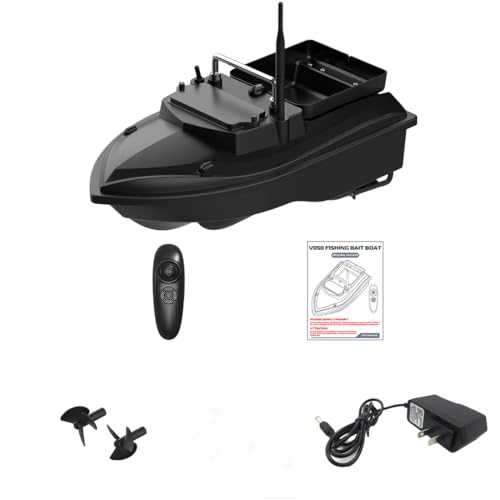
GPS positioning, auto-yaw correction and speed adjustment give this boat a focus on controlled travel rather than a quantified bait load. The maker says the remote reaches 500 meters and includes low-battery alerts, hook release and line delivery. Its dimensions are about 20.2 by 10.2 by 11.6 inches, and its weight is about 4.1 pounds. Dual power cables support two batteries, but the feature set does not give a hopper capacity or runtime. It suits anglers who value steering aids and line deployment; buyers who need a known payload should confirm capacity before ordering.
Bottom line: Choose this for cruise and steering features when a specified bait capacity is not essential.
Dual-Motor LED Screen Bait Boat

Dual motors and a longer stated remote distance set this boat apart from the other options. The maker claims a range of 1,968.5 feet, about 656 yards, and describes an ABS hull, three-bladed propeller and LED screen remote. Its large-size version measures about 19.1 by 10.4 by 6.3 inches. This may suit anglers looking for a straightforward powered carrier for open water.
Bottom line: Choose this for the longer remote range and dual-motor design.
How to Choose a Remote Control Bait Boat
Start with the bait load you actually need to carry, then compare navigation and range. A larger hopper is useful only if the boat can maintain control and stability with that load; compare capacity in pounds rather than relying on words such as “large.” For repeated drops, GPS waypoints can save locations, while sonar adds readings about depth and bottom conditions. Remote range is a maker-rated maximum, not a guarantee across every shoreline or weather condition. As a practical decision rule, if you routinely fish beyond 300 yards, prioritize a range of at least 500 meters and a return feature; for shorter, familiar runs, tray layout or capacity may matter more. Keep the controller and boat within sight where possible, and keep people clear of the propellers.
Bait Capacity and Tray Layout
Choose a hopper based on bait weight and the number of drops, not just the boat’s outer size. A single hopper releases bait as one load, while separately controlled trays allow staged drops at different points. Capacity figures are most useful when given in pounds; 2.5 kilograms is about 5.5 pounds. Bait weight also changes how a boat sits in the water, so avoid assuming that the maximum load is easy to steer in wind or current. Use this quick comparison to match a capacity to the amount you expect to deploy.
| Need | Useful specification | Why it matters |
|---|---|---|
| One larger drop | Single-hopper capacity | Indicates the load for one release |
| Separate drops | Independently controlled trays | Allows releases in stages |
| Repeat a known bait spot | GPS waypoint storage | Saves a target for return navigation |
Remote Range, GPS and Sonar
Remote-control range and GPS waypoints solve different problems: range describes the control link, while waypoints help guide a boat back to marked positions. Sonar is a separate tool that can show readings such as depth and bottom shape when the system includes those functions. A 500-meter range is about 547 yards, but obstacles, interference and conditions on the water can reduce reliable control distance. Treat automatic return as a backup feature, not a reason to send a boat beyond a safe recovery distance. If you fish multiple areas, compare waypoint count and zone storage; if you fish one familiar spot, a simple cruise function may be enough.
Using a Bait Boat Safely
Keep bait boats away from swimmers, other anglers’ lines and areas where propellers can snag weeds or debris. Lithium batteries should be charged with the compatible charger and kept dry; stop using a battery that is swollen, damaged or unusually hot. Wind and current can carry a small craft away faster than expected, especially when it is loaded, so keep a return route and recovery plan in mind. Start with a short run near shore to learn steering and release controls before sending the boat farther out. Check local waterway rules before use, particularly on shared or managed waters where remote craft may be restricted.
Frequently Asked Questions
How far can a remote bait boat travel?
A remote range of 500 meters is about 547 yards, but usable distance can fall with obstacles, interference, wind or current. Keep the boat within a distance where you can still recover it safely.
How much bait can a bait boat carry?
Capacity varies by hopper and tray design, so compare stated loads in pounds. A 2.5-kilogram capacity converts to about 5.5 pounds, and a loaded boat may be harder to steer in wind or current.
Are GPS waypoints useful on a bait boat?
Waypoints help save and revisit fishing locations, especially when you make repeated drops. A boat that stores 200 waypoints offers more saved positions than one limited to 16, but the larger count matters mainly if you use many locations.
What does sonar show on a bait boat?
Sonar can report underwater readings such as depth and bottom terrain, and some systems also indicate fish or water temperature. Check the sonar depth range against the depth of the water you fish.
Can a bait boat be used in saltwater?
Some models are marketed for saltwater use, but saltwater exposure can corrode metal parts and damage electronics if residue remains. Rinse the hull and accessible hardware with fresh water after use, and dry the boat before storage.