
Underwater Sealant for Swimming Pools: 5 Types Compared

For a general submerged sealant, Underwater Magic Sealant, White is the closest match because its name identifies it as an underwater sealant and it comes in a 290 mL tube. Choose a tile adhesive or two-part putty instead when the repair is specifically a loose tile, crack or leak; confirm the surface and application method suit your repair before ordering.
We earn a commission if you buy through links on this page. As an Amazon Associate I earn from qualifying purchases. Products are compared on manufacturer specifications, not hands-on testing.
- Best overall: Underwater Magic Sealant, White – A 290 mL tube identified as an underwater sealant.
- Best for tile setting: Pool Patch Underwater Tile Adhesive, 4 oz – The paste is made for ceramic, mosaic and stone tiles while submerged.
- Best for larger putty repairs: Epoxybond Pool Putty, 14 oz – The 14 oz two-part putty is described for cracks, leaks and chipped tile.
| Product | Best for | Type | Size | Color | Shop |
|---|---|---|---|---|---|
| Underwater Magic Sealant, White | General sealing | Sealant | 290 mL | White | Check Price on Amazon |
| Pool Patch Underwater Tile Adhesive, 4 oz | Submerged tile setting | Tile adhesive paste | 4 oz | Natural | Check Price on Amazon |
| Epoxybond Pool Putty, 14 oz | Cracks and leaks | Two-part hand-moldable putty | 14 oz | White or black | Check Price on Amazon |
| AQUABOND DMK-5000 Epoxy Repair Kit, White | Small epoxy repairs | Epoxy putty kit | 50 mL | White | Check Price on Amazon |
| BOSS 802 Clear Silicone Sealant, 2-Pack | Clear pool joints | Silicone sealant | 2 x 280 mL | Clear | Check Price on Amazon |
Underwater Sealant for Swimming Pools Compared
Match the product type to the repair: sealing, setting tile and filling cracks call for different materials.
Underwater Magic Sealant, White

Unlike the tile-setting paste and repair putties, this option is identified as an underwater sealant in a standard tube format. The 290 mL size and white color suit buyers looking for a sealant rather than a product specifically framed as a tile adhesive or two-part putty. The product name indicates underwater use, but the facts do not establish compatible surfaces, cure time or pool-chemical resistance. Confirm those points against the packaging for your particular repair, especially if the joint is continuously submerged or exposed to pool chemicals.
Bottom line: Choose this for a general sealing job when its surface compatibility and immersion directions match the repair.
Pool Patch Underwater Tile Adhesive, 4 oz

For a loose tile, this is the most specifically targeted choice: it is a paste adhesive for ceramic, mosaic and stone, rather than a general crack filler. The maker says it bonds tiles while fully submerged and is formulated for chlorine and saltwater environments. Its 4 oz size makes it a focused tile-setting option, not the largest quantity here. It is not described as a flexible joint sealant, so choose a different type for a seam or moving joint instead of treating tile adhesive as a universal pool seal.
Bottom line: Pick this for a submerged tile bond, not for sealing a moving joint.
Epoxybond Pool Putty, 14 oz
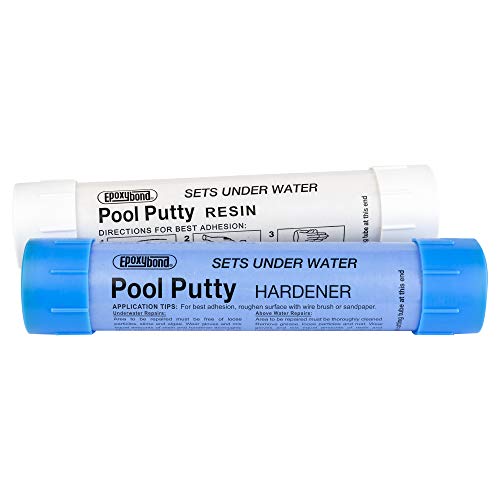
This 14 oz two-part putty offers substantially more material than the smaller repair kits and is positioned for cracks, leaks, and chipped or broken tile. The maker says to mix it 1-to-1, mold it by hand, and apply it underwater or above water; it also says the putty hardens underwater. That makes it a repair filler rather than a tube-applied sealant or tile-setting paste. Its white-or-black color choice may matter on a visible patch, and buyers needing a smooth flexible bead should select a sealant type instead.
Bottom line: Choose this for hand-molded crack, leak or tile-chip repairs where putty is appropriate.
AQUABOND DMK-5000 Epoxy Repair Kit, White

The compact 50 mL kit is an epoxy repair option for buyers addressing cracks or leaks on concrete, fiberglass or PVC. The maker says it is designed for underwater application and can be used for repairs involving those materials. Compared with the 14 oz hand-moldable putty, its package is much smaller, so it fits a limited repair better than a job needing a larger quantity.
Bottom line: Pick this for a small epoxy repair when the surface matches the material range.
BOSS 802 Clear Silicone Sealant, 2-Pack

Clear silicone makes this the distinct choice for a visible pool or spa joint where a transparent seal matters. The two-pack contains two 280 mL tubes, and the maker identifies pool tiles and spa components among its uses. The facts provided do not say it can be applied or cured underwater, so do not assume it is a submerged repair product simply because it is intended for pool use. Check the package directions for immersion and surface compatibility; choose a product explicitly meant for underwater application if the repair cannot be drained.
Bottom line: Choose this for a clear pool or spa seal only when the application conditions match its directions.
How to choose an underwater pool repair product
Choose by the job first: a bead sealant, tile adhesive and epoxy putty do different work. Tile adhesive bonds a loose tile to its backing; putty fills or rebuilds a localized crack or chip; sealant is used to close a seam. A practical rule is to use tile adhesive only when the tile itself needs rebonding, and reserve putty for a gap or damaged area that can be filled. Flexible silicone sealants are commonly used at joints where movement matters, while epoxy products generally form a harder repair. Confirm the repair material and whether application must occur underwater before selecting a product; pool walls and fittings may involve different substrates.
Underwater application and pool water conditions
Only use a product underwater when its directions explicitly permit submerged application; pool use alone does not prove that it cures underwater. The distinction matters because a repair made on a drained, dry surface may have different application requirements from a repair made while the pool is full. Before work, identify whether the area is concrete, fiberglass, PVC, tile or a joint between materials, then match that surface to the product directions. Also check whether the directions address chlorine or saltwater exposure, since the products in this comparison do not all make the same water-resistance claims. Do not apply a material across a drain, suction fitting or other opening where a patch could obstruct flow.
Sealant, tile adhesive and putty compared
A product’s category is a better guide than the word “waterproof” when deciding what repair it can perform. Use this quick guide to match the repair shape to the material type; the exact surface and water conditions still need to suit the chosen product.
| Repair need | Common product type | Key distinction |
|---|---|---|
| Close a seam | Sealant | Applied as a bead; joint movement can matter |
| Rebond a loose tile | Tile adhesive | Made to bond tile to a surface |
| Fill a localized crack or chip | Epoxy putty | Molded or pressed into a repair area |
Do not substitute one category for another just because both mention underwater use. Adhesive is not automatically a joint seal, and putty is not necessarily suitable for a long, moving seam.
Frequently Asked Questions
Can pool sealant be applied underwater?
Only if the product directions explicitly allow underwater application. Pool use by itself does not establish submerged curing; check the application instructions before using it in a filled pool.
Should I use putty or adhesive on a loose pool tile?
Use a tile adhesive when the tile needs rebonding, and use putty for a localized chip or crack. A tile-setting product is designed to bond the tile, while putty is a filler or repair material.
How do I seal a joint that moves?
A flexible sealant is generally more appropriate for a moving joint than rigid epoxy putty. Check that the sealant is compatible with both adjoining surfaces and the immersion conditions.
Can I use silicone sealant in a swimming pool?
Some silicone sealants are intended for pool or spa surfaces, but that does not automatically mean they can be applied or cured underwater. Verify both surface compatibility and submerged-use directions before applying.