
Best RF HDMI Modulators: 5 Options Compared

Thor Broadcast HDMI to Coax Modulator suits the widest range of digital TV setups because it converts HDMI into DVB-C/T, ATSC, or ISDB-T RF output. Choose an analog CH3/CH4 model instead if your TV has an analog tuner but cannot tune digital channels.
RF HDMI modulators convert a device’s HDMI signal into a TV-tunable coaxial signal; the right choice depends on the tuner format your TV or distribution system accepts.
We earn a commission if you buy through links on this page. As an Amazon Associate I earn from qualifying purchases. Products are compared on manufacturer specifications, not hands-on testing.
- Best overall: Thor Broadcast HDMI to Coax Modulator – Its selectable digital output formats include ATSC and QAM, alongside DVB-C/T and ISDB-T.
- Best for PAL systems: HDMI/CVBS to VHF/UHF RF Modulator – It supports PAL and NTSC formats, VHF and UHF, plus HDMI and CVBS RCA inputs.
- Best for a ready-to-connect setup: kurtmark HDMI to RF Modulator – It includes a 1.2 m HDMI cable and outputs NTSC on CH3 or CH4.
| Product | Best for | Output format | RF channel or frequency | Shop |
|---|---|---|---|---|
| Thor Broadcast HDMI to Coax Modulator | Digital TV distribution | DVB-C/T, ATSC, ISDB-T | User-selected RF channel | Check Price on Amazon |
| HDMI/CVBS to VHF/UHF RF Modulator | PAL and NTSC setups | PAL or NTSC; HDMI, CVBS RCA | VHF and UHF | Check Price on Amazon |
| kurtmark HDMI to RF Modulator | Included HDMI cable | NTSC analog | CH3 61.25 MHz; CH4 67.25 MHz | Check Price on Amazon |
| HDM61 HDMI to RF Modulator | NTSC channel output | NTSC analog | CH3 61.25 MHz; CH4 67.25 MHz | Check Price on Amazon |
| HDMI to RF Modulator with Cable | Older coax TVs | RF coax output | CH3/CH4 | Check Price on Amazon |
RF HDMI modulators compared
Choose by the tuner format and RF channel your TV or coax system can receive.
Thor Broadcast HDMI to Coax Modulator
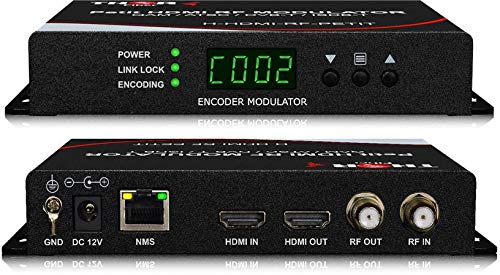
Thor Broadcast HDMI to Coax Modulator stands apart with several digital RF formats, including ATSC and QAM, rather than only NTSC analog channel output. It encodes HDMI audio and video, supports 720p, 1080i, and 1080p sources, and is designed to send a selected RF channel to compatible TVs. Configuration uses Thor Broadcast’s proprietary PC GUI, so it suits someone setting up digital coax distribution who can configure the receiving TVs as well. The main limitation is tuner compatibility: an analog-only TV will not receive a digital ATSC or QAM channel.
Bottom line: Choose this for a digital coax system when its output format matches the TV tuners.
HDMI/CVBS to VHF/UHF RF Modulator

HDMI/CVBS to VHF/UHF RF Modulator is the flexible choice for systems that may use PAL or NTSC and for sources that provide CVBS RCA rather than HDMI. It offers VHF and UHF output, F female coax connectors, and an adjustable AV output level. Its supported input resolutions include 1080p, 1080i, 720p, 576p, 576i, and 480p. The broad format support makes it a fit for mixed legacy equipment, but the fields do not identify specific RF channel numbers, so confirm the needed channel before ordering.
Bottom line: Choose this when PAL support, RCA input, or VHF/UHF flexibility matters.
kurtmark HDMI to RF Modulator

kurtmark HDMI to RF Modulator distinguishes itself by including a 1.2 m HDMI cable and power adapter, reducing the need to source those accessories separately. It converts HDMI to NTSC analog RF on CH3 or CH4 and uses PLL control for frequency output; supported HDMI inputs include 1080p, 1080i, 720p, 576p, and 480p. This is a straightforward fit for an antenna-style TV input that can tune those channels. It is one-way HDMI-to-RF conversion, so it cannot take a coax signal and convert it back to HDMI.
Bottom line: Choose this for an NTSC CH3/CH4 setup when the included cable is useful.
HDM61 HDMI to RF Modulator

HDM61 HDMI to RF Modulator provides a defined NTSC channel pair: CH3 at 61.25 MHz or CH4 at 67.25 MHz. Its PLL-controlled VHF output accepts HDMI sources such as game consoles, computers, cameras, and TV boxes, with input resolutions up to 1080p among its supported modes. This makes it a fit when the receiving TV or coax system is already set up for one of those analog channels. Its output is NTSC, so a PAL-only TV system is the wrong match.
Bottom line: Choose this for a VHF NTSC installation already set to CH3 or CH4.
HDMI to RF Modulator with Cable

HDMI to RF Modulator with Cable is aimed at connecting HDMI devices to older displays with antenna or coax inputs, and its title identifies CH3/CH4 output with PLL frequency control. The specifications also mention an HDMI cable and power adapter, making it an option for a basic installation with those accessories included. Choose it only after confirming that its output works with the TV or coax system you plan to use.
Bottom line: Choose this for an older coax TV after confirming its tuner compatibility.
How to choose an RF HDMI modulator
Start with the tuner format the receiving TV can decode: analog NTSC, PAL, or a digital standard such as ATSC or QAM. Analog modulators commonly use TV channels 3 or 4; a digital modulator must use a format supported by the TV’s tuner or an external receiver. If the TV has only an analog tuner, choose an analog RF output rather than ATSC or QAM. HDMI input resolution is not the deciding factor by itself: the modulator’s RF format and the television’s tuner determine whether a picture appears. For a household with multiple tuner types, map each TV’s supported format before choosing one output standard.
This table matches common setup needs to the output type to look for.
| Setup | Output to match |
|---|---|
| Analog NTSC television | NTSC RF, commonly CH3 or CH4 |
| PAL television system | PAL-capable RF output |
| Digital tuner or coax distribution | A supported digital format such as ATSC or QAM |
Analog CH3 and CH4 versus digital RF
CH3 and CH4 are analog VHF television channels, with frequencies of 61.25 MHz and 67.25 MHz in the NTSC system. A modulator set to one channel can interfere with an over-the-air station using the same channel, so select the other channel when reception is poor. Digital RF formats such as ATSC and QAM carry encoded digital channels and require compatible tuner equipment; an older analog-only TV cannot decode them directly. A digital signal can be distributed through coax, but every receiving device still needs to support the selected standard. Match both the modulation format and the channel plan before connecting more than one TV.
Coax distribution and signal limits
RF modulation lets HDMI audio and video travel over coax to a tuner, but it does not preserve HDMI’s digital picture quality as an RF signal. Analog output is especially limited by the receiving TV’s tuner and display, even when the source accepts 1080p. For multi-room distribution, a splitter can divide a coax signal, while long cable runs and multiple splitters reduce signal level. Use a direct connection first; if a picture is weak, remove extra splitters and check connectors before adding amplification. Digital formats can show reception problems as dropouts rather than gradual image noise, so verify tuner compatibility at each set.
Safe setup and common mistakes
Connect the modulator’s RF output to the TV’s antenna or coax input, then tune the TV to the matching channel or digital standard. Turn off and unplug powered equipment before changing coax connections, and avoid bending coax sharply or leaving connectors loose. A frequent mistake is assuming an HDMI-to-RF converter also works in reverse; these devices convert HDMI toward RF, not coax toward HDMI. Another is selecting digital ATSC or QAM for a television that only tunes analog signals. For a system using channel 3 or 4, first check that local RF reception does not occupy the selected channel, then switch channels if interference appears.
Frequently Asked Questions
Can an HDMI to RF modulator work with any TV?
No; the TV needs a tuner compatible with the modulator’s RF format. An analog-only set needs analog output, while ATSC or QAM output requires a compatible digital tuner.
What frequency are NTSC channels 3 and 4?
NTSC channel 3 is 61.25 MHz and channel 4 is 67.25 MHz. Choose the channel that is not occupied by a local broadcast signal when interference occurs.
Does RF conversion keep a 1080p picture?
No; accepting a 1080p HDMI input does not mean the RF picture remains 1080p. The output format and TV tuner govern the resulting picture, and analog RF is far below modern HDMI image quality.
Can an HDMI RF modulator send a signal to several TVs?
A coax splitter can distribute an RF output to multiple TVs, provided each set supports the same output format and channel. Long runs and extra splitters can weaken the signal, so test the signal directly at each set.
Will HDMI to RF work in the reverse direction?
No; an HDMI-to-RF modulator converts an HDMI source to coaxial RF output, not RF input to HDMI. A separate RF-to-HDMI converter is needed for the reverse direction.