
Silver Welding Rods: 3 BCuP-3 Options Compared

For a silver welding rod for HVAC copper joints, choose BCuP-5 15% Silver Rods, 10 in if a 10-inch stick suits your work and its 15% silver BCuP-5 alloy matches the joint. BCuP-5 is a brazing alloy, not a general-purpose welding electrode; choose a different filler for steel, and use flux when brazing brass.
Pick BCuP-5 15% Silver Rods, 14 in instead if you need 14-inch rods and want the melting and brazing temperatures; BCuP-5 15% Silver Rods, 10 in, 10-pack is a 10-inch alternative with a 10-stick kit.
We earn a commission if you buy through links on this page. As an Amazon Associate I earn from qualifying purchases. Products are compared on manufacturer specifications, not hands-on testing.
- Best overall: BCuP-5 15% Silver Rods, 10 in – Its 15% silver BCuP-5 alloy and 10-inch length suit common copper HVAC work.
- Best for longer reach: BCuP-5 15% Silver Rods, 14 in – The 14-inch sticks provide more working length, with a specified 1,300–1,500°F brazing range.
- Best for a smaller kit: BCuP-5 15% Silver Rods, 10 in, 10-pack – The 10-stick pack gives the same 10-inch length and 15% silver alloy.
| Product | Best for | Length | Shop |
|---|---|---|---|
| BCuP-5 15% Silver Rods, 10 in | Copper HVAC joints | 10 in | Check Price on Amazon |
| BCuP-5 15% Silver Rods, 14 in | Longer working length | 14 in | Check Price on Amazon |
| BCuP-5 15% Silver Rods, 10 in, 10-pack | Ten-stick quantity | 10 in | Check Price on Amazon |
Silver Welding Rods
These silver brazing rods use BCuP-5 alloy; match rod geometry and filler type to the joint before heating.
BCuP-5 15% Silver Rods, 10 in
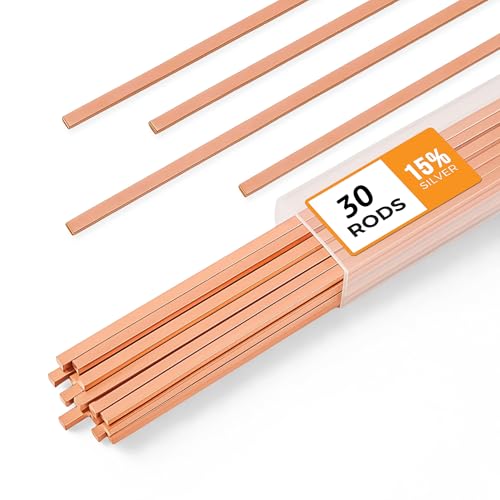
For a 10-inch BCuP-5 stick, this option pairs 15% silver with a flat 0.050 × 1/8-inch cross-section. The maker says the alloy flows smoothly and forms strong, clean joints, and identifies HVAC, refrigeration, and industrial work as intended uses. The size suits buyers who prefer shorter rods for compact work areas. Brass joints need flux, and BCuP-5 is not the right filler for every base metal.
Bottom line: Choose this for 10-inch BCuP-5 rods for copper HVAC work, after confirming the pack quantity.
BCuP-5 15% Silver Rods, 14 in

The 14-inch length distinguishes this BCuP-5 option from the 10-inch sticks, giving more rod to handle for longer seams or repeated joints. Each tube contains 20 sticks, and the maker gives a solidus of 1,190°F, liquidus of 1,475°F, and brazing range of 1,300–1,500°F. Those figures help plan torch heat, but the actual joint temperature depends on the base metal, joint mass, and torch setup. Use flux when brazing brass; this product’s own guidance specifically calls for it on copper alloys such as brass.
Bottom line: Choose this when a 14-inch stick and an explicitly specified temperature range matter.
BCuP-5 15% Silver Rods, 10 in, 10-pack

This 10-stick set is the clearest choice when you want a defined small pack of 10-inch, 15% silver BCuP-5 rods. The maker positions the rods for HVAC, refrigeration, and plumbing copper joints, and says their operating window is 1,193–1,472°F. Its 0.050 × 1/8-inch flat profile matches the other 10-inch option, so the deciding difference is the pack count rather than geometry. Choose another filler for metals that phosphorus-copper alloys are unsuitable for, and apply flux when the joint includes brass.
Bottom line: Choose this for a clearly defined 10-stick set of 10-inch BCuP-5 rods.
How to Choose a Silver Welding Rod
Choose filler metal by the metals being joined, not by the word “silver.” BCuP-5 is a phosphorus-copper alloy with 15% silver; common BCuP-5 compositions also include roughly 5% phosphorus, with copper making up most of the balance. Phosphorus helps the alloy self-flux on copper-to-copper joints, but it can form brittle compounds with iron- or nickel-bearing metals, so it is not a universal rod. For copper-to-brass joints, use compatible brazing flux. Brazing uses filler that melts above 840°F while the base metals remain solid; it is different from fusion welding, where the base metal melts.
Rod shape and length are handling choices: a flat 0.050 × 1/8-inch stick offers a defined feed profile, while 10- and 14-inch lengths suit different reach and storage needs. If the joint includes steel or nickel alloy, select a filler specifically compatible with those metals instead.
BCuP-5 Rod Sizes and Joint Fit
Match rod size to the joint access and capillary gap: brazing filler is drawn through a close-fitting joint, rather than used to bridge a wide opening. A practical clearance target for many brazed joints is about 0.002–0.005 inch, though the base-metal alloy and joint design change the ideal gap. Clean, bright metal is essential because oil, oxide, and dirt interfere with wetting. The 0.050 × 1/8-inch flat dimensions in these choices describe the rod, not the joint clearance.
Use 10-inch rods when shorter pieces are easier to maneuver around compact assemblies; choose 14-inch rods when extra reach or fewer rod changes help. Do not compensate for poor fit by adding excess filler: correct the gap and clean the surfaces before heating. Confirm the joint’s permitted filler alloy and clearance for critical refrigeration or pressure-containing work.
Silver Brazing Rod Temperature and Torch Use
BCuP-5 melts across a temperature interval rather than at one exact point: one option gives 1,190°F solidus and 1,475°F liquidus, with a 1,300–1,500°F working range. Solidus marks the point where melting starts; liquidus is where the alloy is fully liquid. Heat the joint evenly so the base metal brings the filler to flow temperature, rather than overheating one spot with the torch flame. Joint mass, torch size, and airflow all affect heating time.
Keep a torch clear of refrigerant, insulation, wiring, and combustible materials, and protect nearby surfaces with a suitable heat shield. Wear eye protection and gloves, provide ventilation, and keep an appropriate fire extinguisher nearby. A measurable decision rule: if the torch cannot heat the joint evenly without directing flame at a combustible part, stop and change the setup before brazing.
Common Silver Brazing Mistakes
Using BCuP-5 on the wrong base metal is a common mistake: phosphorus-copper filler is suited to copper and some copper alloys, not steel or nickel-bearing joints. Another is skipping flux on brass; copper-to-copper joints can benefit from BCuP’s self-fluxing action, but brass requires compatible flux. Surface preparation matters too: remove oxide and contamination before assembly, because filler cannot reliably wet a dirty joint.
Do not judge heat by rod color or flame appearance alone; use the alloy’s working range and heat the joint evenly. Avoid overheating copper, which can oxidize heavily and compromise flow. For sealed refrigeration circuits, follow applicable trade practices and the equipment maker’s filler and safety requirements; brazing near a charged system can create serious fire and pressure hazards.
Frequently Asked Questions
Is BCuP-5 the same as a silver welding rod?
BCuP-5 is a silver-bearing brazing alloy, not a conventional welding electrode. It contains 15% silver in these options and is intended for compatible copper-based joints.
Do BCuP-5 rods need flux on copper?
Clean copper-to-copper joints are commonly brazed with phosphorus-copper filler without separate flux because phosphorus provides a self-fluxing effect. Brass requires compatible flux, and dirty or oxidized copper still needs proper cleaning.
Can silver brazing rods join copper to steel?
BCuP-5 is generally not suitable for copper-to-steel joints because phosphorus can form brittle compounds with iron. Use a filler alloy specifically intended for the base metals being joined.
What gap should a brazed copper joint have?
Many brazed joints use about 0.002–0.005 inch clearance so molten filler can flow by capillary action. The best fit changes with the alloy and joint design, so avoid using extra filler to fill a wide gap.
How hot does BCuP-5 brazing get?
The BCuP-5 option with temperature figures gives a brazing range of 1,300–1,500°F. Its solidus is 1,190°F and liquidus is 1,475°F, so it melts over a range rather than at a single temperature.