
Ceiling Fan Air Filters: 5 Options Compared by Fit

20-Pack Activated Carbon Blade Pads is the closest match for shoppers seeking ceiling fan air filters, with 20 activated-carbon pads sized 10 by 3.5 inches. Choose another option if you prefer coconut-shell carbon, a smaller pack, or an explicitly stated replacement schedule.
Ceiling fan air filters are adhesive pads fitted to blade surfaces; they are not a substitute for a room air purifier or HVAC filter.
We earn a commission if you buy through links on this page. As an Amazon Associate I earn from qualifying purchases. Products are compared on manufacturer specifications, not hands-on testing.
- Best overall: 20-Pack Activated Carbon Blade Pads – Twenty activated-carbon pads measure 10 by 3.5 inches for blade coverage.
- Best for coconut-shell carbon: Barnakl 5-Pack Coconut Carbon Pads – Five unscented pads use activated coconut-shell carbon.
- Best for scheduled upkeep: Deposhion 10-Pack Coconut Carbon Pads – Ten pads specify replacement every 30 to 45 days.
| Product | Best for | Pad length | Pad width | Pack count | Shop |
|---|---|---|---|---|---|
| 20-Pack Activated Carbon Blade Pads | More replacement pads | 10 in | 3.5 in | 20 | Check Price on Amazon |
| Barnakl 5-Pack Coconut Carbon Pads | Coconut-shell carbon | 10 in | 3.5 in | 5 | Check Price on Amazon |
| ZIMER 20-Pack Activated Carbon Pads | Twenty-pad supply | — | — | 20 | Check Price on Amazon |
| Deposhion 10-Pack Coconut Carbon Pads | Frequent replacement | 9.8 in | 3.5 in | 10 | Check Price on Amazon |
| 21-Pack Activated Carbon Pads | Largest pack | 10 in | 3.5 in | 21 | Check Price on Amazon |
Ceiling Fan Air Filters Compared
Compare pad dimensions, carbon material and pack size, then confirm the pad fits your blade before applying it.
20-Pack Activated Carbon Blade Pads
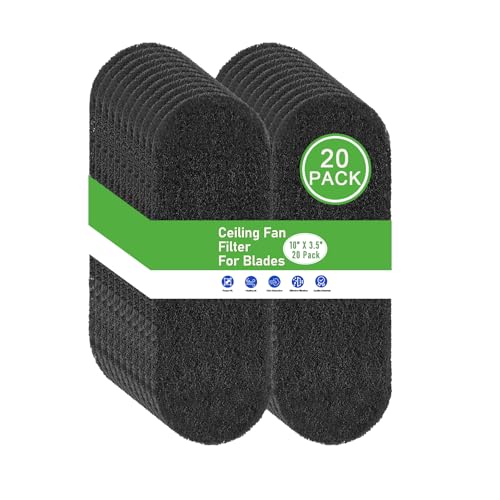
The 20-pad count sets this option apart for households wanting more replacements on hand. Each black pad measures 10 by 3.5 inches, and the maker says the activated carbon is coal-based and intended to capture dust, pollen and pet dander as the fan spins. At 0.2 inches thick, the pad is lightweight. The broad stated width may suit wider blades better than narrower pads, but measure the flat blade area first; a pad that overhangs can interfere with blade balance or appearance. The claimed fine-particle capture is not a substitute for a correctly sized room air cleaner.
Bottom line: Choose this if you want a larger supply and a 3.5-inch-wide pad.
Barnakl 5-Pack Coconut Carbon Pads
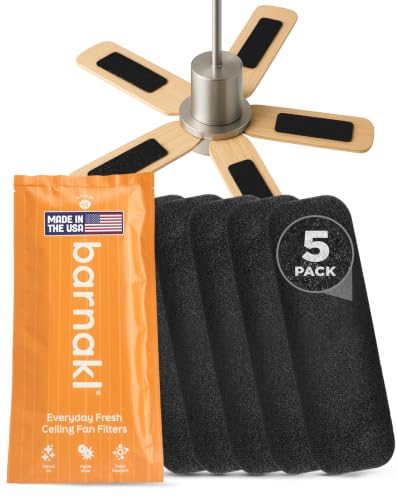
Coconut-shell carbon distinguishes these five pads from the coal-based material in some alternatives. The maker describes them as unscented, with an easy-stick universal fit for ceiling fan blades, and says they trap dust, odors and allergens. The dimensions provided are 10 inches long and 3.5 inches wide; the pads weigh 0.07 ounces. This smaller pack makes sense for a trial fit or limited replacement supply. The specifications do not give a replacement interval, so buyers who want a timed upkeep schedule should favor an option that states one and check blade adhesion regularly.
Bottom line: Choose this if coconut-shell carbon and an unscented pad matter most.
ZIMER 20-Pack Activated Carbon Pads

ZIMER offers a 20-pad count and describes the carbon as odorless, with dust, smoke and pollen among the particles it aims to capture. Buyers should compare the actual pad dimensions on the package with their blade’s flat mounting area before installation. The maker suggests weighing a pad before use and after two to three months as one way to observe collected material; that interval is a maker claim, not a universal replacement rule.
Bottom line: Choose this only if you can confirm the pad dimensions before buying.
Deposhion 10-Pack Coconut Carbon Pads

Deposhion is the only option here that explicitly recommends replacing pads every 30 to 45 days. The ten black pads use activated coconut carbon, measure 9.8 by 3.5 inches and are described as washable and self-adhesive. The maker advises wiping blades clean and dry before installation because dust or oil residue weakens adhesion. A frequent schedule may suit a dusty room or a buyer who prefers regular upkeep, but the maker’s washable claim does not establish how many cleaning cycles a pad tolerates. Avoid washing until you have confirmed the care method for the specific pad.
Bottom line: Choose this if you want a 30-to-45-day replacement interval.
21-Pack Activated Carbon Pads

The 21-pad pack is the largest count among these choices, paired with a 10-by-3.5-inch pad size. The maker describes the material as high-density activated carbon and says it absorbs dust, pet dander, smoke and cooking odors as the fan rotates. At 0.2 inches thick, the pads are slender. This quantity suits buyers prioritizing a long replacement supply over a smaller trial pack.
Bottom line: Choose this if getting the most pads in one pack is the priority.
How to choose ceiling fan air filters
Start with blade dimensions, because an adhesive pad must fit the flat top surface without overhanging. Most choices here are about 10 inches long and 3.5 inches wide, while one gives dimensions of 9.8 by 3.5 inches; compare those measurements with each blade’s usable area. Carbon source is another distinction: some pads use coal-based activated carbon and others coconut-shell carbon. Neither material name alone tells you how much particulate reduction a room will get. Treat manufacturer capture claims as intended use, not a replacement for a properly sized HEPA air cleaner when particle control is important.
Adhesive pads add material to a rotating blade, so even placement matters. Apply matching pads in corresponding positions on all blades and stop the fan if you notice wobble, scraping or unusual noise.
Pad sizing and ceiling fan fit
Measure the flat blade surface before choosing a pad; here, common stated widths are 3.5 inches and lengths are roughly 10 inches. A pad should sit within the blade edges and avoid screws, decorative trim and curved tips. A rough overhang or uneven placement can affect balance, especially when the fan runs at higher speed. The measurement is the pad size, not a promise that every fan blade can accept it.
Use this fit guide before installation:
| Blade condition | What to do |
|---|---|
| Flat usable area at least 10 by 3.5 inches | Compare the 10-inch pads for full coverage |
| Shorter usable length | Check whether the 9.8-inch pad fits within the edges |
| Narrower than 3.5 inches | Do not apply an overhanging pad; verify a smaller pad option |
Clean and dry blade surfaces first; residue can weaken adhesive. A ceiling fan filter should never cover blade hardware or compromise secure attachment.
Carbon pad maintenance and replacement
Replacement timing depends on dust load, fan use and pad construction; one maker recommends 30 to 45 days, while another suggests checking weight after two to three months. Those are product-specific recommendations, not a universal service interval. Look for visible dust buildup, curled edges or peeling adhesive, and replace a pad that no longer stays secured. A black surface can make collected debris easier to see, but visible dust alone does not measure fine-particle removal.
Although one option is described as washable, cleaning can affect carbon pores and adhesive. Do not assume that rinsing restores filtration capacity or that every carbon pad is reusable. For reliable upkeep, confirm the care method for the chosen pad, keep a replacement supply, and stop using a loose pad rather than letting it detach while the fan is moving.
What ceiling fan air filters can and cannot do
Blade-mounted carbon pads rely on air passing over the fan while it turns; they are not the same as a sealed HVAC filter or a room air purifier with a clean-air delivery rate. Carbon is commonly used for odor adsorption, while mechanical particle filters use a dense fiber medium to capture particles. These pad descriptions mention dust and allergens, but the specifications provide no standardized efficiency rating or airflow test, so do not use them as the sole control for smoke, pollen or other indoor-air concerns.
For particle removal, match a portable air cleaner’s clean-air delivery rate to room area: a common target is roughly 2/3 of the room’s square footage in CADR for a typical 8-foot ceiling. Keep the ceiling fan pads as an adjunct, not a substitute for an appropriate filtration system or ventilation.
Frequently Asked Questions
How do I measure a ceiling fan blade for a filter pad?
Measure the flat top surface, excluding curved tips, hardware and trim. A pad close to 10 by 3.5 inches needs at least that much usable surface to avoid an overhang.
Do ceiling fan carbon filters remove smoke from a room?
For smoke, use a room air cleaner sized to the room and keep the fan pad as a supplemental measure.
How often should ceiling fan filter pads be changed?
Replacement schedules vary by pad and conditions: one option recommends 30 to 45 days, and another suggests weighing after two to three months. Replace earlier if the pad peels, becomes heavily dusty or no longer adheres securely.
Can ceiling fan filter pads be washed and reused?
One product is described as washable, but that does not establish how many washes it tolerates or whether cleaning preserves carbon performance. Confirm the cleaning method for that pad and replace it if adhesion weakens.
Can a filter pad make a ceiling fan wobble?
Uneven pad placement can add imbalance to rotating blades, so apply matching pads in consistent positions on every blade. Turn the fan off immediately if wobble or scraping starts, and remove any loose pad.