
Manual Tire Changer Duck Head Kits Compared by Fit

VEVOR Manual Tire Changer Duck Head Kit is the best match for most manual tire changer setups because its 1.97-inch mounting tube fits shafts up to 1.8 inches and its head adjusts for 16- to 21-inch tires. Choose Bearing Manual Tire Changer Duck Head Kit if you need an adapter specified for a Harbor Freight changer, or Manual Tire Changer Kit for 2-Inch Posts if your changer has 2-inch posts.
A duck head guides a tire bead over a wheel rim during mounting and demounting; post fit and wheel range matter before material or add-ons.
We earn a commission if you buy through links on this page. As an Amazon Associate I earn from qualifying purchases. Products are compared on manufacturer specifications, not hands-on testing.
- Best overall: VEVOR Manual Tire Changer Duck Head Kit – Its 1.97-inch tube is specified for changer shafts up to 1.8 inches, with adjustment for 16- to 21-inch tires.
- Best for Harbor Freight: Bearing Manual Tire Changer Duck Head Kit – Its fit is specified for Harbor Freight tire changers, and it has a bearing design.
- Best for 2-inch posts: Manual Tire Changer Kit for 2-Inch Posts – It is designed for 2-inch posts and includes nylon contact parts and thrust bearings.
| Product | Best for | Post compatibility | Duckhead material | Shop |
|---|---|---|---|---|
| VEVOR Manual Tire Changer Duck Head Kit | Broad vehicle fit | Shafts ≤1.8 in | Reinforced nylon | Check Price on Amazon |
| Bearing Manual Tire Changer Duck Head Kit | Harbor Freight fit | Harbor Freight fit | — | Check Price on Amazon |
| Manual Tire Changer Kit for 2-Inch Posts | 2-inch posts | 2 in posts | Nylon | Check Price on Amazon |
Manual Tire Changer Duck Heads
Match the post specification first, then compare wheel range and rim-contact material.
VEVOR Manual Tire Changer Duck Head Kit

VEVOR Manual Tire Changer Duck Head Kit gives the clearest shaft-fit specification of these kits: its 1.97-inch mounting tube is compatible with manual changer shafts up to 1.8 inches. The adjustable duck head is intended for 16- to 21-inch tires on cars, SUVs, trucks, UTVs and ATVs. Its reinforced nylon head has a grooved design without sharp edges; VEVOR says that design helps reduce rim scratches. This is a practical choice when your changer shaft falls within that limit and you want the vehicle range. It may not fit a changer with a larger shaft, so measure the shaft before choosing it.
Bottom line: Choose this if your changer shaft is no more than 1.8 inches and you need the broad vehicle fit.
Bearing Manual Tire Changer Duck Head Kit

Bearing Manual Tire Changer Duck Head Kit stands out for its compatibility with Harbor Freight tire changers and its integrated steel pipe and duck head adapter, which avoids a separate adapter-to-pipe assembly. The kit is intended for 16- to 21-inch wheels and includes a bearing structure. Its thickened steel pipe and precision-welded construction are maker claims about durability, not a substitute for confirming fit. Choose it when the Harbor Freight compatibility is the deciding factor.
Bottom line: Choose this for a Harbor Freight changer when the 16- to 21-inch wheel range suits your work.
Manual Tire Changer Kit for 2-Inch Posts
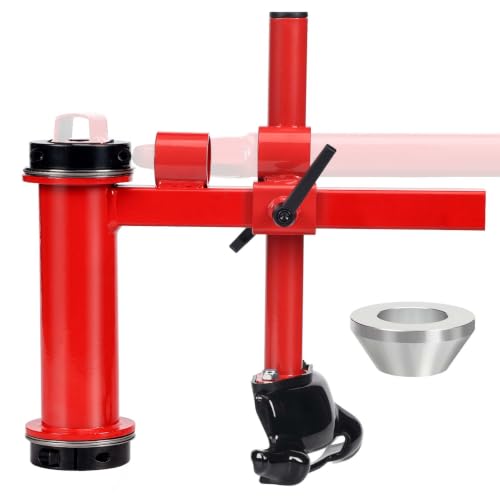
Manual Tire Changer Kit for 2-Inch Posts is the option here built around a 2-inch post and supplied with more supporting pieces: a nylon duckhead, two sets of thrust bearings, two lock collars, a centering cone and bar holders. It is intended for 16- to 21-inch wheels on cars, light trucks, SUVs, ATVs and trailers. The nylon contact surface is described as more forgiving during bead guidance, but careful angle control still matters. This suits a DIY garage or small workshop whose changer has the specified post size and needs the included accessories.
Bottom line: Choose this when your changer has 2-inch posts and you want the included bearings and centering accessories.
How to choose a manual tire changer duck head
Start by matching the duck head’s mounting interface to your changer, not by relying on the wheel range alone. The 1.97-inch tube in VEVOR Manual Tire Changer Duck Head Kit is specified for shafts no larger than 1.8 inches, while Manual Tire Changer Kit for 2-Inch Posts is intended for 2-inch posts; those measurements describe different interface specifications and should not be treated as interchangeable. Next, match the wheel range: all three kits cover 16- to 21-inch wheels. Wheel diameter is measured at the bead seat, not across the tire’s outer tread. If your changer post is 2 inches, choose a kit specified for that post; if it is smaller, measure it and compare it with the maker’s fit limit. Confirm fit before assembling the changer.
Duckhead material also affects how the head contacts the rim. A nylon contact surface can be more forgiving than metal if alignment is imperfect, but it cannot prevent damage from poor technique.
Post fit and wheel sizing
Post compatibility and wheel size are separate checks: a kit can cover the right wheel diameter yet fail to mount securely on your changer. The wheel span is 16 to 21 inches, a five-inch range, and applies to wheel diameter rather than tire width or overall tire height. Measure the post at the point where the kit mounts, then compare that measurement with the product’s shaft or post specification. For example, VEVOR Manual Tire Changer Duck Head Kit specifies a maximum shaft diameter of 1.8 inches; Manual Tire Changer Kit for 2-Inch Posts specifies 2-inch posts. Do not infer that one will fit the other’s post just because both handle the same wheel range.
Vehicle labels such as truck or ATV do not guarantee fit for every wheel. Confirm both the changer interface and wheel diameter before work begins.
| Setup need | Relevant kit distinction |
|---|---|
| Changer shaft up to 1.8 in | VEVOR Manual Tire Changer Duck Head Kit gives this limit with a 1.97-inch tube |
| 2-inch post | Manual Tire Changer Kit for 2-Inch Posts is specified for this post size |
| Harbor Freight changer | Bearing Manual Tire Changer Duck Head Kit states this compatibility |
Rim protection and safe tire changing
Rim protection depends on both the duckhead contact surface and controlled bead movement. VEVOR Manual Tire Changer Duck Head Kit and Manual Tire Changer Kit for 2-Inch Posts use nylon duckheads, while Bearing Manual Tire Changer Duck Head Kit describes a steel pipe and adapter but does not identify the duckhead material. Nylon can be more forgiving when the head is aligned correctly, yet no material makes a rim scratch-proof. Before demounting, fully deflate the tire and remove the valve core; never try to force a bead while the tire remains inflated. Keep hands clear of pinch points between the bead, head and rim, and stop if the tool shifts or the post fit is loose.
Use tire lubricant intended for mounting rather than petroleum grease, which can damage rubber. Incorrect lubricant or a poorly seated head can make bead movement harder and increase the chance of damage.
Frequently Asked Questions
What does a duck head do on a manual tire changer?
A duck head guides the tire bead over the rim during mounting and demounting. It works with the changer’s post and bar, so the head’s interface must fit the machine before the wheel range matters.
How do I measure a manual tire changer post?
Measure the post’s outside diameter where the duckhead adapter mounts, using calipers or a ruler. Compare that measurement with the specified interface; for example, VEVOR Manual Tire Changer Duck Head Kit gives a maximum shaft diameter of 1.8 inches.
Can a 16-inch duck head fit a 21-inch wheel?
These kits are specified for an adjustable 16- to 21-inch wheel range, so the range includes both diameters. Wheel diameter means the rim’s bead-seat diameter, and the changer interface must also match.
Should I deflate a tire before demounting it?
Yes. Fully deflate the tire and remove the valve core before breaking the bead; a pressurized tire can release forcefully during demounting. Keep hands out of pinch points while the bead moves.
Is a nylon duck head scratch-proof?
No material guarantees a scratch-free rim. Nylon has a more forgiving contact surface, but careful alignment and controlled bead movement are still needed to reduce the risk of rim damage.