
Pro Offset Extension Wrench: 3 Models Compared by Reach

Pro Offset Extension Wrench, 16.34-Inch is the named Pro Offset Extension Wrench match, and its 0.63-inch-thick head and 16.34-inch length are the deciding fit points for tight access. Choose another model if its length, adapters or stated torque limit better match your clearance and socket setup.
Offset extension wrenches transfer turning force from a handle positioned away from a fastener; these options use a chain-driven mechanism designed to turn without a swinging arc at the socket.
We earn a commission if you buy through links on this page. As an Amazon Associate I earn from qualifying purchases. Products are compared on manufacturer specifications, not hands-on testing.
- Best overall: Pro Offset Extension Wrench, 16.34-Inch – Its 16.34-inch reach, 0.63-inch profile and three drive adapters make it the clearest match for varied tight-access work.
- Best for two-piece set: wrjpigf Pro Zero Offset Wrench, 2-Piece – The set includes three square-drive adapters and measures about 3/4 inch thick.
- Best for shorter reach: 3/8-Inch Offset Extension Wrench, 13.4-Inch – Its 13.4-inch length is shorter than the 16.34-inch option, and it gives a 55.3 ft-lb maximum torque.
| Product | Best for | Length | Thickness | Max torque | Shop |
|---|---|---|---|---|---|
| Pro Offset Extension Wrench, 16.34-Inch | Longer reach | 16.34 in | 0.63 in | 55.3 ft-lb | Check Price on Amazon |
| wrjpigf Pro Zero Offset Wrench, 2-Piece | Two-piece set | — | 0.75 in | — | Check Price on Amazon |
| 3/8-Inch Offset Extension Wrench, 13.4-Inch | Shorter reach | 13.4 in | 0.63 in | 55.3 ft-lb | Check Price on Amazon |
Pro Offset Extension Wrenches Compared
Compare reach, head thickness and torque limits against the space and socket drive you need to use.
Pro Offset Extension Wrench, 16.34-Inch

Pro Offset Extension Wrench, 16.34-Inch combines the longest reach here with a 0.63-inch-thick flat head, making it the option to consider when the handle needs to clear nearby components. The tool uses a chain-driven 1:1 mechanism and is supplied with 1/4-, 3/8- and 1/2-inch adapters. The maker gives a maximum torque of 55.3 ft-lb. That limit matters: this is not the right choice for a job requiring more torque, even if the head fits. Check the fastener’s required torque and available clearance before selecting it.
Bottom line: Choose this when 16.34 inches of reach and a slim head suit the access path.
wrjpigf Pro Zero Offset Wrench, 2-Piece

wrjpigf Pro Zero Offset Wrench, 2-Piece is the set option, with two pieces and three adapters for 1/4-, 3/8- and 1/2-inch square drives. Its thickness is about 3/4 inch (19 mm), so compare that profile with the narrowest gap along the path to the fastener—not just the opening at the fastener itself. The adapters let the tool connect to different socket drive sizes, while sockets and an impact wrench are separate.
Bottom line: Choose this for the two-piece format and varied square-drive adapter sizes.
3/8-Inch Offset Extension Wrench, 13.4-Inch
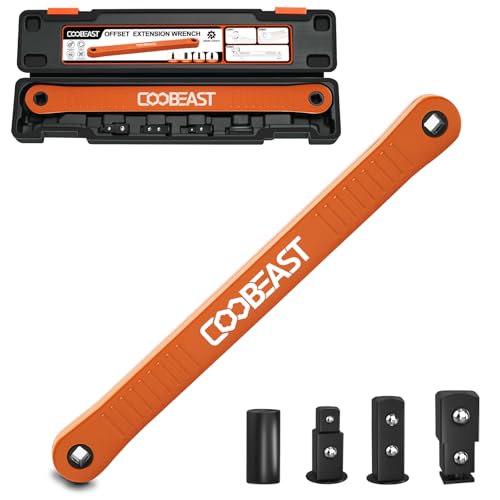
3/8-Inch Offset Extension Wrench, 13.4-Inch is 13.4 inches long, shorter than the 16.34-inch model, while keeping the same 0.63-inch-thick profile and 55.3 ft-lb maximum torque. It is chain driven with a 1:1 ratio, and the maker says it can be used with an impact wrench. Three adapters cover 1/4-, 3/8- and 1/2-inch square drives. The shorter body may suit a work area where extra length interferes with nearby parts, but it gives less reach; measure the route from your hand position to the fastener before choosing it.
Bottom line: Choose this when a shorter body fits the work area and its torque cap is sufficient.
How to choose an offset extension wrench
Choose by the smallest clearance, required reach, drive size and torque the job needs. Measure the narrowest gap along the tool’s entire path, then compare that with head thickness; a 0.63-inch head cannot pass through a gap narrower than 0.63 inch. Also measure from the intended handle position to the fastener, since a longer body can reach farther but may collide with surrounding parts. Match the output square drive to the socket, using an adapter only when the adapter sizes match the tool and socket. For these models, two give a 55.3 ft-lb maximum; do not apply either above that cap. The third does not give a torque limit, so avoid relying on it when a precise torque ceiling is essential.
Drive adapters and socket fit
Match square-drive sizes before starting: these wrench options include adapters for 1/4-, 3/8- and 1/2-inch drives, but socket compatibility still depends on the adapter arrangement. A reducer adapter lets a larger drive accept a smaller-drive socket; it does not increase the wrench’s torque rating. Keep the socket fully seated and aligned with the fastener to reduce the chance of slipping or rounding corners. If the tool is paired with an impact wrench, confirm the wrench’s torque capability does not exceed the extension tool’s maximum; the two models with known limits are capped at 55.3 ft-lb. The adapter set alone does not establish that a socket or impact wrench is included.
Zero-swing chain drive compared with a ratchet
A chain-driven zero-swing tool turns the socket from an offset handle, which can help when a ratchet handle cannot swing through an arc. A conventional ratchet is simpler when there is room for its handle to move and the fastener is easy to reach directly. The zero-degree swing claim describes turning at the fastener, not unlimited access: the tool still needs a clear path for its body and handle. Use this quick guide to match the main constraint.
| Work condition | What to prioritize | Tradeoff |
|---|---|---|
| Very narrow gap | Head thickness | Confirm full-path clearance |
| Handle blocked from swinging | Zero-swing chain drive | Still needs room for the body |
| Torque-critical fastener | Known maximum torque | Stay within the cap |
Torque limits and safe use
Stay below the extension wrench’s maximum torque and the limits of any connected socket or drive tool. Two of these models specify 55.3 ft-lb; that is a maximum, not a target for every fastener. When a fastener requires a controlled torque value, use an appropriate torque wrench and a method suited to the extension arrangement rather than assuming the tool’s rating is the desired setting. Keep hands clear of pinch points between the tool and nearby components, and stop if the socket begins to slip or the chain mechanism binds. Before applying force, confirm the socket is seated, the adapters are fully engaged and the workpiece is stable.
Frequently Asked Questions
How much clearance does an offset extension wrench need?
The opening must exceed the wrench head thickness, and the full body needs a clear route to the fastener. A 0.63-inch-thick head needs more than 0.63 inches of clearance to pass through.
Can I use an offset extension wrench with an impact wrench?
Only use a model that is compatible with the impact wrench and keep applied torque within the extension’s limit. Two options here specify 55.3 ft-lb maximum; compare that with the impact wrench’s output before use.
Do square-drive adapters change the torque rating?
No, an adapter changes the drive-size connection, not the wrench’s maximum torque. Use matched square-drive sizes and keep the assembled setup within every component’s limit.
Does zero swing mean the tool needs no room to move?
No, zero swing refers to the socket turning without a normal ratchet-handle arc at the fastener. The tool body and handle still need a clear path, so check the full working space.