
Best Insulated Boot Covers for Hunting: 3 Picks

Hunthor 600D Insulated Boot Covers, X-Large is the strongest all-around pick because its zipper and adjustable drawstring make it easier to fit over hunting boots. Choose Hunthor 600D Insulated Boot Covers, XX-Large if you need the XX-Large size; Berlune Insulated Boot Cover, XX-Large is another XX-Large option with a height of 5.91 inches.
Insulated boot covers slip over footwear to add a layer around the boot, but they do not replace insulated hunting boots. Confirm the cover dimensions against your boots before ordering.
We earn a commission if you buy through links on this page. As an Amazon Associate I earn from qualifying purchases. Products are compared on manufacturer specifications, not hands-on testing.
- Best overall: Hunthor 600D Insulated Boot Covers, X-Large – The zipper and adjustable drawstring offer two ways to secure the cover over boots.
- Best for XX-Large: Hunthor 600D Insulated Boot Covers, XX-Large – The product is listed in XX-Large and includes a zipper and adjustable drawstring.
- Best for packability: Berlune Insulated Boot Cover, XX-Large – At about 360 g per pair, these covers are described as foldable for carrying.
| Product | Best for | Insulation | Size | Shop |
|---|---|---|---|---|
| Hunthor 600D Insulated Boot Covers, X-Large | Adjustable over-boot fit | 5 mm pearl cotton, foil | X-Large | Check Price on Amazon |
| Hunthor 600D Insulated Boot Covers, XX-Large | XX-Large Hunthor fit | 5 mm pearl cotton, foil | XX-Large | Check Price on Amazon |
| Berlune Insulated Boot Cover, XX-Large | Packable XX-Large option | Insulated; material — | XX-Large | Check Price on Amazon |
Insulated Boot Covers for Hunting
Compare the fit, insulation materials, and construction details that distinguish these over-boot covers.
Hunthor 600D Insulated Boot Covers, X-Large
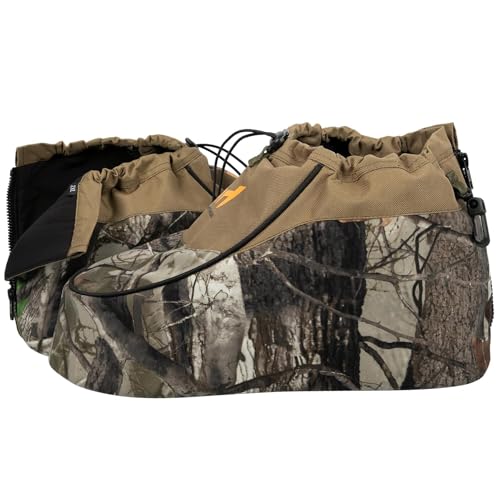
Hunthor 600D Insulated Boot Covers, X-Large gives hunters an X-Large option with both a zipper and adjustable drawstring, making it the most flexible fit approach among these picks. The covers use aluminum foil and 5 mm pearl cotton; the maker says the insulation can keep feet cozy at -4°F. A water-resistant upper and PU leather sole are intended for wet or slippery ground. Choose this pair if X-Large matches your boot-and-sock setup; the size alone does not establish its internal dimensions, so compare your boots with the cover before buying.
Bottom line: Pick this if you want an X-Large cover with both zipper access and drawstring adjustment.
Hunthor 600D Insulated Boot Covers, XX-Large

Hunthor 600D Insulated Boot Covers, XX-Large shares the Hunthor insulation and adjustment design but is the XX-Large option, making size the key reason to choose it over Hunthor 600D Insulated Boot Covers, X-Large. Aluminum foil and 5 mm pearl cotton form the insulating layer, and the maker says the covers are suited to conditions down to -4°F. A waterproof upper and sole plus skid-proof PU leather are aimed at damp, slick ground. The XX-Large label is not a substitute for measuring your boots, especially when thick socks or bulky boot hardware add width.
Bottom line: Choose this when XX-Large is the size you need and you want the Hunthor adjustment system.
Berlune Insulated Boot Cover, XX-Large

Berlune Insulated Boot Cover, XX-Large is the distinct XX-Large alternative, with a 5.91-inch height and a pair weight of about 360 g. Its high-density fabric has a water-resistant coating, and the maker describes it as an insulating layer for people already wearing hunting boots. The lighter carry weight and foldable design suit hunters who want covers stowed in a pack or vehicle.
Bottom line: Pick this if low carry weight and a cover height matter more than a named insulation material.
How to Choose Insulated Boot Covers for Hunting
Choose hunting boot covers by fit first, then insulation and the terrain you expect. A cover that is too tight can compress the boot’s insulation, while excess space can make walking awkward. Wear the socks you expect to hunt in when checking fit, and account for boot laces, buckles, and ankle shape. These covers are an added outer layer, not a replacement for a properly sized, insulated boot. Water resistance also is not the same as a fully sealed waterproof boot: standing water can enter at openings around the top. For ground that regularly floods above the cover’s opening, select footwear designed for that depth rather than relying on an over-boot cover.
Boot Cover Sizing and Fit
Match the cover to the outside dimensions of your hunting boots, not just the shoe size printed on the boot. Measure boot length and widest point with the hunting socks and any gaiters you plan to wear; allow enough room for the cover to close without pulling tight across the sole. Zippers and drawcords help secure a cover, but they cannot correct a mismatch in length or width. Here, the sizes are X-Large and XX-Large, and one product gives a 5.91-inch height. Since size labels are not a universal measurement system, compare boot dimensions with the seller’s cover measurements before ordering. If a maker does not provide the fit dimensions you need, confirm them before purchase.
Insulation and Cold-Weather Limits
Insulated boot covers add a surrounding layer that can reduce heat loss from footwear, but warmth still depends on boot insulation, sock thickness, circulation, activity, wind, and moisture. The Hunthor products combine foil with 5 mm pearl cotton, and their maker gives a -4°F warmth claim; that figure is not a guarantee for every wearer or length of exposure. The Berlune option is described as insulated but has no material or temperature figure in the specifications. Avoid treating one product’s rating as a standard for all covers. In freezing conditions, keep socks dry, stop to check for numbness, and leave cold conditions if your feet lose normal feeling.
Water Resistance, Grip, and Hunting Terrain
Water-resistant fabric can shed rain, snow, dew, and splashes, but seams and the opening can still admit water during prolonged exposure. The Hunthor covers specify a PU leather sole and describe its grip as skid-proof; the Berlune cover uses coated high-density fabric and is intended to resist rough-ground contact. Neither description supplies a standardized traction rating, so do not assume a cover makes slick rocks or ice safe. A removable cover can also change how a boot flexes and contacts the ground. Test the fit and walking motion on safe, dry ground before a hunt, and use boots with appropriate tread for steep or icy terrain.
Comparing Hunting Boot Cover Types
Hunting boot covers differ most in how they secure, insulate, and pack over footwear. A zipper-and-drawcord design gives adjustment at the opening, while a foldable lightweight cover can be easier to carry between locations. Materials and quoted warmth claims are not directly comparable unless the products give the same measurements and conditions. For long periods stationary in cold weather, prioritize a warm boot-and-sock system that fits comfortably; a cover should be an added layer, not the only source of warmth.
| Need | Relevant feature | Pick to compare |
|---|---|---|
| Adjust opening over boots | Zipper and adjustable drawstring | Hunthor 600D Insulated Boot Covers, X-Large or Hunthor 600D Insulated Boot Covers, XX-Large |
| Listed XX-Large size with a height | 5.91-inch height | Berlune Insulated Boot Cover, XX-Large |
| Named insulation materials | Foil and 5 mm pearl cotton | Hunthor 600D Insulated Boot Covers, X-Large or Hunthor 600D Insulated Boot Covers, XX-Large |
| Lower carry weight | About 360 g per pair | Berlune Insulated Boot Cover, XX-Large |
Frequently Asked Questions
Can insulated boot covers replace insulated hunting boots?
No, covers add an outer layer over footwear rather than replacing the boot’s insulation, fit, or tread. Use boots suited to the temperature and terrain, especially when you will be stationary for long periods.
How should hunting boot covers fit over boots?
They should close without compressing the boot or binding at the sole. Check the boot’s length and widest point while wearing your hunting socks, and compare those measurements with the cover dimensions.
Does a -4°F boot cover claim guarantee warm feet?
No, the Hunthor maker’s -4°F claim is not a universal guarantee. Activity, wind, dampness, sock choice, fit, and time spent stationary all affect comfort and cold exposure.
Are water-resistant boot covers safe on ice?
Use footwear appropriate to icy ground and avoid relying on a cover’s grip description alone.
Can I wear boot covers with gaiters?
Often, but the combined layers can increase bulk and interfere with the cover’s closure or your boot’s range of motion. Try the full setup on dry ground before heading out.