
Digital Pool Water Tester: 4 Models Compared by Fit

Wynvex 7-in-1 Strip Reader suits most pool and spa owners who want seven strip-based readings on a digital display in about 15 seconds. Choose Oomiak 7-in-1 Strip Reader if high/low alerts are a priority; Hofun 5-in-1 Salinity and pH Meter and Bevvronix 7-in-1 Digital Meter are better suited to saltwater checks because their measurements differ from strip reader panels.
Digital pool water testers use either a reader to interpret a test strip or a meter to measure water properties such as salinity, pH, or conductivity. Match the method to the chemicals you need to monitor.
We earn a commission if you buy through links on this page. As an Amazon Associate I earn from qualifying purchases. Products are compared on manufacturer specifications, not hands-on testing.
- Best overall: Wynvex 7-in-1 Strip Reader – Reads seven pool and spa values from a strip and displays numerical results in about 15 seconds.
- Best for range alerts: Oomiak 7-in-1 Strip Reader – Shows high/low indicators and an in-range or attention status alongside seven readings.
- Best for salinity and pH: Hofun 5-in-1 Salinity and pH Meter – Measures salinity, pH, temperature, EC, and TDS, with several salinity display formats.
| Product | Best for | Method | Measurements | Included strips | Shop |
|---|---|---|---|---|---|
| Wynvex 7-in-1 Strip Reader | Routine pool checks | Strip reader | 7 values | 150 | Check Price on Amazon |
| Oomiak 7-in-1 Strip Reader | Range alerts | Strip reader | 7 values | Included | Check Price on Amazon |
| Hofun 5-in-1 Salinity and pH Meter | Saltwater readings | Water meter | Salinity, pH, temp, EC, TDS | — | Check Price on Amazon |
| Bevvronix 7-in-1 Digital Meter | Salt pool monitoring | Digital meter | Chlorine, pH, salt, ORP, EC, TDS, temp | — | Check Price on Amazon |
Digital Pool Water Testers
Choose a strip reader for multi-chemical checks or a meter when salinity and pH are the main priorities.
Wynvex 7-in-1 Strip Reader

Wynvex 7-in-1 Strip Reader combines seven routine pool and spa measurements with 150 test strips, making it a practical fit for owners who want a numeric readout rather than visual color matching. The device reads total and free chlorine, bromine, hardness, cyanuric acid, alkalinity, and pH; its maker says results appear in about 15 seconds. The included strip count is the clearest distinction from Oomiak 7-in-1 Strip Reader. This format suits recurring checks across several water-balance measures, but it still depends on strips, so buyers who mainly need salt concentration should consider a salinity-focused meter instead.
Bottom line: Pick this for routine seven-value pool or spa checks with strips included.
Oomiak 7-in-1 Strip Reader

Oomiak 7-in-1 Strip Reader stands apart from Wynvex 7-in-1 Strip Reader with a 2.4-inch screen that summarizes readings as in range or needing attention, then flags high or low results. It checks seven values: total and free chlorine, bromine, hardness, cyanuric acid, alkalinity, and pH. The maker says its strip-based process takes about 15 seconds and requires no app. That status-first display can help buyers quickly identify which readings need attention, while those who prefer an exact included strip count may favor Wynvex 7-in-1 Strip Reader, which specifies 150 strips.
Bottom line: Choose this if quick high/low status cues matter more than a specified strip count.
Hofun 5-in-1 Salinity and pH Meter
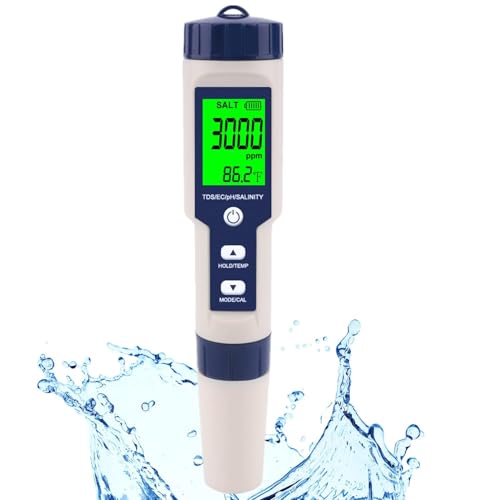
Hofun 5-in-1 Salinity and pH Meter is a multiparameter water meter rather than a seven-chemical strip reader, so it fits buyers focused on salinity, pH, temperature, electrical conductivity, and total dissolved solids. Its salinity display can use ppm, ppt, or percent; the maker gives a pool salt range of 0–9,999 ppm. This is useful when monitoring a saltwater pool or comparing conductivity-related readings, but it does not provide the same chlorine, bromine, alkalinity, hardness, and cyanuric-acid panel as Wynvex 7-in-1 Strip Reader or Oomiak 7-in-1 Strip Reader. Choose a strip reader if those chemical readings are central.
Bottom line: Pick this for pool salt, pH, temperature, EC, and TDS measurements.
Bevvronix 7-in-1 Digital Meter

Bevvronix 7-in-1 Digital Meter differs from the strip readers by combining free chlorine with salt, pH, ORP, EC, TDS, and temperature measurements. Its maker gives a free-chlorine ideal range of 1–3 ppm and a salinity range of 0–10,000 ppm; those claims make it most relevant to saltwater pool owners seeking both chlorine and salt checks in one meter. Buyers needing that broader strip-test panel should choose Wynvex 7-in-1 Strip Reader or Oomiak 7-in-1 Strip Reader.
Bottom line: Choose this when salt, free chlorine, and related meter readings are the priority.
How to choose a digital pool water tester
Choose a strip reader when you want several chemical readings together, and choose a multiparameter meter when salinity, pH, or conductivity are the focus. Free chlorine, pH, and stabilizer (cyanuric acid) are useful routine checks because the balance between them affects chlorine performance. A typical residential pool target is 1–3 ppm free chlorine and pH 7.2–7.8; outdoor pools using cyanuric acid commonly keep it around 30–50 ppm. Conditions and pool type can shift target ranges, so compare readings against the pool-care guidance for your sanitizer system. For a pool that uses a salt chlorine generator, prioritize a tester that measures salt as well as chlorine rather than assuming a seven-value strip panel includes salt.
A practical decision rule is to choose a seven-value reader if you need at least three of chlorine, pH, alkalinity, hardness, or cyanuric acid in routine checks; choose a salinity meter when salt concentration is the main question.
Strip readers and multiparameter meters
Strip readers interpret reagent colors and report several chemical values, while multiparameter meters use electrical sensing for properties such as conductivity and salinity. The methods answer different questions: a salinity reading does not replace a free-chlorine test, and an ORP value is not a direct chlorine concentration. Use the measurement type that matches the adjustment you plan to make.
The table separates the two approaches by their usual purpose; a model’s own measurement list determines what it can actually check.
| Method | Useful for | Key limitation |
|---|---|---|
| Strip reader | Several reagent-based chemical values | Requires compatible test strips |
| Salinity or multiparameter meter | Salt, pH, temperature, conductivity-related values | Does not automatically cover the full chemical panel |
Do not treat total dissolved solids or conductivity as interchangeable with a specific chemical concentration; both reflect multiple dissolved ions.
Pool chemistry ranges that guide testing
Many residential pools aim for free chlorine around 1–3 ppm and pH from 7.2 to 7.8, while cyanuric acid in outdoor pools commonly falls near 30–50 ppm. These are typical operating ranges, not universal targets: chlorine generators, indoor pools, and local rules may call for different limits. Total alkalinity is commonly managed around 80–120 ppm because it helps buffer pH changes. Test more often after heavy use, rain, or a large water addition, since those events can shift readings.
For safety, test before swimming when water balance may be off; CDC guidance advises pH 7.0–7.8 and chlorine at least 1 ppm in pools (at least 2 ppm when cyanuric acid is used). Avoid combining chemicals directly, and keep them stored as their labels direct.
How to avoid misleading pool readings
Use a fresh strip and the exact dip and reading timing for its chemistry, because wetting or waiting too long can change reagent colors. Keep strips dry and closed between uses; moisture and heat can degrade reactive pads. A digital screen reduces visual color matching but does not remove the need for careful sampling. Take water from below the surface and away from return jets or chemical feeders so a concentrated plume does not dominate the sample.
When two readings seem inconsistent, repeat the test with a new strip or clean sample before making a large chemical adjustment. Make one correction at a time and retest after circulation; this helps distinguish a real water change from a sampling or handling error.
Frequently Asked Questions
How often should I test pool water?
Test free chlorine and pH at least twice a week during regular pool use, and test more often after heavy swimming, rain, or chemical adjustment. Saltwater systems still need routine chlorine and pH checks.
What is a normal free chlorine level for a pool?
A common residential target is 1–3 ppm free chlorine, though stabilizer use and the sanitizer system can change the appropriate range. CDC advises maintaining at least 1 ppm in pools, or at least 2 ppm when cyanuric acid is used.
Can a salt tester measure pool chlorine?
A salinity-only reading does not measure free chlorine; salt concentration and sanitizer concentration are different measurements. Choose a meter that explicitly includes free chlorine if you want both readings from one device.
What pH range should pool water have?
A typical pool target is pH 7.2–7.8, while CDC guidance gives 7.0–7.8. Test again after adding chemicals or significant rain because either can move pH.
Do digital strip readers need replacement strips?
Yes, strip readers depend on compatible reagent strips, which are consumed during testing. Keep strips sealed and dry, since moisture or heat can degrade the reactive pads.