
Barbour Powell Quilted Jacket: Fit and Features Compared

Barbour Powell Quilted Jacket, Navy, L suits shoppers who want the most measurable fit guidance: it gives a 29.5-inch length, a 47.25-inch chest and a 33.75-inch sleeve in Large. Choose a different option if black or a branded zip is your priority.
A quilted jacket uses stitched sections to hold its fill in place; fit and insulation matter as much as the pattern.
We earn a commission if you buy through links on this page. As an Amazon Associate I earn from qualifying purchases. Products are compared on manufacturer specifications, not hands-on testing.
- Best overall: Barbour Powell Quilted Jacket, Navy, L – The navy Large includes length, chest and sleeve measurements plus polyester fill.
- Best for black: Barbour Powell Jacket, Black, L – The Powell is identified in black and size Large.
- Best for zip detail: Barbour Powell Quilt, Black, LG – The black Large has a Barbour-branded zip and box-diamond quilting.
| Product | Best for | Color | Distinguishing feature | Shop |
|---|---|---|---|---|
| Barbour Powell Quilted Jacket, Navy, L | Measured fit | Navy | 29.5 in long; technical weave | Check Price on Amazon |
| Barbour Powell Jacket, Black, L | Black color | Black | Powell coat | Check Price on Amazon |
| Barbour Powell Quilt, Black, LG | Branded zip | Black | Box diamond; branded zip | Check Price on Amazon |
Barbour Powell Quilted Jacket Options
Compare the Powell choices by fit, color and design.
Barbour Powell Quilted Jacket, Navy, L

Barbour Powell Quilted Jacket, Navy, L stands apart with actual garment measurements, making it the clearest choice for checking proportions before choosing a size. The jacket has a mid-weight, non-stretch technical weave, polyester lining and polyester fill; its Large measures 29.5 inches long, with a 47.25-inch chest and 33.75-inch sleeve. Snap tabs at the waist add an adjustable detail. The limitation is the non-stretch fabric, which gives less flexibility than a stretch shell; shoppers planning thick layers should compare the chest measurement with a jacket they already wear comfortably.
Bottom line: Choose this if garment measurements and a navy technical weave are your priorities.
Barbour Powell Jacket, Black, L
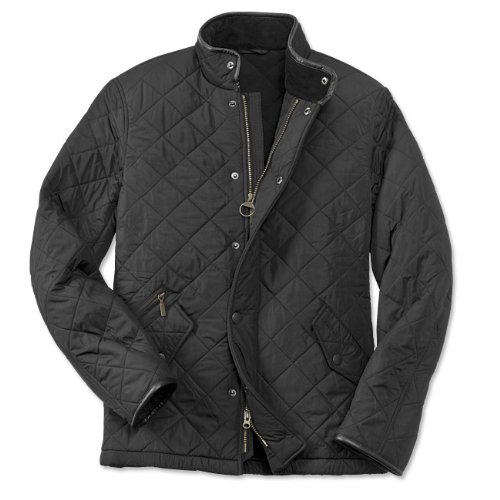
Barbour Powell Jacket, Black, L is the black Large choice for shoppers who want the Powell name and color without using the navy option’s measurements as a fit substitute. Its product designation identifies it as a coat, so it is the straightforward color alternative within the Powell group. The limitation is that garment measurements are not available to check proportions. Because jacket sizing can feel different over a sweater than over a shirt, compare shoulder and chest fit in the layers you expect to wear.
Bottom line: Pick this for a black Powell in Large, especially if color is the deciding factor.
Barbour Powell Quilt, Black, LG

Barbour Powell Quilt, Black, LG distinguishes itself with box-diamond quilting and a Barbour-branded zip, giving the black Large a visible hardware detail. It suits shoppers who prefer a zip-front look and want the Powell quilt in black. Before settling on a size, assess shoulder seam position and whether sleeves reach the wrist with arms extended.
Bottom line: Choose this if the branded zip and black box-diamond finish matter most.
How to choose a quilted jacket
Choose by warmth, shell behavior and the layers you plan to wear underneath. Quilted jackets hold insulation in stitched compartments; the fill’s type and amount, the shell fabric and the fit all affect warmth and comfort. Polyester fill is synthetic and can retain some insulating ability when damp, while down usually offers more warmth for its weight but needs more care when wet. For a useful fit check, try the jacket over your usual midlayer and reach forward: the hem should stay in place and the shoulders should not pull. A non-stretch shell needs enough ease for movement, so a close fit over a T-shirt may be restrictive over a sweater.
How to check jacket fit and measurements
Compare garment measurements with a jacket that fits you, not just with body measurements. Lay the reference jacket flat and measure chest across the front below the armholes, then double that number; compare sleeve and back length in the same way when those measurements are available. Sleeve length is measured differently by brands, so check whether the figure runs from the shoulder seam or the center back before comparing. For layering, leave room across the chest and upper back; if the shell is non-stretch, movement through the shoulders is especially important. A practical rule is to try the jacket over the thickest layer you expect to wear, then raise both arms and reach forward before deciding the fit works.
What quilting and jacket materials mean
Quilting is a construction method: stitching separates insulation into chambers and helps keep fill from shifting. Smaller stitched sections can limit movement of the fill, while larger baffles may allow more loft; stitching itself can also create pathways where wind or heat moves more readily. Shell fabric matters too: woven, non-stretch fabrics give structure but do not expand with your movement, while stretch fabrics can feel more forgiving. A jacket’s lining, fill and outer shell each serve different functions, so do not infer insulation warmth from the word “quilted” alone. Use the materials and intended layering conditions to judge whether a lightweight quilted jacket is enough for your climate.
Frequently Asked Questions
How should a quilted jacket fit over layers?
A quilted jacket should allow a sweater or midlayer without pulling across the chest, back or shoulders. Try it over the thickest layer you expect to wear and reach forward; a non-stretch shell needs extra ease for that movement.
What does box-diamond quilting mean on a jacket?
Box-diamond quilting describes a stitched pattern that divides the jacket into diamond-shaped sections. The seams help hold fill in place, but the pattern alone does not tell you how warm the jacket will be.
Is polyester fill warm when the jacket gets damp?
Polyester fill can retain some insulating ability when damp, though wet fabric and wind can still make a jacket feel colder. A shell’s wind resistance and how quickly the garment dries also affect comfort.
How do I compare jacket sleeve measurements?
First check how the sleeve measurement is taken: shoulder seam to cuff and center back to cuff are different measurements. Compare jackets measured from the same point, then check cuff reach with your arms extended.
Does quilting alone indicate a winter-weight jacket?
No; quilting describes the stitched construction, not a warmth rating. Fill type and amount, shell fabric, wind protection and the layers worn underneath determine whether a jacket suits cold conditions.