
Microsoft Surface Car Charger: 5 Options Compared

The 42W charger with a 12V, 2.58A Surface output suits most buyers seeking a conventional Microsoft Surface car charger, and it adds a 5V USB port for a second device. Choose a different option if you need USB-C power delivery or a newer Surface model explicitly named in its compatibility list.
These adapters draw power from a vehicle’s 12V socket; confirm your Surface model and its required charging connector before choosing.
We earn a commission if you buy through links on this page. As an Amazon Associate I earn from qualifying purchases. Products are compared on manufacturer specifications, not hands-on testing.
- Best overall: 42W Surface Car Charger – Its 42W Surface output is paired with a 5V, 2.1A USB port for another device.
- Best for higher wattage: 65W Surface Car Charger – It provides 65W output at 15V and names Surface Pro models through Pro 11.
- Best for USB-C: 45W USB-C Surface Car Charger – Its USB-C port supports up to 45W, alongside two USB-A ports.
| Product | Best for | Surface output | Other ports | Cord | Shop |
|---|---|---|---|---|---|
| 42W Surface Car Charger | USB second device | 12V, 2.58A; 42W | USB-A: 5V, 2.1A | 4.8 ft | Check Price on Amazon |
| KSW KINGDO 36W Surface Car Charger | USB-A simplicity | 12V, 2.58A; 36W | USB-A 2.0: 5V, 1A | 4.8 ft | Check Price on Amazon |
| 65W Surface Car Charger | Newer Surface models | 15V, 4.5A; 65W | — | — | Check Price on Amazon |
| KFD 15V 6.33A Surface Car Charger | 15V higher current | 15V, 6.33A | — | — | Check Price on Amazon |
| 45W USB-C Surface Car Charger | USB-C charging | USB-C: up to 45W | USB-C up to 45W; 2 USB-A up to 12W each | — | Check Price on Amazon |
Microsoft Surface Car Chargers Compared
Compare Surface output, additional charging ports and included cord length before matching a charger to your device.
42W Surface Car Charger

The 42W output and 5V, 2.1A USB port distinguish this charger from options with USB-C or a lower-current USB port. It is designed for Surface Pro 3 through Pro 6, Surface Book, Surface Go and Surface Laptop models named by the maker, and its input accepts 12–24V DC. The cord is 4.8 feet long, and the product is UL listed. The compatibility range is narrower than options naming newer Surface models, so buyers with a later device should verify the exact model and connector before choosing it.
Bottom line: Choose this if your listed Surface model fits and you want a USB-A port for another device.
KSW KINGDO 36W Surface Car Charger
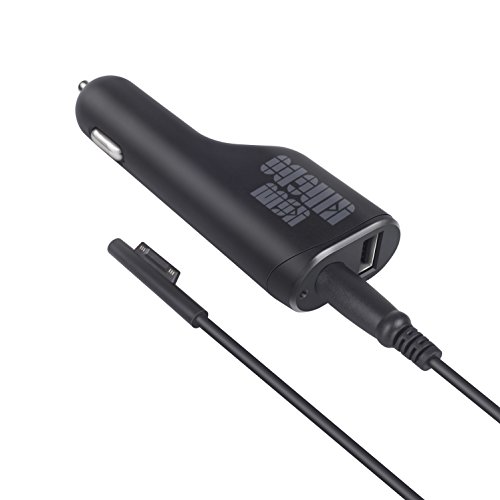
The USB-A 2.0 port supplies 5V at 1A, less current than the 2.1A USB port on the 42W alternative. This 36W adapter is designed for Surface Pro 3 through Pro 6, Surface Book, Surface Laptop and Surface Go generations named by the maker; it accepts 12–24V DC. It includes a 4.8-foot cord and a carrying pouch, which gives it a travel-oriented accessory the other standard-output options do not list.
Bottom line: Pick this for a named compatible model when the included pouch is useful.
65W Surface Car Charger

The 65W, 15V output and compatibility list through Surface Pro 11 set this adapter apart from the lower-wattage 12V models. It names Surface Laptop generations 1–7, Surface Laptop Studio, Surface Go generations 1–3, and Surface Book generations 1–3, among other Surface devices. The maker says it includes over-voltage, short-circuit, overload and heat protection and lists CE, UL, FCC and RoHS certifications.
Bottom line: Choose this if your Surface is named and you need the 65W, 15V output.
KFD 15V 6.33A Surface Car Charger

The 15V, 6.33A output distinguishes this adapter from the 15V, 4.5A option and the 12V chargers. Its name identifies compatibility with Surface Book 1–3, Surface Go 1–4, Surface Laptop 1–7 and Surface Pro through Pro 11, with some model numbers also named. The maker cites UL, CE, FCC and RoHS certifications and describes over-voltage, over-current and short-circuit protection.
Bottom line: Consider this for a named model requiring 15V at up to 6.33A.
45W USB-C Surface Car Charger

The USB-C power-delivery output, rather than a dedicated Surface DC output, is the defining difference here. Its USB-C port supports 5V, 9V, 12V, 15V or 20V at listed currents, up to 45W, and two USB-A ports each provide up to 12W. The maker names Surface Pro 3–7, Surface Laptop Go 1–2, Surface Book and Surface Go generations 1–3; it also says three devices can charge at once. This option suits a Surface that charges over supported USB-C input, but check that requirement before choosing it because its charging method differs from the barrel-style adapters.
Bottom line: Pick this if your Surface accepts USB-C charging and you want three device ports.
How to choose a Surface car charger
Match the charger’s output voltage, current and connector to the Surface model before comparing extra ports. Voltage must match the device’s requirement; current capacity may be equal to or higher than the device’s draw, while the device only takes what it needs. Wattage is volts multiplied by amps, so 12V at 2.58A is about 31W, not 42W; a 42W rating may include additional output such as a USB port. For a Surface that charges by USB-C, verify USB Power Delivery support and the required voltage profile rather than assuming any USB-C port is suitable. Avoid choosing from a broad compatibility phrase alone: confirm the exact generation and connector.
What the charger outputs mean
Output voltage and current are the useful comparison points: 15V at 4.5A equals 67.5W mathematically, while 15V at 6.33A is about 95W. A product’s printed wattage may use a different rating convention, so use the device’s required voltage and connector as the primary fit checks. Vehicle sockets generally provide 12V in passenger cars, while some trucks and recreational vehicles use 24V; a charger’s input range must cover the vehicle’s supply. The lower-current USB ports are suited to basic secondary charging, whereas higher-power USB-C ports can serve compatible devices. More ports do not mean every connected device receives maximum output simultaneously.
Surface model and connector fit
Surface compatibility is model-specific, even when charger names group multiple generations together. Check the complete model name, generation and charging connection against the charger’s named range; a Surface Pro 7 and Surface Pro 9 should not be treated as interchangeable just because both are Surface Pro devices. USB-C charging requires a Surface model that supports charging through that port, along with a compatible power profile. A conventional dedicated Surface adapter uses a different connection approach, so the connector itself can rule an option out before wattage does. With a newer model absent from a charger’s compatibility list, select an option that names it rather than extrapolating compatibility.
Using a car charger safely
Use only the vehicle voltage and device connection supported by the charger, and unplug it if the adapter or socket becomes unusually hot. Car electrical systems can experience voltage changes during engine start and other transients, so protection claims matter, but they do not make incompatible voltage safe. Keep cords clear of pedals, steering controls and seat tracks; a 4.8-foot cord can reach farther than a short adapter lead but can also cross the cabin. When charging multiple devices, budget total output across ports rather than assuming each port retains its maximum rating. Disconnect accessories before leaving the vehicle if the socket remains powered with the ignition off.
Frequently Asked Questions
Can a Surface Pro charge from a car socket?
Yes, if the charger matches the Surface model’s required voltage and connector or supported USB-C power profile. Most passenger-car accessory sockets supply 12V, so the charger must accept that input.
Does a 65W charger charge faster than a 42W charger?
Not necessarily; the Surface controls the power it draws, and charging speed depends on its requirements and usage. Compare the required voltage and connector first, then choose an output rating that meets the device’s needs.
Can I charge a phone and Surface together?
A charger with a separate USB port can charge another device while powering a compatible Surface. USB output is divided by port design, so do not assume that every port can provide its maximum power at the same time.
Will a USB-C car charger work with every Surface?
No; USB-C charging depends on the Surface model supporting charging through USB-C and the charger providing a compatible power profile. Verify both before choosing a USB-C-only charging approach.
Is a 24V truck socket safe for these chargers?
Only when the charger’s input range includes 24V DC. A 12–24V input range covers that nominal supply, but never plug a 12V-only adapter into a 24V socket.