
Flood Barriers for Doors: 4 Types Compared by Fit

For adjustable doorway coverage up to 28 inches high, Dam Easy Door Dam is the strongest match because it fits openings from 30.7 to 43.3 inches wide without permanent hardware. Choose Quick Dam Water-Activated Barrier, 5 ft instead for a lightweight absorbent barrier, or compare the fixed-width and reusable frame options if your doorway falls within their ranges.
We earn a commission if you buy through links on this page. As an Amazon Associate I earn from qualifying purchases. Products are compared on manufacturer specifications, not hands-on testing.
- Best overall: Dam Easy Door Dam – Adjusts across 30.7–43.3-inch openings and provides protection up to 28 inches high.
- Best for quick placement: Quick Dam Water-Activated Barrier, 5 ft – Water activation expands the 60-inch barrier to 3.5 inches high without sand or labor.
- Best for 34–36-inch doors: Aluminum Flood Protection Barrier – Reusable aluminum panels are sized for a 34–36-inch door.
- Best for steel-frame fit: Quick Dam FloodGate QDFG30 – Expandable steel and neoprene frame fits openings 30–35 inches wide.
| Product | Best for | Opening width | Protection height | Material | Shop |
|---|---|---|---|---|---|
| Dam Easy Door Dam | Adjustable coverage | 30.7–43.3 in | Up to 28 in | — | Check Price on Amazon |
| Quick Dam FloodGate QDFG30 | Steel-frame seal | 30–35 in | Up to 26 in | Steel, neoprene | Check Price on Amazon |
| Aluminum Flood Protection Barrier | Aluminum panels | 34–36 in | — | Aluminum, ABS rubber | Check Price on Amazon |
| Quick Dam Water-Activated Barrier, 5 ft | Compact storage | 60 in length | 3.5 in | Absorbent material | Check Price on Amazon |
Flood barriers for doors
Compare doorway fit, barrier height and construction before choosing a flood-control style.
Dam Easy Door Dam

For a wide adjustable range and a high barrier, this system fits openings from 30.7 to 43.3 inches and provides protection up to 28 inches. The maker says it extends into position and inflates to form a seal, without adhesives, hardware or permanent changes to the home. That makes it suited to residential doorways where the opening width falls within its range. The tradeoff is its substantial size and weight, so buyers who need a compact unit to store or carry may prefer the absorbent alternative.
Bottom line: Choose this for an in-range doorway when a taller, adjustable barrier matters.
Quick Dam FloodGate QDFG30

The expandable steel-and-neoprene frame distinguishes this gate from absorbent and panel barriers, fitting doorway openings 30 to 35 inches wide. The maker says it installs without alterations or fixations and can be used indoors or outdoors; its maximum stated flood-water protection is 26 inches. This option suits someone who wants a reusable frame and whose opening is within that narrower span. It does not cover openings wider than 35 inches, so measure the clear doorway width rather than relying on the nominal door size.
Bottom line: Pick this if your clear opening is 30–35 inches and you want an expandable frame.
Aluminum Flood Protection Barrier
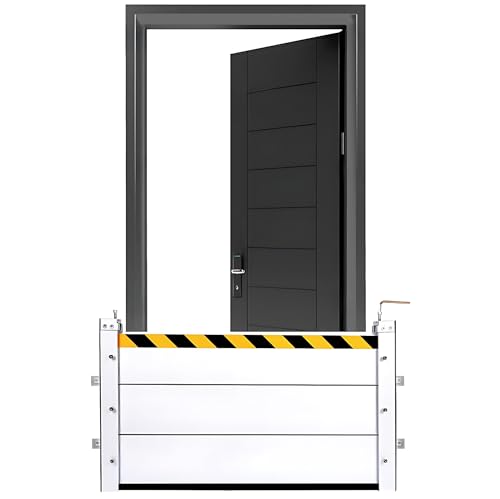
Rigid aluminum panels and columns set this barrier apart from the inflatable and expandable-frame options. The maker describes 4-centimeter-thickened panels with ABS rubber strips around their edges and says the system is reusable; the size is for a 34–36-inch door. It suits buyers seeking a panel-based barrier for that specific width range. Its panel thickness is not the same as a water-blocking height, so confirm the barrier’s protective height before choosing it for a site where that measurement determines suitability.
Bottom line: Choose this for a 34–36-inch door if you prefer an aluminum panel system.
Quick Dam Water-Activated Barrier, 5 ft

Unlike the taller doorway gates, this 60-inch flexible barrier expands to 3.5 inches high when wet, making it a lower-profile option for diverting or containing shallow water. The maker says it activates with water, needs no sand or labor, and uses a dual-chamber design to resist rolling; the pack contains two. It suits doorways where a short barrier is appropriate and compact storage is useful. Its low height limits the level of water it can hold back, and the maker warns not to use it with salt water because the reaction causes deflation.
Bottom line: Pick this for shallow-water diversion and compact storage, not a tall doorway seal.
How to choose a flood barrier for a door
Start with the clear opening width and the maximum water height you need to resist; the barrier must cover both measurements. These options range from 3.5 inches high for the water-activated unit to stated maximum protection of 26 or 28 inches for two doorway systems. A barrier’s height is not a guarantee that a doorway is watertight under every flood condition: surface flatness, side contact and water pressure all matter. Measure between the surfaces the barrier will actually seal against, not the outside trim. As a simple screening rule, if the expected water depth exceeds the barrier’s protection height, choose a taller system or another flood plan rather than relying on it alone.
How to measure a doorway for flood barriers
Measure the narrowest clear span across the opening where the barrier will sit, then compare that figure with the product’s usable width range. A 34-inch opening, for example, is inside the 30–35-inch gate range and the 30.7–43.3-inch adjustable range, while the aluminum option is intended for 34–36 inches. Door slabs and trim can make nominal door size differ from the usable opening. Also check whether the floor is level and smooth where the seal contacts it; grit, gaps or a sloped threshold can undermine a seal. Do not assume a barrier can bridge a threshold or uneven floor unless its fit system is designed for that condition.
Absorbent barriers versus reusable doorway gates
Absorbent barriers swell after water activation and can be flexible, but their low profile suits shallow diversion rather than a tall doorway closure. Mechanical gates use a frame or panels to span an opening and can provide substantially more stated height, but they require a compatible width and a surface that supports sealing. For example, a 3.5-inch barrier and a gate rated up to 26 inches solve different water-depth problems, even when both can be placed at a doorway. Floodwater pressure increases with depth—about 0.43 pounds per square inch per foot of water—so deeper water can create significant force on a barrier and its surroundings.
| Barrier style | Best fit condition | Key tradeoff |
|---|---|---|
| Water-activated absorbent | Shallow water, flexible placement | Low stated height |
| Expandable frame | Opening within frame’s width range | Requires sealing contact across the threshold |
| Panel system | Door width matched to panel size | Verify protective height |
Flood barrier placement and safety
Place a doorway barrier before water reaches the opening; installing one amid rising water can expose a person to moving water and debris. Floodwater can exert enough pressure to shift a barrier, especially as depth rises, so do not treat a doorway device as a substitute for evacuation guidance or structural flood protection. Keep people away from floodwater that may be electrically contaminated, and never enter water around energized equipment. For the absorbent option here, salt water is specifically unsuitable because the maker says the chemical reaction causes deflation. After use, inspect seals and contact surfaces for damage or debris before storing a reusable barrier.
Frequently Asked Questions
How wide should a door flood barrier be?
The barrier’s fit range must include the narrowest clear width of the opening. Measure at the intended sealing surface; for example, a 34-inch opening falls within the 30–35-inch and 30.7–43.3-inch ranges.
How high of a flood barrier do I need?
Choose a barrier with a protective height above the water depth you need to block. A 3.5-inch barrier is meant for much shallower water than systems stating protection up to 26 or 28 inches.
Can a flood barrier seal an uneven threshold?
An uneven or dirty threshold can create gaps beneath a barrier, even when the width fits. Clean the contact path and verify that the device is designed to seal the floor condition at your doorway.
How much pressure does floodwater add?
Water pressure rises by about 0.43 pounds per square inch for each foot of water depth. That increasing force is why a doorway barrier should not be treated as a structural flood wall or a reason to enter floodwater.
Can water-activated flood barriers be used with salt water?
No; the maker warns that salt water causes the absorbent barrier’s chemical reaction to deflate. Use a barrier intended for the water conditions at the site.