
Left-Handed Trolling Fishing Reels: Fit and Features

For a left-handed trolling fishing reel, the Sougayilang LDT40 is the clearest match because it is explicitly left-handed and lists a 22-pound maximum drag. Choose a linecounter if tracking line out matters more than a conventional reel’s drag figures; confirm the handle side and line capacity before ordering when those specifications are not clear.
We earn a commission if you buy through links on this page. As an Amazon Associate I earn from qualifying purchases. Products are compared on manufacturer specifications, not hands-on testing.
- Best overall: Sougayilang LDT40 Left-Hand Trolling Reel – Explicitly left-handed, with a 3.8:1 gear ratio and 22-pound maximum drag.
- Best for line tracking: Okuma MA-20DLXT Left-Hand Linecounter Reel – A left-hand linecounter reel with a capacity of 210 yards of 20-pound line.
- Best for round-reel versatility: KastKing Rover 60 Left Round Baitcaster – A left-hand round baitcasting reel with a maximum drag of 20 pounds.
| Product | Best for | Reel type | Gear ratio | Max drag | Shop |
|---|---|---|---|---|---|
| Sougayilang LDT40 Left-Hand Trolling Reel | Heavy trolling | Levelwind conventional | 3.8:1 | 22 lb | Check Price on Amazon |
| Okuma MA-20DLXT Left-Hand Linecounter Reel | Measured line payout | Linecounter conventional | — | — | Check Price on Amazon |
| VBESTLIFE TR12000 Trolling Reel | High drag needs | Conventional trolling | 3.4:1 | 55 lb | Check Price on Amazon |
| KastKing Rover 60 Left Round Baitcaster | Round baitcasting | Round baitcasting | — | 20 lb | Check Price on Amazon |
Left-Handed Trolling Fishing Reels
Compare retrieve orientation, reel style and the specifications that matter for your intended line and target fish.
Sougayilang LDT40 Left-Hand Trolling Reel

The Sougayilang LDT40 is the only reel that pairs an explicit left-hand label with a conventional trolling design and stated drag figure. It combines an aircraft-grade aluminum frame, graphite side panels, a stainless steel spool and handle, and brass gears. The maker says the reel has a 3.8:1 gear ratio and up to 22 pounds of drag, a combination suited to anglers prioritizing cranking force for boat fishing. Its 1.32-pound stated weight may matter on long sessions; the bearing count is incomplete, so avoid relying on it to compare smoothness.
Bottom line: Choose this if you want an explicitly left-handed conventional reel with a drag rating.
Okuma MA-20DLXT Left-Hand Linecounter Reel

The Okuma MA-20DLXT stands apart as the only linecounter among the left-hand options, making it the fit for trolling where repeatable line payout is useful. It is identified as a left-hand reel, and its capacity is 210 yards of 20-pound line. A linecounter can help reproduce a productive depth, but it does not replace knowing how lure weight, speed, and line diameter affect running depth.
Bottom line: Choose this when line payout tracking is more important than comparing listed drag or ratio.
VBESTLIFE TR12000 Trolling Reel

The VBESTLIFE TR12000 lists the largest drag figure here, but its name and details do not establish a left-hand retrieve, so it is only a partial match. The maker describes an all-metal construction, stainless steel sealed bearings and a carbon-fiber brake washer; its 3.4:1 ratio favors torque over fast line pickup compared with the Sougayilang’s 3.8:1. The 25-kilogram braking force converts to about 55 pounds. Anglers who need a left-hand reel should confirm retrieve orientation before choosing it.
Bottom line: Consider it only if its retrieve side is confirmed and a high stated drag rating is a priority.
KastKing Rover 60 Left Round Baitcaster
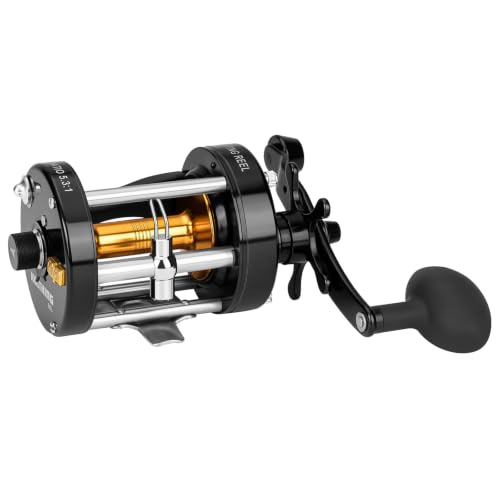
The KastKing Rover 60 is explicitly left-hand, but it is a round baitcasting reel rather than a reel identified specifically for trolling, so it is a partial fit. Its 20-pound maximum drag, carbon-fiber drag system, reinforced metal body and levelwind suit anglers seeking a robust round reel for line control. At 13 ounces, it is lighter than the Sougayilang.
Bottom line: Choose it if a left-hand round baitcaster fits your trolling setup and line needs.
How to choose a left-hand trolling reel
Start by matching retrieve orientation, then choose between line tracking and a conventional reel’s drag and gear specifications. A gear ratio of 3.8:1 turns the spool 3.8 times per handle turn; lower ratios generally trade pickup speed for more leverage. A linecounter adds a repeatable line-out reference, useful when you want to reset to the same payout, but line length alone does not guarantee lure depth because speed, lure, and line diameter also matter.
Match line capacity to the amount of line you expect to let out plus reserve for a run. The Okuma’s 210 yards of 20-pound line gives a concrete reference point, while the other specifications do not provide capacities. For a 50-pound-class fish, do not treat a reel’s maximum drag figure as the whole system rating: rod, line, knots, and hook all limit safe pressure.
Left-hand conventional reels and round baitcasters
Conventional levelwind reels and round baitcasters are distinct styles, even when both can be used from a boat. A levelwind guides line across the spool during retrieval, while a linecounter adds a numerical payout reference; these features help organize line but do not measure running depth. Round baitcasters offer a compact spool-and-frame format and can work for trolling when capacity, drag, and retrieve suit the target.
Use the comparison below to decide which reel type aligns with your priority, then check line capacity and retrieve orientation together. A right retrieve can be awkward even when other specifications fit. Maximum drag is a ceiling, not a recommended setting for every line or fish; start lower and account for the weakest connection in the rig.
| Priority | Reel type | Check before choosing |
|---|---|---|
| Repeatable line payout | Linecounter conventional | Capacity and counter units |
| Direct trolling setup | Levelwind conventional | Retrieve side, drag, and capacity |
| Compact round spool format | Round baitcaster | Capacity and gear ratio |
Set drag and line for trolling
Set trolling drag according to the weakest part of the rig, not the reel’s maximum. A common starting point is roughly one-quarter to one-third of the line’s rated breaking strength, measured with a scale; for 20-pound line, that is about 5 to 7 pounds. Knots, abrasion, and sudden surges reduce the margin, so the rod and terminal tackle must also tolerate the setting.
Use the reel’s drag smoothly rather than locking it down to stop a fish instantly. Carbon-fiber and other drag washers dissipate heat through friction, and sustained runs can heat the drag stack. Keep fingers clear of a moving spool and line, especially during a fast run; never wrap line around a hand to control a fish.
Frequently Asked Questions
What does a trolling reel linecounter measure?
A linecounter measures line payout, not lure depth. Use the same line, lure, and boat speed when repeating a setting, since those factors change how deep a lure runs.
How much drag should I set on 20-pound fishing line?
A common starting range is about 5 to 7 pounds, or one-quarter to one-third of a 20-pound line rating. Measure the setting with a scale and reduce it if knots, abrasion, or tackle are the weaker link.
Does a lower gear ratio help with heavy fish?
A lower ratio typically gives more cranking leverage but retrieves less line per handle turn. Compare ratios alongside spool size, since spool fill also changes line pickup.
Can a round baitcasting reel be used for trolling?
Yes, a round baitcaster can suit trolling if its retrieve side, line capacity, drag, and rod fit the setup. Confirm that it holds the intended line length plus reserve before fishing.