
Best Shoes With Secret Compartment: 3 Inserts Compared

Storage Soles Trim-to-Fit Insert is the best choice for most people seeking shoes with a secret compartment because its storage insert is trim-to-fit for men’s sizes 8–12 and women’s sizes 10–14. Choose Storage Soles Two-Way Trim Insert if you need an insert that can be cut in two directions, or Vepose Mid-Calf Combat Boot if you prefer an exterior zip pocket over concealed insole storage.
We earn a commission if you buy through links on this page. As an Amazon Associate I earn from qualifying purchases. Products are compared on manufacturer specifications, not hands-on testing.
- Best overall: Storage Soles Trim-to-Fit Insert – Trim-to-fit sizing covers men’s 8–12 and women’s 10–14.
- Best for custom trimming: Storage Soles Two-Way Trim Insert – The insert can be cut horizontally and vertically.
- Best for quick access: Vepose Mid-Calf Combat Boot – The boot has an outer zip pocket for small carry items.
| Product | Best for | Storage style | Fit or size | Material | Shop |
|---|---|---|---|---|---|
| Storage Soles Trim-to-Fit Insert | Most shoe sizes | Insole compartment | Men’s 8–12; women’s 10–14 | Foam | Check Price on Amazon |
| Storage Soles Two-Way Trim Insert | Custom shoe fitting | Insole compartment | Men’s 7–8 (feature); 4-inch size | PU foam | Check Price on Amazon |
| Vepose Mid-Calf Combat Boot | Quick-access carry | Outer zip pocket | Women’s size 11 | PU upper | Check Price on Amazon |
Shoes With Secret Compartments and Storage Inserts
Compare concealed insole storage with an accessible boot pocket, then choose the carry style and fit that match your shoes.
Storage Soles Trim-to-Fit Insert

Storage Soles Trim-to-Fit Insert is the most broadly sized concealed-storage option here: the foam insert trims to fit men’s sizes 8–12 and women’s sizes 10–14. Its 11.5-inch length and 0.5-inch height give you a starting point for checking the insole space in your shoe. The hidden cavity is intended for small items such as keys or cash, while the cushioning adds an underfoot layer. This is a better match for discreet carry than for frequent access; removing a shoe is less convenient than opening an exterior pocket.
Bottom line: Choose this insert if your shoe falls within its trim-to-fit range and concealed carry matters most.
Storage Soles Two-Way Trim Insert
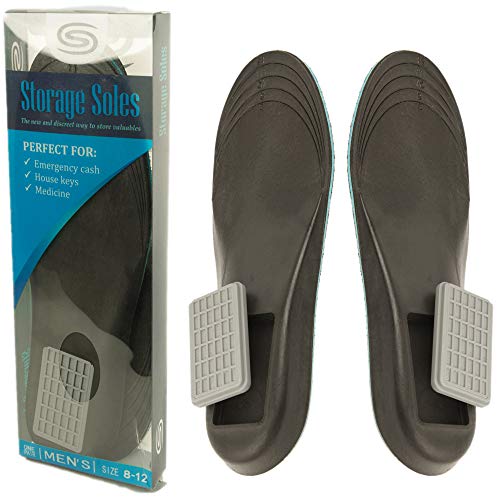
Storage Soles Two-Way Trim Insert differs through its two-direction trimming: it can be cut horizontally and vertically to adapt to a shoe shape. The insert is made from PU foam and provides a concealed place for small items, including money, keys, or a ring. It is also explicitly not waterproof, which matters near water or wet sand.
Bottom line: Pick this when two-way trimming suits your shoe and you can verify its fit first.
Vepose Mid-Calf Combat Boot

Vepose Mid-Calf Combat Boot is a boot with an exterior zip pocket, not a hidden compartment inside the sole. The pocket is intended for small items such as cards, folded cash, coins, or keys, making access more direct than with an insole stash. It has a lace-up fit, an inner side zipper, memory-foam insole, and water-repellent upper. The maker identifies this as a women’s size 11, so it is a narrow fit choice rather than an adjustable insert that can be moved between shoes.
Bottom line: Choose these boots if you wear women’s size 11 and want a pocket you can reach without removing your shoe.
How to choose shoes with secret compartments
Start with the storage location: an insole cavity conceals small items underfoot, while an exterior pocket offers faster access but is easier to see. Shoe inserts commonly need trimming to match the shoe’s existing footbed; use the original insole as a shape guide and trim a little at a time. A loose insert can shift and create pressure, so it should lie flat without bunching. For everyday walking, test the fit at home before carrying anything; a compartment that makes the footbed uneven is a poor fit regardless of its storage capacity.
Use a practical rule: if you need access without taking off your shoe, favor an outer pocket; if visual concealment matters more, consider an insole insert. Neither format should hold sharp, bulky, or fragile objects against the foot.
Insole stash versus an exterior boot pocket
Insole storage keeps small valuables beneath the footbed, while a zip pocket stores items outside the foot area. Choose based on access and concealment rather than treating these as identical compartments. An insert can move between compatible shoes, but fit depends on the shoe’s insole shape and available depth. A boot pocket is tied to that boot and can be opened directly.
The two storage styles also have different limitations: an insole stash must not disrupt the fit, and the boot pocket is visible. The comparison below shows which carry style aligns with common needs.
| Need | Better match | Tradeoff |
|---|---|---|
| Concealed small-item carry | Insole insert | Must fit flat underfoot |
| Access without removing shoe | Exterior zip pocket | Storage is more visible |
Fitting a trim-to-fit storage insole
Use the shoe’s removable factory insole as a template, and cut conservatively along its outline so the new insert does not crowd the toe box. Many shoe insoles are shaped with a narrower heel and wider forefoot, so a straight cut can leave gaps or cause rubbing. Check that the insert lies flat and that the shoe still has enough room over the toes after installation.
Do not assume every trim-to-fit insert has the same sizing: stated ranges and dimensions can differ, and a fit claim may not resolve the exact shoe shape. Verify measurements when the size guidance conflicts. Keep the storage cavity limited to flat, soft items; bulky objects can create pressure points during walking.
Keeping valuables safe around water and heat
Storage inserts are not automatically waterproof: one of these inserts explicitly says it is not waterproof. Keep cash and electronics in a separate sealed waterproof pouch around pools, beaches, or rain, and do not leave valuables unattended just because they are concealed. Heat resistance also cannot be inferred from an insole’s foam material.
Carry only items that sit flat and cannot puncture or press into the foot. Sharp objects, hard keys, and overfilled compartments can cause discomfort or injury; use a separate bag for anything rigid. A concealment compartment hides an item from casual view but is not a lock or theft-proof safe.
Frequently Asked Questions
What can fit inside a shoe storage insole?
A shoe storage insole is suited to small, flat items such as folded cash or a key. Avoid bulky or sharp objects because they can create pressure underfoot.
How do I trim a secret storage insole?
Use the shoe’s existing removable insole as a template and trim gradually around its outline. Stop if the insert no longer lies flat or crowds the toe area.
Are hidden shoe compartments waterproof?
No assumption of waterproofing is safe; one storage-insole option explicitly says it is not waterproof. Use a sealed waterproof pouch to protect valuables near water.
Can I put a phone in a shoe stash compartment?
A phone is generally too bulky for a concealed insole compartment and can make the footbed uneven. Keep electronics in a pocket or bag instead.
Are shoe stash compartments secure from theft?
A concealed shoe compartment can hide an item from casual view, but it is not a lock or a theft-proof safe. Keep valuables with you in crowded or unattended settings.